← The Wingmakers Ways · Astronomy & Exoplanets
Archived page · Checkable
Triangulum
Triangulum.html · captured from wingmakers.co.nz
Triangulum 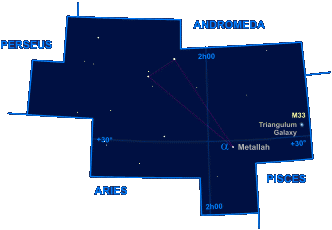
The Triangle
Triangulum lies just Andromeda's left leg. You can easily find the snug isosceles triangle formed three stars with the third and fourth magnitudes. Though the origin of Triangulum isn't known distinctly, has fairly long history registered in the Ptolemaic constellation. Now, the shape of constellation is often applied a set square.
The constellation contains one of Messier's objects, a faint face-on spiral galaxy of M33, it's one of major deep sky objects in the autumn skies like the Andromeda Galaxy (M31).
M33 (NGC598) is a very large (about two times of the Moon) but quite faint face-on spiral galaxy at just Andromeda's left foot. The galaxy is about 2.6 million light years away, and one of main members consist of the Local group of galaxies, that includes our Galaxy. Visible magnitude of the galaxy is about 6.7, but it's probable to recognize that with naked eyes under the clear and dark sky. It's considered that M33 and our Galaxy have about same shapes, and plenty of diffused nebulae or globular clusters have been discovered in M33, many astronomers are researching into the galaxy in detail.
NGC925 is a bared galaxy positioned about 2 degrees east of gamma Tri that forms the base of the constellation of Triangulum. The galaxy has an expectedly large major axis of 10 arc minutes, but it's very dimmed so you might be needed fairly larger telescopes to appreciate the light of this minor outer galaxy. Although this picture hasn't been shown clearly, somehow you can see a bared structure stretched in east-west direction and two arms coiled up loosely. And there are several dots of nebulosities along the arms. The constellation of Triangulum is famous for a major galaxy of M33, but the compact galaxy of NGC925 is another scenic spot in this small constellation.
This festively colorful nebula, called NGC 604, is one of the largest known seething cauldrons of star birth seen in a nearby galaxy. NGC 604 is similar to familiar star-birth regions in our Milky Way galaxy, such as the Orion Nebula, but it is vastly larger in extent and contains many more recently formed stars. This monstrous star-birth region contains more than 200 brilliant blue stars within a cloud of glowing gases some 1,300 light-years across, nearly 100 times the size of the Orion Nebula.
NGC 672 (at the top) and IC 1727 (at the bottom) are interacting galaxies some 18 million light years distant. From each other they are separated by only 88,000 light years- little more than their own diameters. While outside of the "Local Group" of galaxies, these two are close enough to begin to resolve some of the brighter stellar associations and dust lanes. This gives the galaxies their granulated and bumpy appearence. By examining these galaxies in the radio wavelengths of light, astronomers have detected a large envelope of gas that surround these galactic friends.
MAPPING TECHNIQUE
VISUAL EXERCISE : Two Person Exercise.
DESTINATION : Your Choice
STEP ONE
Traveller : Get comfortable and relax.
STEP TWO
Traveller : Charge your physical body with light energy.
STEP THREE
Traveller : See your visual body standing in front of your physical body and prepare your visual body for interstellar travel with a Interstellar Protection Shield.
STEP FOUR
Traveller : See your visual body filling with light energy.
STEP FIVE
Traveller : Focus your mind on teleporting your visual body to the Your Destination.
STEP SIX
Traveller : Then see your visual body teleporting to the Your Destination.
STEP SEVEN
Traveller : When you arrive in the destination Look around can you see any planets or moons in the System? If not use the Interstellar Planetary Detection Rapid and see if you can detect any planets or moons in that system.
STEP EIGHT
Traveller : If you can see or detect a planet or moon using Telekinesis or Teleportation move towards the planetary body.
STEP NINE
Traveller : When you arrive at the outer atmosphere of the planet or moon stop and ask your spiritual guide to tell you the name of this planet or moon.
Traveller : Tell the mapper the name of the planet or moon. Also tell the mapper all you can about the planet or moon.
STEP TEN
Then us the Core Comparison Crystal Technique to perform a core reading on this planet or moon and give the mapper your reading on this planet or moon
STEP ELEVEN
Traveller : Then levitate or Teleport your visual body to the surface of the planet or moon.
STEP TWELVE
Mapper : When the traveller arrives on the surface ask the following questions.
Is there any plant life or water on the surface of the planet or moon that you can see? Is there an atmosphere around this planet or moon? Is the atmosphere an match with earths atmosphere?
Mapper : Write down the answers to these questions.
PLANETARY DATA FILE 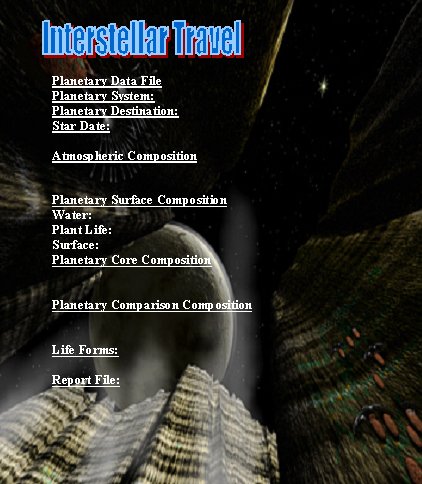
STEP THIRTEEN
Traveller : When you are finished on the surface teleport your visual body to the nearest planetary body that you can see in that Galaxy.
STEP FOURTEEN
Traveller and Mapper : Follow steps nine through to twelve again till you have mapped out the whole Galaxy.
STEP FIFTEEN
Traveller : When you have finished mapping the Galaxy teleport your visual body back to your physical body back on earth.
REMEMBER
When you are travelling if you come across an alien race that you think may be friendly feel free to make contact with that alien race.
IMPORTANT
When you are contacting alien races always be ready to teleport if there is trouble.
MAPPER
Make a note of any planets or moons with an atmospheric match with earths. That way you both know which planets can support human life forms.
MAPPER & TRAVELLER
To check that your mapping of that Galaxy is correct by changing roles and do this exercise again. Also remember to check for life force energy around the planets or moons that you visit on your journeys. Because if you can feel life force energy that means the planet or moons is a real planet or moon.