← The Wingmakers Ways · Astronomy & Exoplanets
Archived page · Checkable
Upsilon Andromedae
Upsilon_Andromedae.html · captured from wingmakers.co.nz
Upsilon Andromedae
Planetary System
Interstellar Card 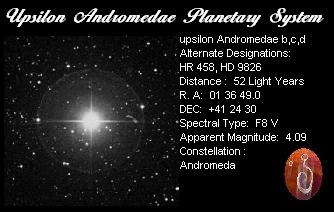
CONSTELLATION: Andromeda
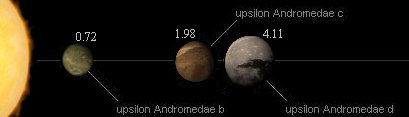
The first main sequence star around which an extrasolar planetary system has been found. The discovery was announced in 1999 by a team from the San Francisco State University Planet Search (SFSU) group and independently by astronomers from the Harvard-Smithsonian Center for Astrophysics and the High Altitude Observatory in Boulder, Colorado, who had been studying the star for more than four years at the Whipple Observatory. Prior to this, only single extrasolar planets. had been confirmed around Sun-like stars, together with two planetary systems around pulsars. A planet, with about two-thirds the mass of Jupiter, was found around upsilon Andromedae by the SFSU group in mid-1996. This became the fourth known epistellar jovian, having an orbit that brings it seven times closer to its host star than Mercury is to the Sun. Three years later, two companions of larger mass were announced orbiting at about 0.8 and 2.5 astronomical units.1 As one of the SFSU researchers, Debra Fischer, pointed out, this important discovery "implies that planets can form more easily than we ever imagined, and that our Milky Way is teeming with planetary systems." The greatest surprise is the presence in one system of so many giant worlds. Theorists had only just begun to adjust to the idea of Jupiter-size planets in very small or highly elongated orbits. But this new triple-jovian system promises to cause an even bigger shake-up of ideas of planet formation. As to whether there might be life around upsilon Andromedae, that is impossible to say. The star's age is about 3 billion years-old enough for life to have evolved; however, further study will be needed to establish whether any Earth-like worlds are present.
Upsilon Andromedae b 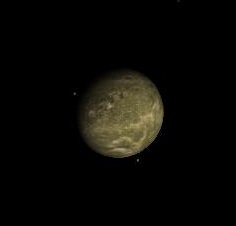
Epistellar Giant
Planetary Statistics
Star System : upsilon Andromedae
Discovery Status : Confirmed
Mass : 0.72 Jupiters
Average Distance : 0.059 AUs
Period : 4.6171 Days
Orbital Eccentricity : 0.04
Argument of Perihelion (omega) : 32°
Tug on Star : 47.5 m/s
Average Temperature : 1300 Kelvin
Detection Method : Doppler Spectroscopy
Discovered By : M arcy and Butler
Year Discovered : 1996
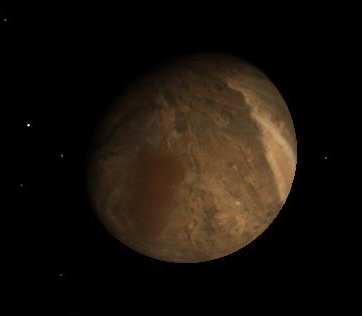
Upsilon Andromedae c
Near Epistellar Giant
Planetary Statistics
Star System : upsilon Andromedae
Discovery Status : Confirmed
Mass : 1.98 Jupiters
Average Distance : 0 .83 AUs
Period : 242 Days
Orbital Eccentricity : 0.23
Argument of Perihelion (omega) : 251°
Tug on Star : 56 m/s
Average Temperature : 350 Kelvin
Detection Method : Doppler Spectroscopy
Discovered By : Marcy and Butler
Year Discovered : 1999
Upsilon Andromedae d
Eccentric Giant 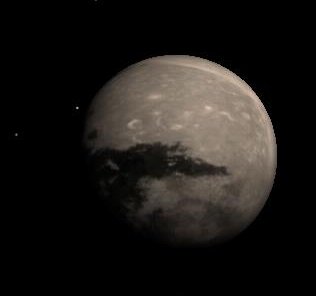
Planetary Statistics
Star System : upsilon Andromedae
Discovery Status : Confirmed
Mass : 4.11 Jupiters
Average Distance : 2.5 AUs
Period : 1266.6 Days
Orbital Eccentricity : 0.36
Argument of Perihelion (omega) : 255°
Tug on Star : 69.5 m/s
Average Temperature : 200 Kelvin
Detection Method : Doppler Spectroscopy
Discovered By : Marcy and Butler
Year Discovered : 1999
Planetary Orbits Around Upsilon Andromedae 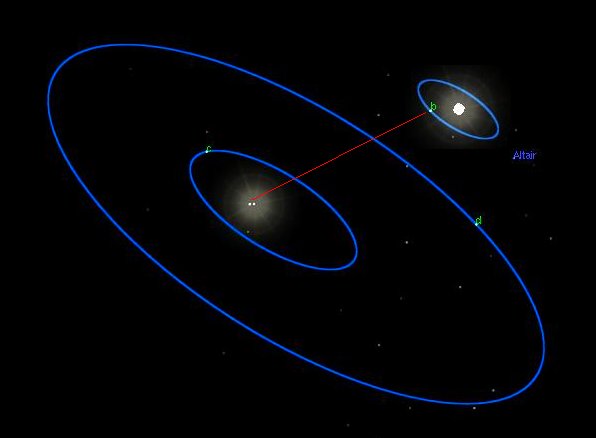
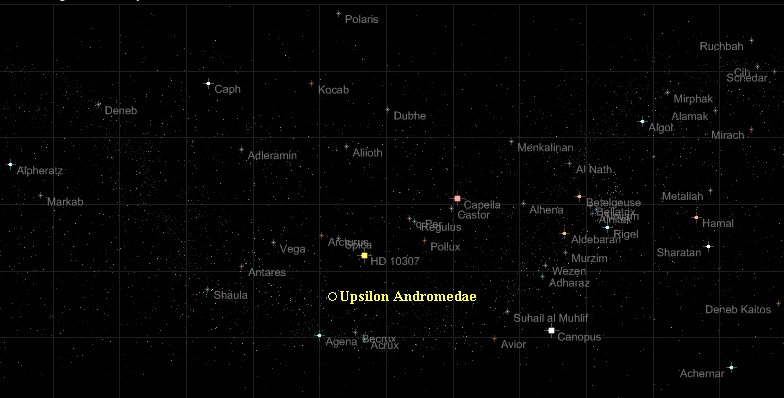
Position In Andromeda