← The Wingmakers Ways · Astronomy & Exoplanets
Archived page · Checkable
51 Pegasi System
51_Pegasi_System.html · captured from wingmakers.co.nz
51 Pegasi Planetary System
CONSTELLATION: Pegasus
Interstellar Card 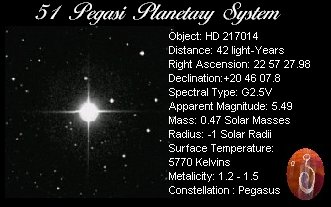
The Star
51 Pegasi, 50 light years away, is a fifth magnitude (5.49, just short of sixth magnitude) star 1.3 times more luminous than the Sun. The class of the star is uncertain. It is sometimes listed as a G2 subgiant (a somewhat evolved kind of star with a temperature of 5800 Kelvin, about that of the Sun) and sometimes as a G5 ordinary dwarf, one that, like the Sun, fuses hydrogen into helium in its core. The planet is the first one found by the Doppler (velocity) technique.
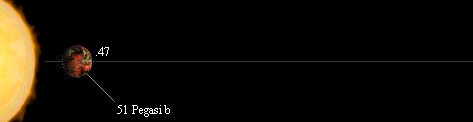
Object : 51 Pegasi b
Average Distance : 0.05 AUs
Object Type : Epistellar Giant
Epistellar Giant
Star System: 51 Pegasi
Discovery Status: Confirmed
Mass: 0.47 Jupiters
Average Distance: 0.05 AUs
Period: 4.2293 Days
Orbital Eccentricity: 0.015
Tug on Star: 57 m/s
Average Temperature: 1122 Kelvin
Detection Method: Doppler Spectroscopy
Discovered By: M. Mayor and D. Queloz
Year Discovered: 1995
The Planet
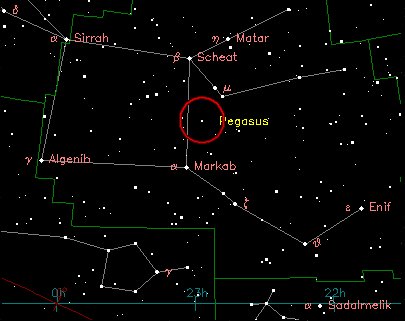
The circle shows the location of the sunlike class G star 51 Pegasi (in the constellation Pegasus). Its planet orbits in a mere 4.23 days (only 5 percent the period of Mercury around the Sun), has at least 0.47 times the mass of Jupiter, and is 0.05 astronomical units from the star. That is only 7.5 million kilometers, 4.6 million miles, or 13 percent Mercury's distance from the Sun.
51 Pegasi b has the distinction of being the first planet to be discovered orbiting another sun-like star. The discovery sent shock waves through the astronomical community, not only for the fact that it was one of the first exoplanets, but because of the unexpected nature of this world. 51 Pegasi b is a massive Jupiter-like planet orbiting at only 0.05 AUs from its sun, far closer than Mercury. At the time, theories of planet evolution allowed giant planets to form only at distances greater than several AU, at about the distance of Jupiter from the sun. To have 51 Pegasi b orbiting so close to its star made astronomers re-examine their theories.
It wouldn't be so bad if 51 Pegasi b was a rare case. But the discovery of planets orbiting 55 Cancri, tau Bootes, and other sun-like stars have shown that many, maybe even half, of the exoplanets so far discovered are similar to 51 Pegasi b. Although Doppler Spectrography, the technique used to detect these planets, favors massive planets close to their stars over planets further away, these epistellar planets may be quite common.
51 Pegasi b would suffer constant broiling from solar radiation, as well as extremely intense tidal forces. Due to its large mass (0.6 Jupiters) many assume that 51 Pegasi b is a Jovian gas giant, much like Saturn. But it is questionable whether or not a hydrogen atmosphere could be maintained so close to a sun. In this speculation, let us assume that the planet does not have an atmosphere. Instead, 51 Pegasi b is a super giant terrestrial world.
Such a massive rocky world would most likely have a molten core and a thin crust, much like the Earth. That and the tidal forces from its close orbit of 51 Pegasi would make 51 Pegasi b the most tectonically active world known. 51 Pegasi b may be a supergiant version of the Jovian moon Io.
Jupiter's moon Io is constantly stretched by the tidal forces of the massive planet and it's three other large moons (Europa, Ganymede, and Callisto). As a result, Io is extremely volcanically active; as many as 8 simultaneous volcanic events have been recorded on Io. Io's surface is constantly turning itself inside out. Any impact craters formed on the moon are almost immediately wiped out by a new layer of sulfurous ash.
Likewise, 51 Pegasi b would be craterless, with a surface constantly refreshed by titanic volcanic eruptions. And where Io's 'lava' consists of sulfur and ice, 51 Pegasi would erupt with molten rock, as on Earth. If these volcanic eruptions are powerful enough, it's possible that dust and ejecta may escape the planet and settle into a faint toroidal cloud around 51 Pegasi, much like Io produces a cloud around Jupiter.
Another interesting possibility is that the heat of the sun (the surface temperature is calculated at 1200 degrees Celcius) and of the eruptions is high enough to vaporize some metals. If this is the case, then 51 Pegasi b may have a transient atmosphere of silicon or nickel/iron!
Recent studies indicate that stars with epistellar planets, like 51 Pegasi b, might emit superflares every century or so. If this is happening within the 51 Pegasi system, then any as yet undiscovered and more distant icy worlds may have been melted smooth by these titanic stellar eruptions.
Even Venus, the reigning hostile world of our own solar system, can't hold a candle to 51 Pegasi b.

MAPPING TECHNIQUE
VISUAL EXERCISE : One or Two Person Exercise.
DESTINATION : 51 Pegasi b
STEP ONE
Traveller : Get comfortable and relax.
STEP TWO
Traveller : Charge your physical body with light energy.
STEP THREE
Traveller : See your visual body standing in front of your physical body and prepare your visual body for interstellar travel with a Interstellar Protection Shield and scanner.
STEP FOUR
Traveller : See your visual body filling with light energy.
STEP FIVE
Traveller : Focus your mind on teleporting your visual body to your destination above.
STEP SIX
Traveller : Then see your visual body teleporting to your destination.
STEP SEVEN
Traveller : When you arrive in the destination look around can you see any other planets or moons Orbiting the planet 51 Pegasi b? If not use the Interstellar Planetary Detection Rapid and see if you can detect any planets or moons in that system.
STEP EIGHT
Traveller : Check the atmospheric scanner is the surface of 51 Pegasi b an atmospheric match with earths atmosphere? Can you see any life forms on the surface of 51 Pegasi b? Is there any water on the surface of 51 Pegasi b?
STEP NINE
ask your spiritual guide to tell you the name of this planet or moon.
Traveller : Tell the mapper the name of the planet or moon. Also tell the mapper all you can about the planet or moon.
STEP TEN
Then use the Core Comparison Crystal Technique to perform a core reading on the core structure of the planet 51 Pegasi b and give the mapper your core reading.
STEP ELEVEN
Traveller : If you can see or or you have detected a planet or moon using the Interstellar Planetary Detection Rapid use Telekinesis or Teleportation move towards the planetary body.
STEP TWELVE
Traveller : Then levitate or Teleport your visual body to the surface of that planet or moon.
STEP THIRTEEN
Mapper : When the traveller arrives on the surface of the new planet or moon preform steps Eight to Ten again and give the mapper your reading on the planet or moons surface, core, and Atmosphere.
STEP FOURTEEN
Traveller : When you are finished on the surface teleport your visual body to the nearest planetary body that you can see or detected and do steps eight to thirteen again to get your readings.
STEP FIFTEEN
Traveller : When you have finished mapping 51 Pegasi b planetary System teleport your visual body back to your physical body back on earth.
REMEMBER
When you are travelling if you come across an alien race that you think may be friendly feel free to make contact with that alien race.
IMPORTANT
When you are contacting alien races always be ready to teleport if there is trouble.
MAPPER
Make a note of any readings on the planets or moons surface, core, and Atmosphere and check to see if that planet or moon is an atmospheric match with earths. That way you both know which planets can support human life forms.
MAPPER & TRAVELLER
To check that your mapping of 51 Pegasi b and the Pegasi Planetary System is correct change roles and do this exercise again. Also remember to check for life force energy around the planets or moons that you visit on your journeys. Because if you can feel life force energy that means the planet or moons is a real planet or moon. This technique can also be done as a single person exercise.