← The Wingmakers Ways · Astronomy & Exoplanets
Archived page · Checkable
Pegasus
Pegasus.html · captured from wingmakers.co.nz
Pegasus 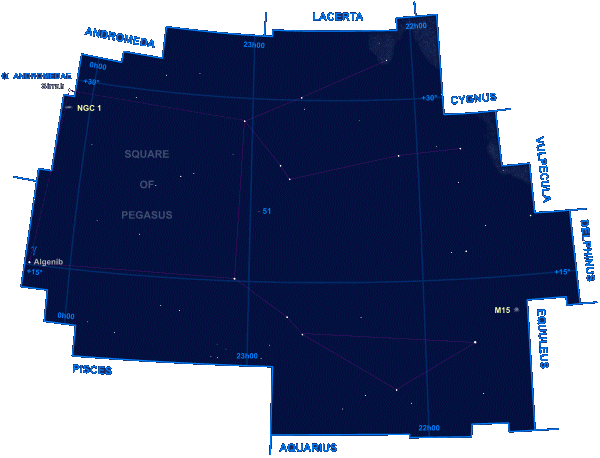
Easily recognisable from its 'square' of stars, Pegasus is a large ,well-populated constellation with several points of interest, including 51 Pegasi, which is thought to have a planet in orbit. A number of extragalactic phenomena are also to be found here: NGC 7331, for example, is a spiral galaxy with a structure very similar to our own Milky Way.
Pegasus, the winged horse, can be seen at the southern middle sky in autumn, and is conspicuous constellation that includes the "Great Square of Pegasus". All of four stars are generally second or third magnitude, but the vast asterism is fairly obvious because the bright stars hardly can be found around this field. The each side of the square is nearly parallel to each direction, so it's a good guide to identify the other constellations in autumn skies.
The Pegasus flew out of the blood of Medusa when Perseus slew her, and being upside down when you gaze at Pegasus turning south.
M15 (NGC7078) is a globular cluster found at the nose of Pegasus, about 4 degrees NW of epsilon Pegasi. The cluster is a medium sized one with a diameter of 12 arc minutes and looks like a coma of comet with magnitude of 6. A medium-sized telescope should be needed to resolve the individual stars. You can find a star of 6th magnitude just 17 arc minutes east of the cluster, these two objects have almost same brightness. It's slightly contrastive between the star and the dimmed cluster.
In autumnal southern sky, there is another major globular cluster of M2 in Aquarius about 13 degrees south of M15. M15 and M2 are positioned at almost same right ascension, and they have almost same size and brightness, look like the "Twin" globular clusters.
We can find a tiny galaxy of NGC7331 about 9 degrees NW of beta Pegasi, locating at the north west star of Pegasus's square. The galaxy shows us a bit slant from being edge-on, nearly same angle with the Andromeda Galaxy (M31). And it's detectable a crossing dark lane on pictures with long-exposure. You can appreciate a bright nucleus and surrounding fine light through medium-sized telescopes.
This star field contains many other small galaxies, and you can find a very famous compact group of galaxies, "Stephan's quintet" nearly 30 arc minutes south of NGC7331. This nickname came from that an astronomer A.E.Stephan introduced this group in his paper in 1877. Five indistinct ellipses can be seen by magnifying the field circled in upper image. Now many other compact group of galaxies like the Stephan's quintet have been discovered in heavens, and they're registered in a catalogue of "Hickson's Compact Group (HCG)". Stephan's quintet has a number of HCG92. Members of Stephan's quintet have codes from a to e, it's considered that galaxy "a" has no relations with other members and galaxies "b" and "d" are just colliding. Recently, evidence has discovered that over one million supernovae had exploded simultaneously in a member of this group; many astronomical topics can be written about the Stephan's quintet.
Lensing Galaxy G2237+0305 / Einstein Cross
Einstein's Cross, or G2237+0305 is perhaps the best known gravitational lens in the northern sky. A distant quasar is "split" into four parts by a closer foreground galaxy. The gravitation field of the galaxy bends and refocuses the light from the distant quasar into four roughly equal components. This galaxy has a designation CGCG 378-15, a 14th magnitude system in the constellation of Pegasus. This galaxy is not very difficult to view even with moderate aperture but the quasar is a different story. The southern component A has a magnitude of 17.36, component B (northern) is 17.39 magnitude, C (eastern) is 18.43 and D (western) is the most difficult at 18.72 magnitude. Barbara Wilson provided much of the information on this object. The key to seeing "the cross" is a combination of large aperture, very dark skies and excellent seeing conditions.
NGC 7177 - A small, moderately bright galaxy, 3'x1' in size, oriented NE-SW. It has a definite central bulge about 1' in diameter, a stellar nucleus, and is broadly concentrated to the center.
NGC 7332 - A small, but very nice edge-on spiral. It is about 4'x7', oriented NE-SW, sharply brighter to the center, has a stellar nucleus, and a definite central bulge. A much fainter companion (NGC 7339) lies 10' to the east, and is 4'x'1', oriented E-W, and is only very slightly brighter to the center.
NGC 7479 - Large, 5-6'x3', extended NNW-SSE, with a slightly brighter center. There is a 13th magnitude star seemingly imbedded in its northern tip. The tips of the galaxy show hints of curving slightly, indicating that it is a barred spiral.
Stephan's Quintet - These five, tightly gathered galaxies are faint and nearly impossible to see in moderate instruments, so find a friend with a light bucket you can borrow. I found its brighter members in my scope, but was unable to definitely identify all of them. I was, however, treated to a fine view of them through my friend Keith Shank's 16" Newtonian at last year's club picnic. A truly impressive sight.
Planetary Systems In Pegasus
THE STAR
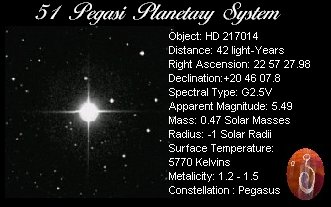
51 Pegasi, 50 light years away, is a fifth magnitude (5.49, just short of sixth magnitude) star 1.3 times more luminous than the Sun. The class of the star is uncertain. It is sometimes listed as a G2 subgiant (a somewhat evolved kind of star with a temperature of 5800 Kelvin, about that of the Sun) and sometimes as a G5 ordinary dwarf, one that, like the Sun, fuses hydrogen into helium in its core. The planet is the first one found by the Doppler (velocity) technique.
THE PLANET
The circle shows the location of the sunlike class G star 51 Pegasi (in the constellation Pegasus). Its planet orbits in a mere 4.23 days (only 5 percent the period of Mercury around the Sun), has at least 0.47 times the mass of Jupiter, and is 0.05 astronomical units from the star. That is only 7.5 million kilometers, 4.6 million miles, or 13 percent Mercury's distance from the Sun.
MAPPING TECHNIQUE
VISUAL EXERCISE : Two Person Exercise.
DESTINATION : Your Choice
STEP ONE
Traveller : Get comfortable and relax.
STEP TWO
Traveller : Charge your physical body with light energy.
STEP THREE
Traveller : See your visual body standing in front of your physical body and prepare your visual body for interstellar travel with a Interstellar Protection Shield.
STEP FOUR
Traveller : See your visual body filling with light energy.
STEP FIVE
Traveller : Focus your mind on teleporting your visual body to the Your Destination.
STEP SIX
Traveller : Then see your visual body teleporting to the Your Destination.
STEP SEVEN
Traveller : When you arrive in the destination Look around can you see any planets or moons in the System? If not use the Interstellar Planetary Detection Rapid and see if you can detect any planets or moons in that system.
STEP EIGHT
Traveller : If you can see or detect a planet or moon using Telekinesis or Teleportation move towards the planetary body.
STEP NINE
Traveller : When you arrive at the outer atmosphere of the planet or moon stop and ask your spiritual guide to tell you the name of this planet or moon.
Traveller : Tell the mapper the name of the planet or moon. Also tell the mapper all you can about the planet or moon.
STEP TEN
Then us the Core Comparison Crystal Technique to perform a core reading on this planet or moon and give the mapper your reading on this planet or moon
STEP ELEVEN
Traveller : Then levitate or Teleport your visual body to the surface of the planet or moon.
STEP TWELVE
Mapper : When the traveller arrives on the surface ask the following questions.
Is there any plant life or water on the surface of the planet or moon that you can see? Is there an atmosphere around this planet or moon? Is the atmosphere an match with earths atmosphere?
Mapper : Write down the answers to these questions.
PLANETARY DATA FILE 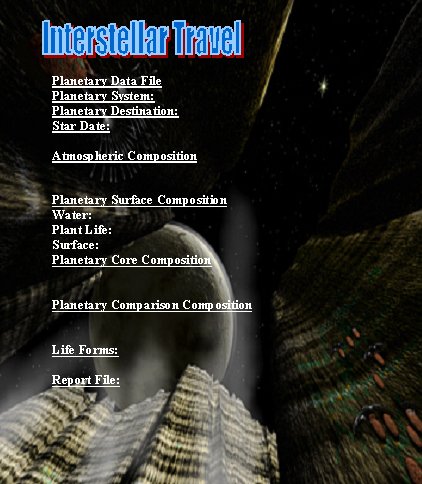
STEP THIRTEEN
Traveller : When you are finished on the surface teleport your visual body to the nearest planetary body that you can see in that Galaxy.
STEP FOURTEEN
Traveller and Mapper : Follow steps nine through to twelve again till you have mapped out the whole Galaxy.
STEP FIFTEEN
Traveller : When you have finished mapping the Galaxy teleport your visual body back to your physical body back on earth.
REMEMBER
When you are travelling if you come across an alien race that you think may be friendly feel free to make contact with that alien race.
IMPORTANT
When you are contacting alien races always be ready to teleport if there is trouble.
MAPPER
Make a note of any planets or moons with an atmospheric match with earths. That way you both know which planets can support human life forms.
MAPPER & TRAVELLER
To check that your mapping of that Galaxy is correct by changing roles and do this exercise again. Also remember to check for life force energy around the planets or moons that you visit on your journeys. Because if you can feel life force energy that means the planet or moons is a real planet or moon.