← The Wingmakers Ways · Astronomy & Exoplanets
Archived page · Checkable
Bootes Constellation
Bootes.html · captured from wingmakers.co.nz
Bootes 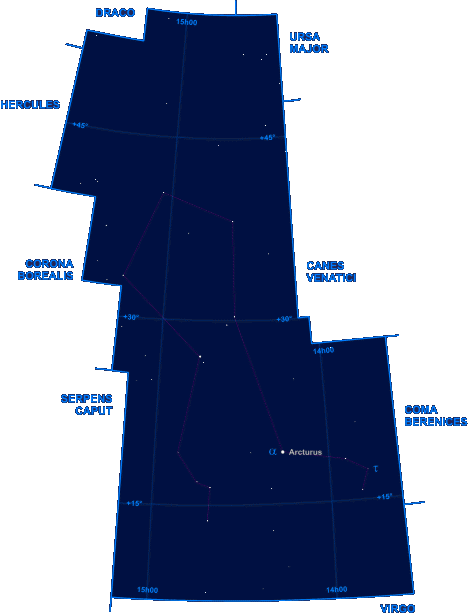
Bootes is known as the protector of the Bear (Ursa Major) because of being on the tracks of the Great Bear, accompanied by two dogs (the Canes Venatici).
The constellation includes a major star of Arcturus, alpha Bootis. The star is easily found out by following the sweep of the Big Dipper's handle, and the curve takes you to an another bright star of Spica in south sky, alpha Virginis. The curve across the night sky in spring from the Big Dipper to Spica called "The Spring's Great Curve".
Arcturus is the brightest star in the Northern Hemisphere and the third brightest in all of the heavens with a magnitude of -0.1 and a color of orange. Arcturus means "Guardian of the Bear", and has a name of the wheat star in Japan because the star is seen at zenith when the wheat is harvested in late spring.
NGC5466 is a very dimmed globular cluster in west region of Bootes. It's difficult to catch the globular cluster with finder scopes, you can use a way of searching that firstly find out a bright globular cluster of M3 in Canes Venatici, and next tracing about 5 degrees east from M3. NGC5466 has a visual magnitude of 10, you might need over 4 inch telescopes to detect it clearly. The globular has fairly sparse stellar density; long exposed films can easily resolve member stars around central region. This star field is very far from the Milky Way, and a distance of the globular is estimated about 47 thousand light years. The globular cluster is positioned apart from the galactic disk, to say, lying at a remote region of the Galaxy.
This is a small-scaled bared galaxy of NGC5248 floating around south west of Bootes near the boundary on Virgo. The galaxy has a long axis of 6 arc minutes and an apparent brightness of 10th magnitude. This picture shows you two undeveloped arms are stretching in east west direction. But the galaxy shows you a simple lump of dimmed light through large-scaled telescopes. And it's considered that NGC5248 is a member galaxy of the Virgo Cluster though it's lying considerably distant field.
Tau Bootis Planetary System
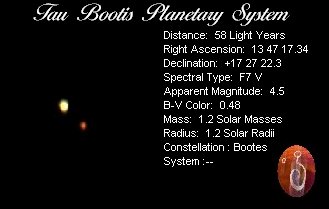
Tau Bootis, on the border between fourth and fifth magnitude, has been classed both as an F6 subgiant
and an F7 dwarf. At a distance of 51 light years, it shines with triple the solar luminosity. Warmer than
the Sun, as befits its class, the surface temperature lies between 6440 and 6550 Kelvin, and probably
closer to the latter. Its higher luminosity and temperature show it to have a radius 1.4 times solar and a
mass 30 percent larger than the Sun. Subgiant status implies that the star is nearing the end of its
hydrogen-fusing life, but age measurements suggest otherwise, that the star is only about 1.3 billion years
old. About a third of the way through its normal life, the star must therefore still be a dwarf. Tau Bootis is
suspected of being a slight variable with a magnitude range of under 10 percent, which would make it
unusual among stars with planets. More unusual, Tau Bootis has a distant companion, a red (class M2)
dwarf that orbits far outside the "planetary system" (if indeed there is an actual "system") at an average
distance of 250 astronomical units with a 2000 year revolutionary period. (From Earth, the separation is
now around 5 seconds of arc.) The orbit is highly elliptical, the star coming as close as 22 astronomical
units and going out as far as 470. The "double sun" would present quite a sight from a hypothetical earth
orbiting Tau Bootis proper. Even at the average distance it would shine with the brilliance of 16 Venuses;
at its closest, it would glower redly with that of a dozen full Moons.
This triple star system is located about 41.6 light-years (ly) away from our Sun, Sol. It lies in the
northwestern part (15:3:47.3+47:39:14.6, ICRS 2000.0) of Constellation Boötes, the Herdsman or Bear
Driver -- north of Nekkar (Beta Boötis), east of Lamda Boötis, northeast of Seginus (Gamma Boötis),
southwest of Edasich (Iota Draconis), southeast of Theta Boötis and Alkaid (Eta Ursae Majoris), and
west of Tau and Nu Herculis. The "star" was noted to be variable in 1785 by Sir William Herschel
(1738-1822), who was born Friedrich Wilhelm Herschel. According to Robert Burnham, Jr. (1931-93),
the system was confirmed to be a visual binary in 1832 by Friedrich Georg Wilhelm Struve (1793-1864).
In 1926, the fainter component itself was found to be an eclipsing binary by Jan Schilt by photographic
observations, which had already been suspected from a spectrum that showed rotationally broadened
absorption lines. The system has the variable star designation i Boötis and is often confused with Iota
Boötis, a Delta-Scuti-type variable star of spectral and luminosity type A9 V.
Epsilon (e) Bootis (Izar)
A nice pair, but can be difficult to resolve in small apertures. The K0 giant of magnitude 2.7, and its A2 main sequence companion of magnitude 5.1 can be split with a medium aperture and good optics. The two stars orbit each other every 153 years. Pale yellow & light blue.
MAPPING TECHNIQUE
VISUAL EXERCISE : Two Person Exercise.
DESTINATION : Your Choice
STEP ONE
Traveller : Get comfortable and relax.
STEP TWO
Traveller : Charge your physical body with light energy.
STEP THREE
Traveller : See your visual body standing in front of your physical body and prepare your visual body for interstellar travel with a Interstellar Protection Shield.
STEP FOUR
Traveller : See your visual body filling with light energy.
STEP FIVE
Traveller : Focus your mind on teleporting your visual body to the Your Destination.
STEP SIX
Traveller : Then see your visual body teleporting to the Your Destination.
STEP SEVEN
Traveller : When you arrive in the destination Look around can you see any planets or moons in the System? If not use the Interstellar Planetary Detection Rapid and see if you can detect any planets or moons in that system.
STEP EIGHT
Traveller : If you can see or detect a planet or moon using Telekinesis or Teleportation move towards the planetary body.
STEP NINE
Traveller : When you arrive at the outer atmosphere of the planet or moon stop and ask your spiritual guide to tell you the name of this planet or moon.
Traveller : Tell the mapper the name of the planet or moon. Also tell the mapper all you can about the planet or moon.
STEP TEN
Then us the Core Comparison Crystal Technique to perform a core reading on this planet or moon and give the mapper your reading on this planet or moon
STEP ELEVEN
Traveller : Then levitate or Teleport your visual body to the surface of the planet or moon.
STEP TWELVE
Mapper : When the traveller arrives on the surface ask the following questions.
Is there any plant life or water on the surface of the planet or moon that you can see? Is there an atmosphere around this planet or moon? Is the atmosphere an match with earths atmosphere?
Mapper : Write down the answers to these questions.
PLANETARY DATA FILE 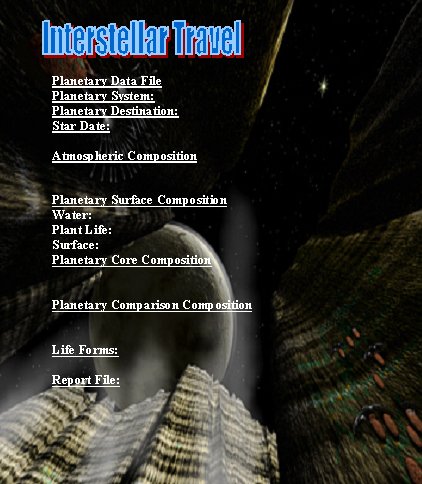
STEP THIRTEEN
Traveller : When you are finished on the surface teleport your visual body to the nearest planetary body that you can see in that Galaxy.
STEP FOURTEEN
Traveller and Mapper : Follow steps nine through to twelve again till you have mapped out the whole Galaxy.
STEP FIFTEEN
Traveller : When you have finished mapping the Galaxy teleport your visual body back to your physical body back on earth.
REMEMBER
When you are travelling if you come across an alien race that you think may be friendly feel free to make contact with that alien race.
IMPORTANT
When you are contacting alien races always be ready to teleport if there is trouble.
MAPPER
Make a note of any planets or moons with an atmospheric match with earths. That way you both know which planets can support human life forms.
MAPPER & TRAVELLER
To check that your mapping of that Galaxy is correct by changing roles and do this exercise again. Also remember to check for life force energy around the planets or moons that you visit on your journeys. Because if you can feel life force energy that means the planet or moons is a real planet or moon.