← The Wingmakers Ways · Astronomy & Exoplanets
Archived page · Checkable
Tau Bootis
Tau_Bootis_Planetary_System.html · captured from wingmakers.co.nz
Tau Bootis Planetary System
Parent Star: PSR B1620-26 (Pulsar) in the constellation of Scorpius is located at a distance of 12399.4 Light Years from our Solar system.
Solar System
Sun
Mercury
Venus
Earth
Mobius
Mars
Jupiter
Saturn
Uranus
Neptune
Pluto
2004 DW
Quaoar
Sedna
2002 AW197
2003 UB313
Comets
Meteorites
Asteroids
Extrasolar planets
Mistori System
Marillian System
Cassidian System
Tristeka System
Krillian System
Hekar System
Noack System
Deridian System
Frakanain System
Pallalonian System
55 Cancri System
HD 62509 System
Planetary Systems
Leota A
Iota Draconis
Pegasi System
Beta Pictoris
Pular 1257+12
Upsilon Andromedae
Herculii System
16 Cygni B
70 Virginis B
79 Ceti Planetary System
Aldebaran System
BD-103166
CM Draconis
Epsilon Eridani
Epsilon Reticulum
Gamma Cephei
HD 37124
OGLE-TR-56b System
Lalande 21185
Barnard's System
Epsilon Indi
HD 209458
OGLE-TR System
OGLE 2003-BLG-235
HD 12661
HD 141937
HD 147513
HD 169830
HD 210277
HD 49674
23 Librae (HD 134987)
HD 162020
mu Ara / HD 160691
HD 74156
HD 38529
GM Aurigae
2M1207 b
91 Aquarii
HD 68988 / NGC 3184
HD 80606-NGC 2841
47 Ursae Majoris
109 Piscium
Gliese 777A
54 Piscium
GJ 436
PSR B1620-26
HD 168443
HD 202206
HD 217107
Gliese 876
HD 3346
HD 82943
HD 183263
HD 142022 A
Zeta Reticuli
OLGE 2005 BLG 071
HD 108874
OLGE 2005 BLG 390
Tau Bootis Planetary System
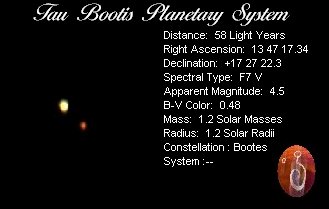
THE STAR Tau Bootis, on the border between fourth and fifth magnitude, has been classed both as an F6 subgiant and an F7 dwarf. At a distance of 51 light years, it shines with triple the solar luminosity. Warmer than the Sun, as befits its class, the surface temperature lies between 6440 and 6550 Kelvin, and probably closer to the latter. Its higher luminosity and temperature show it to have a radius 1.4 times solar and a mass 30 percent larger than the Sun. Subgiant status implies that the star is nearing the end of its hydrogen-fusing life, but age measurements suggest otherwise, that the star is only about 1.3 billion years old. About a third of the way through its normal life, the star must therefore still be a dwarf. Tau Bootis is suspected of being a slight variable with a magnitude range of under 10 percent, which would make it unusual among stars with planets. More unusual, Tau Bootis has a distant companion, a red (class M2) dwarf that orbits far outside the "planetary system" (if indeed there is an actual "system") at an average distance of 250 astronomical units with a 2000 year revolutionary period. (From Earth, the separation is now around 5 seconds of arc.) The orbit is highly elliptical, the star coming as close as 22 astronomical units and going out as far as 470. The "double sun" would present quite a sight from a hypothetical earth orbiting Tau Bootis proper. Even at the average distance it would shine with the brilliance of 16 Venuses; at its closest, it would glower redly with that of a dozen full Moons.
System Components
(Mass in Multiples of Jupiter's Mass)
Tau Bootes B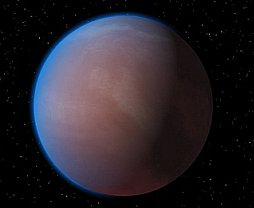
Basic Data
Parent Star: tau Bootes (F7 V)
Discovery Status: Confirmed
Planet Type: Hot JupiterPhysical Data
Mass ( M sin i ): 3.87 Jupiters
Mean Distance: 0.046 AU
Orbital Period: 3.3128 Days
Eccentricity: 0.018
Argument of Perihelion (omega): 164°Inferred Properties
Average Angular Size of Star: 17.923°
Planet Appearance:
MgSiO3 clouds, dim red glow
Mean Temp: 1576 KelvinDiscovery Facts
Year Discovered: 1996
Detection Method: Doppler Spectroscopy, Reflected Starlight
Discovered By: Butler and Marcy, Reflected Starlight Detected by Cameron et al.Speculations
Tau Bootes b is one of the most extreme of the so-called "Hot Jupiters", planets orbiting unusually close to their parent stars. It is both more massive and closer to its star than any of its cousins, such as 51 Pegasi b and 55 Cancri b. Its large mass of 3.87 Jupiters makes tau Bootes b almost certainly a gas giant, and one of the biggest exoplanets yet discovered.
Another way that tau Bootes b stands out is its parent star. Unlike many of the other parent stars of exoplanets, Tau Bootes is an F type star, making it much hotter and brighter than more Sun-like stars. The combination of closer orbit, higher mass (meaning higher internal temperature), and hotter star makes it highly probable that tau Bootes b has the highest surface temperature of any known planet. The temperature may be so high that it is questionable whether the planet's atmosphere could survive.In such hostile environs, tau Bootes b may be slowly evaporating into space. This would make the planet appear hazy and featureless as the departing gases obscure the surface clouds. Both Saturn and Uranus have the same kind of featureless surfaces due to obscuring smog, although not for the same reason. The lost gases may also settle into a cloud around tau Bootes, or it may be blown out of the system entirely by stellar winds. The gas may even trail behind the planet in a faint comet-like tail.
If tau Bootes b is indeed loosing mass due to the proximity of its star, it must have been even more massive in the past. How much more massive depends on the rate of mass loss. The percentage of mass lost may have been insignificant. Or it's possible that the planet was much more massive in the past. This brings up the interesting possibility that the planet is not really a planet at all. It may have started life as a brown dwarf (See Gliese 229) that was unfortunate enough to have formed or wandered too close to its star.
Clearly tau Bootes b holds intriguing possibilities for future exploration.
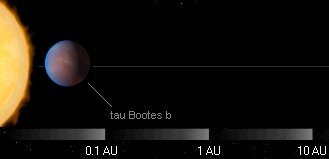
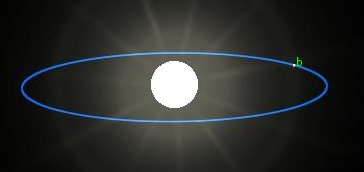
Planetary Orbit Around Tau Bootes
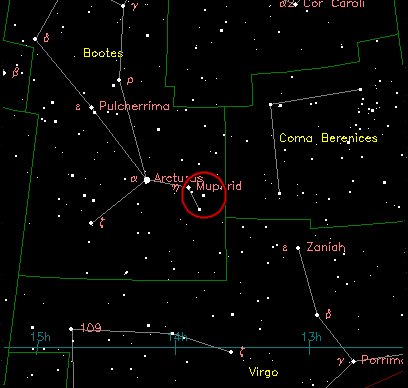
Position In Bootes