← The Wingmakers Ways · not in the site's own index
Archived page · Asserted
Aries
Canes_Venatici~2004.html · captured from wingmakers.co.nz
Canes Venatici 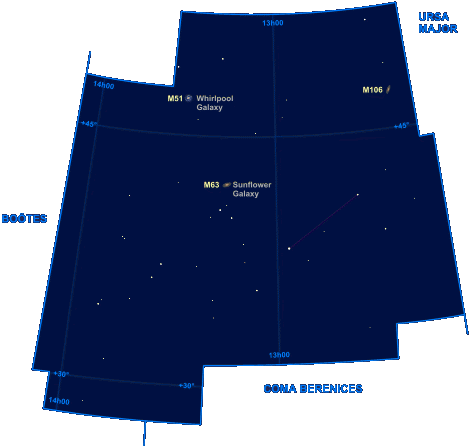
The Hunting Dogs
Canes Venatici, the hound dogs, is very unnoticeable and minor constellation positioned at south of the handle of the Big Dipper. The constellation is formed only two stars of alpha and beta CVn, was introduced by J. Hevelius in 1690. It represents the two dogs of Asterion and Chara, held on a leash by Bootes as they chase the Big Bear (Ursa Major) around the North Pole.
Alpha Canum Venaticorum with the second magnitude is well known called Col Caroli, meaning of the Heart of Charles. This name was given by Edmund Halley, naming it after King Charles II after the restoration of the monarchy in Britain in 1660. The constellation chart in the left shows the Heart with the crown put on at the star of Col Caroli.
The constellation has many bright galaxies in the outer space, and the Col Caroli is the good mark to search those deep sky objects.
Canes Venatici, the Hunting Dogs, mark an area of the sky near the Northern Galactic Pole, and so they describe a slice of sky perpendicular to the plane of our Galaxy.
At about the zenith in spring night sky, we can see a wonderful globular cluster roughly halfway between Cor Caroli (alpha Canum Venaticorum) and Arcturus in Bootes. But you'll need a large scope to resolve its individual stars.
The cluster is about 45,000 light years away.
M51 (NGC5194), "The Whirlpool Galaxy", is the brightest and interesting galaxy in the constellation. This spiral is found just 3 degrees SW of eta Ursae Majoris, a tip star of the Big Dipper's handle. The galaxy is 25 million light years away; you'll need a large telescope and a fine evening to enjoy its detailed structure, which includes an appendage system of NGC5195. Another galaxy seemingly hanging onto one of its arms.
M63 (NGC5055) is a bright spiral galaxy about five degrees north-east of Col Caroli, alpha Canum Venaticorum, and the position is almost equivalent to the midway between Col Caroli and another noticeable galaxy of M51, Whirlpool Nebula. This spiral is sometimes called the Sunflower Galaxy by its numerous arms, and has the apparent diameter of about 10 arc minutes, one of the largest galaxies scattered around this field.
You can appreciate the galaxy as a dimmed ellipse with its tips being sharp through scopes. The galaxy is about 24 million light years away.
M94 (NGC4736) is a large galaxy positioned around the center of Canes Venatici. The galaxy is found to draw a line between Cor Caroli and beta CVn, and at the halfway point draw a perpendicular off to the northeast. M94 is a circular galaxy with about 10 arc minutes diameter and 9th magnitude, it might be easily detected only with small binoculars as a blurred star-like image. The galaxy is conspicuous that has a very bright nucleus, you may miss M94 in not so clear sky because it looks like a normal star.
This image shows the galaxy is face-on, and very dimmed beam of light spreading around the nucleus.
The galaxy lies on about 14 million light years away, and has a span of about 140 thousand light years.
M106 (NGC4258) is a spiral galaxy about 7.5 degree south-east of gamma UMa. Although this galaxy is in Canes Venatici, it's easy to search that from the Big Dipper.
In spring skies, you can find plenty of galaxies, M106 is fairly bright and easy to appreciate in them. The galaxy has visual magnitude of 8.6 and a size of 20 arc minutes, and you can see that the galaxy is stretching north-south direction through a medium-sized telescope. The distance of M106 is estimated about 21 million light years.
This picture shows you a dimmed edge-on galaxy of NGC4244 at the western part of Canes Venatici. You can find out the galaxy at 7.5 degrees west from alpha Canum Venaticorum, Cor Caroli.
The galaxy has a thickness of only a bit smaller than 2 arc minutes while a length of 16.6 arc minutes. This size exceeds that of NGC4565, one of most popular edge-on galaxies in the constellation of Coma Berenices. But NGC4244 has a visual brightness of only 10.6th magnitude, it might be needed a medium-sized telescope with about 6-inches in aperture to enjoy this faint galaxy. We're appreciating the galaxy from almost dead side, and can hardly detect the central bulge region and dark lane.
At about 8 degrees northwest from Cor Caroli, alpha Canum Venaticorum, an irregular galaxy of NGC4449 is lying around midway between two Messier's galaxies of M94 and M106. The galaxy is fairly easy to see, has a brightness of 10th magnitude and about 6 arc minutes in long axis. You can detect several gaseous regions in edge of the galaxy. The distance from us is estimated about 9.8 million light years or so.
NGC4490 is a galaxy with a unique shape lying about a bit closer than 6 degrees northwest of Cor Caroli. NGC4490 has a long axis of about 6 arc minutes and a visual brightness of 10.3th magnitude. It's a major characteristic that the galaxy has a companion galaxy of NGC4485 with 12.5th magnitude in just north.
These two galaxies have gravitational interaction each other, the influence made arms of NGC4490 stretched and distorted. This apparent feature is made when two galaxies pass each other, not a head-on collision.
This image shows you two unique-shaped galaxies around the south edge of Canes Venatici. Right-hand and left-hand ones are NGC4631 and NGC4656 respectively. Both of them are being edge-on.
Though they are typical spiral galaxies, fairly strained by the gravitational exchange each other. NGC4631 has the apparent length of 15.5 arc minute and the magnitude about 10, its slender shape is clearly seen with small telescopes. But NGC4656 is a bit dimmer with the magnitude of 10.6, should be needed a medium-sized telescope.
I associate these galaxies floating in the dark universe with two fishes sailing.
The galaxies lie on about 22 million light years away. And you can notice a tiny satellite galaxy of NGC4627 snuggling up to the north of NGC4631.
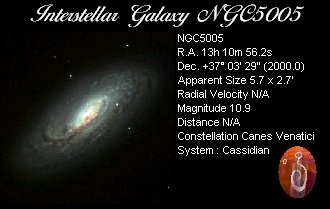
A spiral galaxy about 3 degrees southeast of Cor Caroli, alpha Canum Venaticorum is NGC5005. We're seeing the galaxy from a bit slant angle from being edge-on, and the galaxy has a long axis of about 5 arc minutes. Visual brightness is about 10th magnitude, an elliptical dimmed light can be seen through medium ranged telescopes. Although this picture cannot show you clear spiral structure, a bright nucleus detectable. 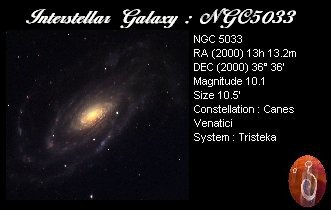
NGC 5033 is a sprawling spiral galaxy with thick insect-like arms. Several HII (pink star forming regions) can be seen in this image. This galaxy is estimated to be 37 million light years away. Although it is a faint galaxy (at least for a 0.4m telescope) it is surprisingly well studied. One of the most interesting characteristics of this galaxy is that it is classified as being a Seyfert type. The nucleus (and small sources within) is extremely luminous and varies in brightness. Astronomers have also found that this galaxy contains twice the abundance of Oxygen than our own solar neighborhood. .
MAPPING TECHNIQUE
VISUAL EXERCISE : Two Person Exercise.
DESTINATION : Your Choice
STEP ONE
Traveller : Get comfortable and relax.
STEP TWO
Traveller : Charge your physical body with light energy.
STEP THREE
Traveller : See your visual body standing in front of your physical body and prepare your visual body for interstellar travel with a Interstellar Protection Shield.
STEP FOUR
Traveller : See your visual body filling with light energy.
STEP FIVE
Traveller : Focus your mind on teleporting your visual body to the Your Destination.
STEP SIX
Traveller : Then see your visual body teleporting to the Your Destination.
STEP SEVEN
Traveller : When you arrive in the destination Look around can you see any planets or moons in the System? If not use the Interstellar Planetary Detection Rapid and see if you can detect any planets or moons in that system.
STEP EIGHT
Traveller : If you can see or detect a planet or moon using Telekinesis or Teleportation move towards the planetary body.
STEP NINE
Traveller : When you arrive at the outer atmosphere of the planet or moon stop and ask your spiritual guide to tell you the name of this planet or moon.
Traveller : Tell the mapper the name of the planet or moon. Also tell the mapper all you can about the planet or moon.
STEP TEN
Then us the Core Comparison Crystal Technique to perform a core reading on this planet or moon and give the mapper your reading on this planet or moon
STEP ELEVEN
Traveller : Then levitate or Teleport your visual body to the surface of the planet or moon.
STEP TWELVE
Mapper : When the traveller arrives on the surface ask the following questions.
Is there any plant life or water on the surface of the planet or moon that you can see? Is there an atmosphere around this planet or moon? Is the atmosphere an match with earths atmosphere?
Mapper : Write down the answers to these questions.
PLANETARY DATA FILE 
STEP THIRTEEN
Traveller : When you are finished on the surface teleport your visual body to the nearest planetary body that you can see in that Galaxy.
STEP FOURTEEN
Traveller and Mapper : Follow steps nine through to twelve again till you have mapped out the whole Galaxy.
STEP FIFTEEN
Traveller : When you have finished mapping the Galaxy teleport your visual body back to your physical body back on earth.
REMEMBER
When you are travelling if you come across an alien race that you think may be friendly feel free to make contact with that alien race.
IMPORTANT
When you are contacting alien races always be ready to teleport if there is trouble.
MAPPER
Make a note of any planets or moons with an atmospheric match with earths. That way you both know which planets can support human life forms.
MAPPER & TRAVELLER
To check that your mapping of that Galaxy is correct by changing roles and do this exercise again. Also remember to check for life force energy around the planets or moons that you visit on your journeys. Because if you can feel life force energy that means the planet or moons is a real planet or moon.