← The Wingmakers Ways · Astronomy & Exoplanets
Archived page · Checkable
Tristeka Solar System
Tristeka_Planetary_System.html · captured from wingmakers.co.nz
Tristeka Planetary System

The Tristeka Planetary System Contains Seven Planets And One moon and is classed as the galaxy NGC 5033 and is a sprawling spiral galaxy with thick insect-like arms. Several HII (pink star forming regions) can be seen in this image. This galaxy is estimated to be 37 million light years away. Although it is a faint galaxy (at least for a 0.4m telescope) it is surprisingly well studied. One of the most interesting characteristics of this galaxy is that it is classified as being a Seyfert type. The nucleus (and small sources within) is extremely luminous and varies in brightness. Astronomers have also found that this galaxy contains twice the abundance of Oxygen than our own solar neighborhood.
Interstellar Card
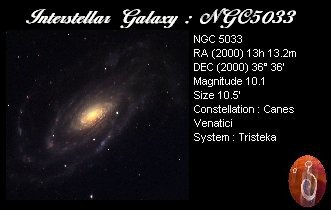

This Is Another view of the Tristeka Planetary System As you can see the seven planetary centres orbit around the galaxies centre
CONSTELLATION: Canes Venatici
SUN: Pinky Red In colour
FIRST PLANET :
Planet Surface :
Atmosphere :
Plant Life :
Water :
Life Forms :
Detection Method: Interstellar Travel
Year Discovered:
SECOND PLANET :
Planet Surface :
Atmosphere :
Plant Life :
Water :
Life Forms :
Detection Method: Interstellar Travel
Year Discovered:
THIRD PLANET:
Planet Surface :
Atmosphere :
Plant Life :
Water :
Life Forms :
Moons Of Mika :
Detection Method: Interstellar Travel
Year Discovered:
FOURTH PLANET:
Planet Surface :
Atmosphere :
Plant Life :
Water :
Life Forms :
Detection Method: Interstellar Travel
Year Discovered:
FIFTH PLANET :
Planet Surface :
Atmosphere :
Plant Life :
Water :
Life Forms :
Moons Of Kryon :
Detection Method: Interstellar Travel
Year Discovered:
SIXTH PLANET :
Planet Surface :
Atmosphere :
Plant Life :
Water :
Life Forms :
Moons Of Sista :
Detection Method: Interstellar Travel
Year Discovered:
SEVENTH PLANET :
Planet Surface :
Atmosphere :
Plant Life :
Water :
Life Forms :
Moons:
Detection Method: Interstellar Travel
Year Discovered :
Traveller : Donna
Mapper : Darryn
TRAVEL TECHNIQUE
VISUAL EXERCISE : One person Exercise.
CONSTELLATION : Canes Venatici
PLANETARY DESTINATION : Your Choice
STEP ONE
Traveller: Get comfortable and relax.
STEP TWO
Traveller: Charge your physical body with light energy.
STEP THREE
Traveller: See your visual body standing in front of your physical body and prepare
your visual body for interstellar travel with a Interstellar Protection Shield and
scanner.
STEP FOUR
Traveller: See your visual body filling with light energy.
STEP FIVE
Traveller: Focus your mind on teleporting your visual body to your destination above.
STEP SIX
Traveller: Then see your visual body teleporting to your destination.
STEP SEVEN
Traveller: When you arrive in the cancri system perform an interstellar planetary
detection rapid to check for were the planets are then teleport to the nearest
destination in that planetary system.
STEP EIGHT
then scan is the surface of the planet and the atmosphere is the planet a match with
earths atmosphere? Can you see any life forms on the surface of planet? Is there any
water on the surface of the planet? Place this information on your planetary data file.
STEP NINE
Then use the Core Comparison Crystal Technique to perform a core reading on the
core structure of the planet.
STEP TEN
Traveller: When you have finished mapping the Planet or moon teleport your visual
body back to your physical body back on earth.
REMEMBER
When you are travelling if you come across an alien race that you think may be
friendly feel free to make contact with that alien race.
IMPORTANT
When you are contacting alien races always be ready to teleport if there is trouble.