← The Wingmakers Ways · Astronomy & Exoplanets
Archived page · Checkable
Iota Draconis
Iota_Draconis.html · captured from wingmakers.co.nz
Iota Draconis Planetary System 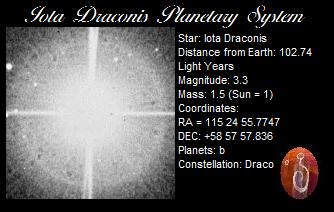
Constellation: Draco
CONSTELLATION: Draco

Iota Draconis Star
Gaseous Giant

iota Draconis A, once a sun-like star, has burned through its supply of hydrogen fuel and has become a red giant star. In five to ten billion years, the sun will face a similar fate.
Planetary Star : Iota Draconis
Planet Surface : Gaseous layers, gas pressurized core. No solid land
Atmosphere : green gas, yellow 'surface', denser red / orange layers.
Plant Life : no physical forms
Water : upper atmosphere
Life Forms : no physical life forms
Detection Method: Interstellar Travel
Year Visited: 23 January 2003
Alternate Designations: HIP 75458
Distance from Sun: 31.5 Parsecs
Right Ascension: 15 24 55.7747
Declination: +58 57 57.836
Spectral Type: K2 III
Apparent Magnitude: 3.3
Mass: 8.64 Solar Masses
Radius: 13 Solar Radii
Metalicity: 0.03
Iota Draconis B
Eccentric Giant
FIRST PLANET : Iota Draconis B
Planet Surface : Barren surface
Atmosphere : Gasyes atmosphere (not fit of human)
Plant Life : No plant life Visable on the surface of the planet
Water : No water on the surface of this planet
Life Forms : there are no life forms to be seen on the surface
Detection Method: Interstellar Travel
Year Discovered: 15 January 2000
Type: Gas Giant
Mass: 8.7 (Jupiter = 1)
Orbital Radius: Unknown
Spiral galaxy in Draco, mag 9.7, 19' x 7' size.
Chart prepared by D. Parkin.
Orbital Period: 547.5 days
Eccentricity: 0.7
Discovery: 2002, by Lick Observatory
Method of Detection: Radial Velocity (or Doppler Spectroscopy)
Details: Iota Draconis b is the first planet to be discovered orbiting a giant star. The host star is not sunlike, but an old star that has already burned the hydrogen fuel in its core. This discovery provides evidence that planets at distances comparable to Earth can survive the evolution of the host star into a giant.
Iota Draconis B
Iota Draconis was visited by myself in 2001 with the use of interstellar travel and is worth visiting if you want to known more about how we came to be the surface of the planet is suitable for humans but only for short periods of time. take notes and take care.
MAPPING TECHNIQUE
VISUAL EXERCISE : Two Person Exercise.
DESTINATION : Iota Draconis Planetary System
STEP ONE
Traveller : Get comfortable and relax.
STEP TWO
Traveller : Charge your physical body with light energy.
STEP THREE
Traveller : See your visual body standing in front of your physical body and prepare your visual body for interstellar travel with a Interstellar Protection Shield.
STEP FOUR
Traveller : See your visual body filling with light energy.
STEP FIVE
Traveller : Focus your mind on teleporting your visual body to the Your Destination.
STEP SIX
Traveller : Then see your visual body teleporting to the Your Destination.
STEP SEVEN
Traveller : When you arrive in the destination Look around can you see any planets or moons in the System? If not use the Interstellar Planetary Detection Rapid and see if you can detect any planets or moons in that system.
STEP EIGHT
Traveller : If you can see or detect a planet or moon using Telekinesis or Teleportation move towards the planetary body.
STEP NINE
Traveller : When you arrive at the outer atmosphere of the planet or moon stop and ask your spiritual guide to tell you the name of this planet or moon.
Traveller : Tell the mapper the name of the planet or moon. Also tell the mapper all you can about the planet or moon.
STEP TEN
Then us the Core Comparison Crystal Technique to perform a core reading on this planet or moon and give the mapper your reading on this planet or moon
STEP ELEVEN
Traveller : Then levitate or Teleport your visual body to the surface of the planet or moon.
STEP TWELVE
Mapper : When the traveller arrives on the surface ask the following questions.
Is there any plant life or water on the surface of the planet or moon that you can see? Is there an atmosphere around this planet or moon? Is the atmosphere an match with earths atmosphere?
Mapper : Write down the answers to these questions.
STEP THIRTEEN
Traveller : When you are finished on the surface teleport your visual body to the nearest planetary body that you can see in that Galaxy.
STEP FOURTEEN
Traveller and Mapper : Follow steps nine through to twelve again till you have mapped out the whole Galaxy.
STEP FIFTEEN
Traveller : When you have finished mapping the Galaxy teleport your visual body back to your physical body back on earth.
REMEMBER
When you are travelling if you come across an alien race that you think may be friendly feel free to make contact with that alien race.
IMPORTANT
When you are contacting alien races always be ready to teleport if there is trouble.
MAPPER
Make a note of any planets or moons with an atmospheric match with earths. That way you both know which planets can support human life forms.
MAPPER & TRAVELLER
To check that your mapping of that Galaxy is correct by changing roles and do this exercise again.
Also remember to check for life force energy around the planets or moons that you visit on your journeys. Because if you can feel life force energy that means the planet or moons is a real planet or moon.