← The Wingmakers Ways · Astronomy & Exoplanets
Archived page · Checkable
Draco
Draco.html · captured from wingmakers.co.nz
Draco Constellation
The Dragon
The constellation of Draco is circumpolar; its gigantic curve surrounding the Little Dipper of Ursa Minor is one of characteristics. Stars forming the curve are fairly fine, but the head of dragon is clear as a strained square and one of that is the second magnitude.
This dragon was a guard of the golden apples in the Hesperides. A Greek Myth tells that Hercules stealed the golden apple by outwitting the dragon.
Alpha Draconis, Thuban, is the third one from the tip of tail, was once the Pole Star about 5000 years ago. This fact is because that the direction of rotational axis is circling with a period about 26 thousand years, so-called "precession". To say, the Pole Star changes one after another as time passed. For an example, Vega, Alpha Lyrae, will be Pole Star about 13 thousand years later.
An elliptic galaxy at the tip of Dragon's tail is NGC4125. You can find out the galaxy by tracing about 8 degrees northeast from alpha UMa, equivalent to the tip of the Big Dipper. NGC4125 has a long axis of 6 arc minutes, and can be detected a dimmed central nucleus through medium-sized telescopes.
Around the western edge of Draco, NGC4236 is a very dimmed outer galaxy lying at the tip of dragon's tail. The galaxy has a long axis over 20 arc minutes, but you might be needed extraordinary clear night sky to recognize the figure by using of large sized telescopes. A low magnification power is suitable to observe the unclear galaxy.
NGC5866 is a compact galaxy in the constellation of Draco. And I wrote "M102" in parentheses; actually this Messier's number is informal because it's considered that Messier mistook M101 for M102. Although recent researches tell this NGC5866 is M102, it's open to question whether telescopes in that time could catch such a faint celestial object with a long axis of 3 arc minutes and brightness of 10.8.
The galaxy has been classified in elliptical and being edge-on, you can appreciate it as a well-proportioned spindle shape. Large telescopes can detect a dark lane crossing the center. The distance from us is estimated about 32 millions light years.
NG5907 is a fine "edge-on" galaxy lying around the center of Draco, near the boundary on Auriga. The galaxy is found by tracing about 3 degrees SSW from iota Draconis with the third magnitude. The galaxy has a length of 14 arc minutes and a thickness of only 1.4-minute; you may be able to see only a simple line through scopes. Though its apparent size is very same as that of NGC4565 in Comae Berenicis, a magnitude of NGC5907 is estimated only 11.3, so NGC5907 shouldn't be listed in the easily visible objects with medium-sized telescopes. The galaxy has an undeveloped central nucleus (Bulge), and it's one of characteristics of the inconspicuous galaxy.
NGC6543 is a compact planetary nebula positioned in the constellation of Draco. The nebula has an apparent diameter of about 20 arc seconds and brightness of 9th magnitude, you can distinguish the nebula from normal stars through small scopes. And as you can see in this picture the nebula looks elliptical shape, the apparent figure can be appreciated by medium-sized telescopes over 6-inches in aperture. The nebula has several helical filaments being coiled up, the structure can be detected only with amateur telescopes under stable atmosphere conditions.
NGC6543 has a nickname of "The Cat's eye nebula" from its elliptical shape with a central star. The Hubble Space Telescope (HST) captured a splendid shot of the nebula, the picture made the nebula very popular including its unique nickname.
Abell 2218, an enormous cluster of galaxies that resides in the constellation Draco some 2 billion light-years from Earth, is so massive that its gravitational field magnifies, brightens, and distorts the light of more distant objects. The phenomenon, known as a gravitational lens, is evident by the arc-shaped patterns found throughout the Hubble image. These "arcs" are actually distorted images of very distant galaxies, which lie five to 10 times farther than Abell 2218. This distant population existed when the universe was just a quarter of its current age. The tiny red dot just left of top center also intrigues researchers. They believe it may be an extremely remote object made visible by the cluster's magnifying powers. This is the second time Hubble observed this cluster. In 1994, scientists analyzed a black-and-white Hubble image and discovered more than 50 remote, young galaxies. The color imagery shown here is even more useful. Colors yield clues to ages, distances, and temperatures of stars.
CM Draconis Planetary System
This cool and dim, main sequence red dwarf (M4.5 Ve) and its companion Ab have a total disc area of about 12 percent that of Sol's and a combined luminosity of 1.03 percent of Sol's (Doyle et al, 2000). Star Aa may have about 24 percent of Sol's mass and 25 percent of its diameter (see a TEP page on CM Draconis). Its large space velocity of 164 km (102 miles) per second and low flare rate are consistent with its probable status as a relatively old, Population II star (McCook et al, 1997; and Metcalfe et al, 1996). The spectrum of stars Aab is similar to that of Barnard's Star (S. M. Rucinski, 1978).
CM Draconis Planetary System
While most astronomical sources still list a distance from Sol of 47.3 light-years (ly) -- apparently as estimated in the early 1970s -- for the CM Draconis system, some astronomers studying the star more recently have been citing a revised distance of 54 to 55 ly away. In any case, this very dim system can be found in the southcentral part of Constellation Draco
Iota Draconis Planetary System
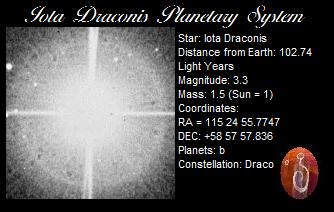
Iota Draconis Planetary System
The proper name for Iota Draconis is derived from the Arabic "Al Dhiba" or "Al Dhih" for Male Hyena, from which comes Eldsich or, more more commonly by the end of the 19th Century, Ed Asich. And on January 8, 2002, astronomers announced the accidental discovery of a giant planet around this star
MAPPING TECHNIQUE
VISUAL EXERCISE : Two Person Exercise.
DESTINATION : Your Choice
STEP ONE
Traveller : Get comfortable and relax.
STEP TWO
Traveller : Charge your physical body with light energy.
STEP THREE
Traveller : See your visual body standing in front of your physical body and prepare your visual body for interstellar travel with a Interstellar Protection Shield.
STEP FOUR
Traveller : See your visual body filling with light energy.
STEP FIVE
Traveller : Focus your mind on teleporting your visual body to the Your Destination.
STEP SIX
Traveller : Then see your visual body teleporting to the Your Destination.
STEP SEVEN
Traveller : When you arrive in the destination Look around can you see any planets or moons in the System? If not use the Interstellar Planetary Detection Rapid and see if you can detect any planets or moons in that system.
STEP EIGHT
Traveller : If you can see or detect a planet or moon using Telekinesis or Teleportation move towards the planetary body.
STEP NINE
Traveller : When you arrive at the outer atmosphere of the planet or moon stop and ask your spiritual guide to tell you the name of this planet or moon.
Traveller : Tell the mapper the name of the planet or moon. Also tell the mapper all you can about the planet or moon.
STEP TEN
Then us the Core Comparison Crystal Technique to perform a core reading on this planet or moon and give the mapper your reading on this planet or moon
STEP ELEVEN
Traveller : Then levitate or Teleport your visual body to the surface of the planet or moon.
STEP TWELVE
Mapper : When the traveller arrives on the surface ask the following questions.
Is there any plant life or water on the surface of the planet or moon that you can see? Is there an atmosphere around this planet or moon? Is the atmosphere an match with earths atmosphere?
Mapper : Write down the answers to these questions.
PLANETARY DATA FILE 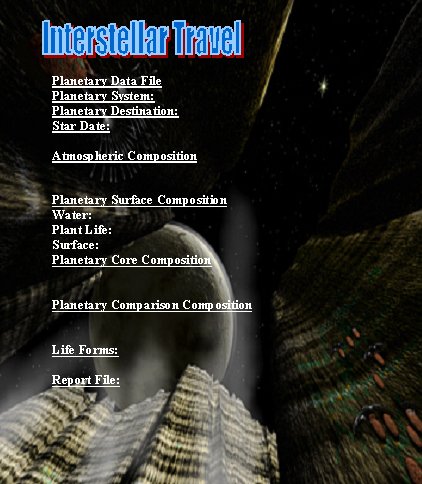
STEP THIRTEEN
Traveller : When you are finished on the surface teleport your visual body to the nearest planetary body that you can see in that Galaxy.
STEP FOURTEEN
Traveller and Mapper : Follow steps nine through to twelve again till you have mapped out the whole Galaxy.
STEP FIFTEEN
Traveller : When you have finished mapping the Galaxy teleport your visual body back to your physical body back on earth.
REMEMBER
When you are travelling if you come across an alien race that you think may be friendly feel free to make contact with that alien race.
IMPORTANT
When you are contacting alien races always be ready to teleport if there is trouble.
MAPPER
Make a note of any planets or moons with an atmospheric match with earths. That way you both know which planets can support human life forms.
MAPPER & TRAVELLER
To check that your mapping of that Galaxy is correct by changing roles and do this exercise again.
Also remember to check for life force energy around the planets or moons that you visit on your journeys. Because if you can feel life force energy that means the planet or moons is a real planet or moon.