← The Wingmakers Ways · Astronomy & Exoplanets
Archived page · Checkable
Libra
Libra.html · captured from wingmakers.co.nz
Libra 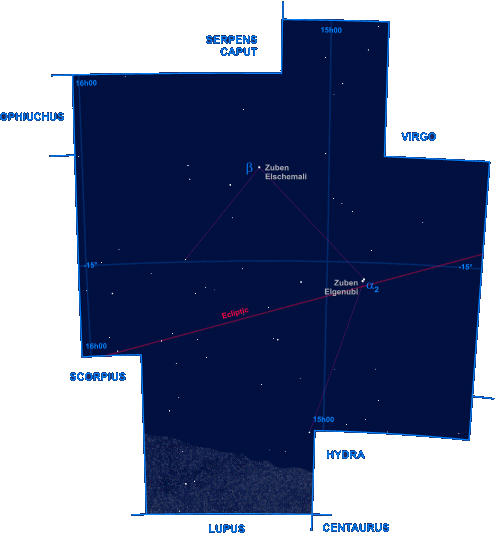
The Balance, The Scales
Libra, the Balance is a member of zodiac next to Virgo. Three stars with the third magnitudes characterize the constellation. It's fairly dim, and was a part of Scorpius in antiquity. About over two thousand years ago, the sun passed through Libra at the autumnal equinox when day and night were of equal length, and the day would begin to shorten from that day on. It's considered that the constellation of Libra was invented to symbolize the equinox that divides day and night equally. Now, the autumnal equinox has moved to Virgo because of the precession of Earth.
Third Cosmic Ray : Linking Through Saturn
"The mind or intellect motivates these folk. They can give form to ideas and transform them into concepts. The first two rays deal with the intangible, but a third ray subject will resolve such abstractions into tangible realities. Practical in all things, with a good aesthetic appreciation of quality, they consider intelligence a virtue and manifestation a necessity. They are good at discriminating and formulating their own opinions, hold things connected with the senses in high regard, and have keen perceptions. Happiness is important to these subjects, whether through the ordinary pursuits of pleasure or education and knowledge. They like doing things with others, enjoy discussion and deliberation, sport, games and art. Because of a deep urge for outside stimulation, such folk need the company of others similar to themselves and, as they are very tactful and diplomatic, they make good advisers and organisers.
Me 2-1, PNG 342.1+27.5, PK 342+27.1, He 2-126, ARO 88, ESO 514-12
Merrill 2-1 is an obscure planetary nebula in Libra -- a constellation with remarkably few deep sky objects of note. This planetary is bright, but very, very small. An experienced observer should be able to pick it out as a sort of "funny looking star", but only at 150x or more. So don't be shy about using high magnification.
One thing that really helps in finding this tiny planetary is that it lies about an arc minute to the east of a 9.8 magnitude star, SAO 183407. This is a rather red (K2) star with a B-V color of 1.2. The nearby star makes finding this one easy and provides an excellent opportunity to experience the subtle difference in appearance between a tiny planetary nebula and a star. Even if the subtle blue-green hue of a planetary nebula is not readily apparent, your eye will still tell you that something is "funny" about the planetary nebula. This is a good instinct to hone because it can help you quickly pick out a tiny planetary in a crowded star field.
NGC5897 is a globular cluster about 5 degrees northeast of sigma Librae, a southern star of warped square of Libra. The cluster has an apparent size of 7 arc minutes; can be classed as one of fairly large globular clusters. But unfortunately it's considerably dimmed and has no Messier's number. As this picture shoes you the cluster has very low concentration level. Compact scopes can easily resolve central member stars. And you will be fascinated with the view under high-powered telescopes with about 8-inch aperture or so. Although NGC5897 is not so celebrated, unexpectedly really worth seeing.
NGC 5792 Pretty bright, pretty large, elongated 2 X 1 in PA 90, much brighter in the middle at 150X. There is a 9th mag star on the western tip of this galaxy. The bright middle shows an obvious nuclear bulge with a very suddenly brighter nucleus. I believe this bright central section is what led Herschel to call this object "round".
THE STAR
At faint sixth magnitude (6.45, almost 7th), HD 134987 or 23 Librae as it is known is for most of us just under naked-eye visibility, though easily seen in binoculars just to the south of the classic figure of Libra. This class G solar type star (G4 V, possibly G5 V) is just a bit cooler (5700 Kelvin) than the Sun. At a distance of 84 light years, the star is, however, half again as luminous as the Sun (a factor of 1.49). The combination of luminosity and temperature shows that 23 Librae has a mass very nearly that of the Sun (1.05 solar), but is older (age brightening solar-type stars), with an age close to 9 billion years, near the time at which hydrogen fusion inside will shut down and the star will begin to die and become a giant. Like so many stars that have planets, 23 Librae is metal-rich, its iron content 70 percent greater than that seen in the Sun. 23 Librae is also a bit unusual in having a fairly high velocity of 77 kilometers per second relative to the Sun, over 3 times that of most normal stars.
THE PLANET
The circle shows the location of the class G dwarf (G4 V) 23 Librae (in the constellation Libra). The planet is in roughly the middle of the mass range of those planets so far discovered, with a minimum mass 1.58 times that of Jupiter. Unlike many of the first planets found, it is also relatively far from its parent star, averaging 0.81 Astronomical Units (122 million kilometers, 12 percent farther than Venus is from the Sun). Like so many extraterrestrial planets, the orbit is relatively eccentric, the planet approaching as closely as 0.62 Astronomical Units, and receding to as far as 1.00 AU, as far as the Earth is from the Sun, the whole course taking 260 days.
MAPPING TECHNIQUE
VISUAL EXERCISE : Two Person Exercise.
DESTINATION : Your Choice
STEP ONE
Traveller : Get comfortable and relax.
STEP TWO
Traveller : Charge your physical body with light energy.
STEP THREE
Traveller : See your visual body standing in front of your physical body and prepare your visual body for interstellar travel with a Interstellar Protection Shield.
STEP FOUR
Traveller : See your visual body filling with light energy.
STEP FIVE
Traveller : Focus your mind on teleporting your visual body to the Your Destination.
STEP SIX
Traveller : Then see your visual body teleporting to the Your Destination.
STEP SEVEN
Traveller : When you arrive in the destination Look around can you see any planets or moons in the System? If not use the Interstellar Planetary Detection Rapid and see if you can detect any planets or moons in that system.
STEP EIGHT
Traveller : If you can see or detect a planet or moon using Telekinesis or Teleportation move towards the planetary body.
STEP NINE
Traveller : When you arrive at the outer atmosphere of the planet or moon stop and ask your spiritual guide to tell you the name of this planet or moon.
Traveller : Tell the mapper the name of the planet or moon. Also tell the mapper all you can about the planet or moon.
STEP TEN
Then us the Core Comparison Crystal Technique to perform a core reading on this planet or moon and give the mapper your reading on this planet or moon
STEP ELEVEN
Traveller : Then levitate or Teleport your visual body to the surface of the planet or moon.
STEP TWELVE
Mapper : When the traveller arrives on the surface ask the following questions.
Is there any plant life or water on the surface of the planet or moon that you can see? Is there an atmosphere around this planet or moon? Is the atmosphere an match with earths atmosphere?
Mapper : Write down the answers to these questions.
PLANETARY DATA FILE 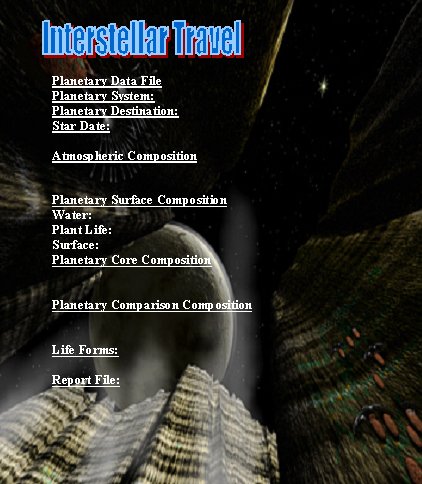
STEP THIRTEEN
Traveller : When you are finished on the surface teleport your visual body to the nearest planetary body that you can see in that Galaxy.
STEP FOURTEEN
Traveller and Mapper : Follow steps nine through to twelve again till you have mapped out the whole Galaxy.
STEP FIFTEEN
Traveller : When you have finished mapping the Galaxy teleport your visual body back to your physical body back on earth.
REMEMBER
When you are travelling if you come across an alien race that you think may be friendly feel free to make contact with that alien race.
IMPORTANT
When you are contacting alien races always be ready to teleport if there is trouble.
MAPPER
Make a note of any planets or moons with an atmospheric match with earths. That way you both know which planets can support human life forms.
MAPPER & TRAVELLER
To check that your mapping of that Galaxy is correct by changing roles and do this exercise again. Also remember to check for life force energy around the planets or moons that you visit on your journeys. Because if you can feel life force energy that means the planet or moons is a real planet or moon.