← The Wingmakers Ways · not in the site's own index
Archived page · Asserted
Saturn
The_planet_Saturn.html · captured from wingmakers.co.nz
Saturn
Saturn is the sixth planet from the Sun and is the second largest in the solar system with an equatorial diameter of 119,300 kilometers (74,130 miles).
Navigation
Planet Vulcan : New
Solar System
Sun
Mercury
Venus
Earth
Mobius
Mars
Jupiter
Saturn
Uranus
Neptune
Pluto
2004 DW
Quaoar
Sedna
2002 AW197
2003 UB313
Comets
Meteorites
Asteroids
Planetary Moons
The Moon
Europa
IO
Ganymede
Titan
Enceladus : New
Tethys
Dione : New
Extra Solar Planets
Lensing Galaxy - Einstein Cross
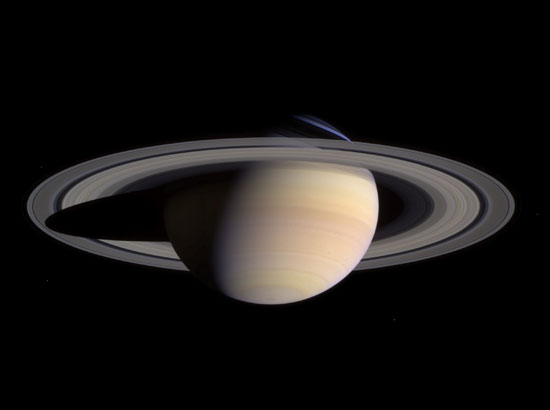 Saturn is the sixth planet from the Sun and is the second largest in the solar system with an equatorial diameter of 119,300 kilometers (74,130 miles). Much of what is known about the planet is due to the Voyager explorations in 1980-81. Saturn is visibly flattened at the poles, a result of the very fast rotation of the planet on its axis. Its day is 10 hours, 39 minutes long, and it takes 29.5 Earth years to revolve about the Sun. The atmosphere is primarily composed of hydrogen with small amounts of helium and methane. Saturn is the only planet less dense than water (about 30 percent less). In the unlikely event that a large enough ocean could be found, Saturn would float in it. Saturn's hazy yellow hue is marked by broad atmospheric banding similar to, but fainter than, that found on Jupiter.
Jovian Planet
Planetary Statistics
Star System : Meridian Solar System
Discovery Status : Imaged
Mass : 0.298 Jupiters
Average Distance : 9.554 AUs
Period : 10759 Days
Orbital Eccentricity : 0.056
Argument of Perihelion (omega) : 92.43194°
Detection Method : Naked Eye
Year Discovered : Prehistory
Planetary Orbits
Vulcan, Mercury, Venus, Earth, Mobius, Mars, Jupiter
Saturn, Uranus, Neptune, Pluto, 2004 DW, Quaoar, Sedna, 2002 AW197.
Saturn's Interior
The Giant planets do not have the same layered structure that the terrestrial planets do. Their evolution was quite different than that of the terrestrial planets, and they have less solid material.
Saturn's interior composition is primarily that of simple molecules such as hydrogen and helium, which are liquids under the high pressure environments found in the interiors of the outer planets, and not solids.
Motions in the interior of Saturn contribute in a very special way to the development of the powerful and extensive magnetosphere of Saturn. Heat generated within Saturn contributes to the unusual motions of the atmosphere.
Storm on Saturn 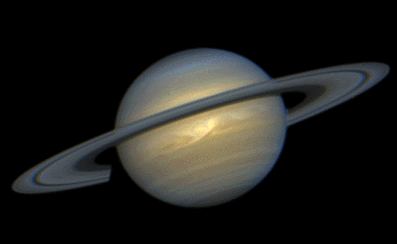
This image, taken by the Hubble Space Telescope, shows a rare storm that appears as a white arrowhead-shaped feature near the planet's equator. The storm is generated by an upwelling of warmer air, similar to a terrestrial thunderhead. The east-west extent of this storm is equal to the diameter of the Earth (about 12,700 kilometers or 7,900 miles). The Hubble images are sharp enough to reveal that Saturn's prevailing winds shape a dark "wedge" that eats into the western (left) side of the bright central cloud. The planet's strongest eastward winds, clocked at 1,600 kilometers (1,000 miles) per hour based on Voyager spacecraft images taken in 1980-81, are at the latitude of the wedge.
To the north of this arrowhead-shaped feature, the winds decrease so that the storm center is moving eastward relative to the local flow. The clouds expanding north of the storm are swept westward by the winds at higher latitudes. The strong winds near the latitude of the dark wedge blow over the northern part of the storm, creating a secondary disturbance that generates the faint white clouds to the east (right) of the storm center. The storm's white clouds are ammonia ice crystals that form when an upward flow of warmer gases shoves its way through Saturn's frigid cloud tops.
Interstellar Card
Saturn's Satellites and Ring Structure
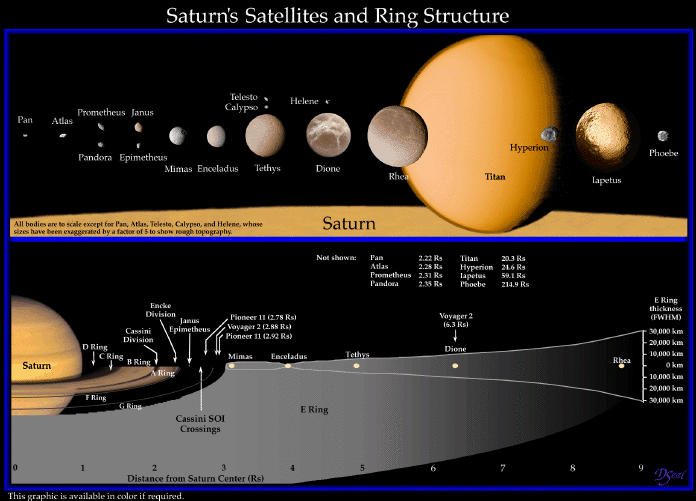 This image shows Saturn's satellites approximately to scale as well as Saturn's ring structure.
Saturn's Rings
Cassini Determines the Density of Saturn's Rings
May 24, 2005 - NASA's Cassini spacecraft has obtained the most detailed images ever taken of Saturn's rings, including new details about its B ring, of which little was known previously. Cassini went behind Saturn's rings on May 3, 2005, and this gave scientists on Earth a chance to probe the ringst. Cassini sent a series of radio signals as it traveled behind the rings; the weaker the signal, the more dense the material in the rings. This allowed scientists to determine the thickness and size of particles at each point in the rings
Saturn Rings Have Own Atmosphere
Saturn's vast and majestic ring system has its own atmosphere - separate from that of the planet itself, according to data from the Cassini spacecraft. And Saturn is rotating seven minutes more slowly than when probes measured its spin in the 70s and 80s - an observation experts cannot yet explain. Cassini-Huygens mission scientists are celebrating the spacecraft's first year in orbit around the ringed planet.
Saturn's Rings
Name
Radius
inner
Radius
outer
width
approx.
position
approx.
mass (kg)
D-Ring
67,000
74,500
7,500
(ring)
Guerin Division
(n/a)
(n/a)
(n/a)
(n/a)
(n/a)
C-Ring
74,500
92,000
17,500
(ring)
1.1e18
Maxwell Division
87,500
88,000
500
(divide)
B-Ring
92,000
117,500
25,500
(ring)
2.8e19
Cassini Division
115,800
120,600
4,800
(divide)
Huygens Gap
117,680
(n/a)
285-440
(subdiv)
A-Ring
122,200
136,800
14,600
(ring)
6.2e18
Encke Minima
126,430
129,940
3,500
29%-53%
Encke Division
133,410
133,740
Keeler Gap
136,510
136,550
F-Ring
140,210
30-500
(ring)
G-Ring
165,800
173,800
8,000
(ring)
1e7?
E-Ring
180,000
480,000
300,000
(ring)
Saturn Moons
Moon : Titan
Discovered in 1655 by the Dutch astronomer Christiaan Huygens, Titan is the biggest of the 31 known moons orbiting Saturn. It is a cold world enclosed by a thick, hazy atmosphere impenetrable by telescopes and cameras.
With an equatorial radius of 2,575 kilometers (1,600 miles), Titan is the second largest moon in our solar system. It's bigger than our own moon and even the planet Mercury. Only Jupiter's moon Ganymede is larger than Titan, with a diameter barely 112 kilometers (62 miles) greater.
The temperature at Titan's surface is about minus 178°C (minus 289°F).
Titan orbits Saturn at a distance of about 1.2 million kilometers (745,000 miles), taking almost 16 days to complete a full orbit - 15.94 days to be exact.
Titan is of great interest to scientists because it is the only moon in the solar system known to have clouds and a mysterious, thick, planet-like atmosphere. In 1980, NASA's Voyager 1 spacecraft tried to take close up images of the natural features of Titan's landscape but was unable to penetrate the thick clouds. Instead, the images showed only slight color and brightness variations in the atmosphere. Titan's atmospheric pressure is about 60 percent greater than Earth's - roughly the same pressure found at the bottom of a swimming pool. 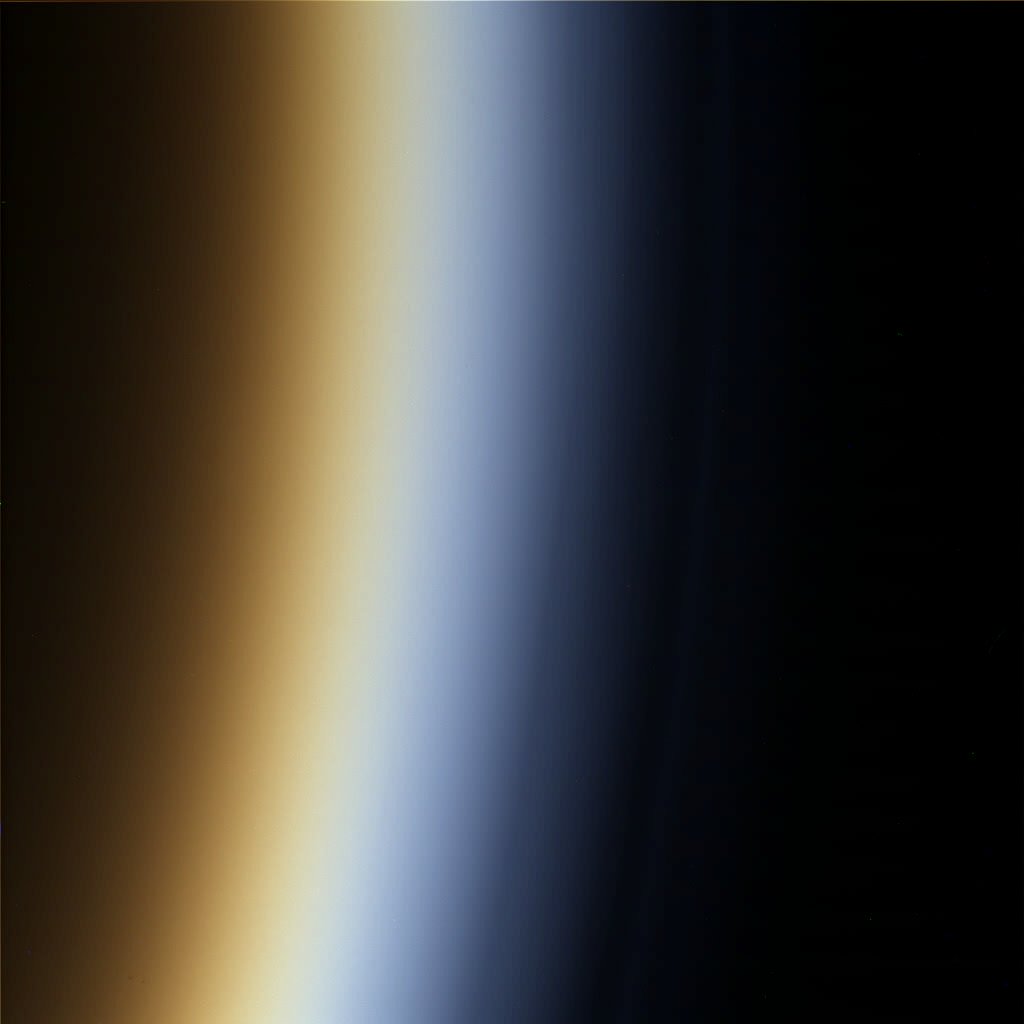
Titan's thick haze layer is shown in this enhanced Voyager 1 image taken Nov. 12, 1980 at a distance of 435,000 kilometers (270,000 miles). Voyager images of Saturn's largest moon show Titan completely enveloped by haze that merges with a darker "hood" or cloud layer over the north pole. Such a mantle is not present at the south pole. At Voyager's closest approach to Titan on Nov. 11, 1980, spacecraft instruments found that the moon has a substantial atmosphere, far denser than that of Mars and possibly denser than Earth's.
Tethys [TEE-this] was discovered by Giovanni Cassini in 1684. It is an icy body similar in nature to Dione and Rhea. The density of Tethys is 1.21 gm/cm3, indicating that it is composed almost entirely of water-ice. Tethys's icy surface is heavily cratered and contains cracks caused by faults in the ice. There is one enormous trench on Tethys about 65 kilometers (40 miles) wide and extending from above the center to the extreme left. It covers three-fourths of Tethys' circumference. The fissure is about the size scientists would predict if Tethys were once fluid and its crust hardened before the interior. The canyon has been named Ithaca Chasma. A vast expanse of relative young plains also exists on Tethys. Tethys' surface temperature is -187° C (-305° F).
Enceladus [en-SELL-ah-dus] is one of the innermost moons of Saturn. It is quite similar in size to Mimas but has a smoother, brighter surface. Enceladus reflects almost 100 percent of the sunlight that strikes it. Unlike Mimas, Enceladus displays at least five different types of terrain. Parts of Enceladus shows craters no larger than 35 km in diameter. Other areas show regions with no craters indicating major resurfacing events in the geologically recent past. There are fissures, plains, corrugated terrain and other crustal deformations. All of this indicates that the interior of the moon may be liquid today, even though it should have frozen aeons ago. It is postulated that Enceladus is heated by a tidal mechanism similar to Jupiter's moon Io. It is perturbed in its orbit by Saturn's gravitational field and by the large neighboring satellites Tethys and Dione.
Because Enceladus reflects so much sunlight, the surface temperature is only -201° C (-330° F).
Cassini Finds an Atmosphere on Saturn's Moon Enceladus
The Cassini spacecraft's two flybys of the icy moon Enceladus have revealed that the moon has a significant atmosphere. Scientists using Cassini's magnetometer instrument for their studies, say the source may be due to volcanism, geysers, or gases escaping from the surface or its interior.
When the Cassini had its first encounter with Enceladus on 17 February 2005 at an altitude of 1,167 kilometres (725 miles), the magnetometer instrument saw a striking signature in the magnetic field. On 9 March 2005 Cassini approached to within 500 km (310 miles) of Enceladus' surface and obtained additional evidence.
The observations showed a bending of the magnetic field with the magnetospheric plasma being slowed and deflected by the moon. In addition magnetic field oscillations were observed. These are caused when electrically charged (or ionised) molecules interact with the magnetic field by spiralling around the field line. This interaction creates characteristic oscillations in the magnetic field at frequencies that can be used to identify the molecule. The observations from the Enceladus flybys are believed to be due to ionised water vapour.
"It was a complete surprise to find these signals at Enceladus. These new results from Cassini may be the first evidence of gases originating either from the surface or possibly from the interior of Enceladus," said Professor Michele Dougherty, of Imperial College, London and Principal Investigator for the Cassini magnetometer. In 1981 the Voyager spacecraft flew by Enceladus at a distance of 90,000 kilometres (56,000 miles) without detecting an atmosphere. It is possible that detection was beyond Voyager's capabilities or something may have changed since that flyby.
This is the first time since Cassini arrived in orbit around Saturn last summer that an atmosphere has been detected around a moon of Saturn, other than its largest moon, Titan. Enceladus is a relatively small moon. The amount of gravity it exerts is not enough to hold an atmosphere very long. Therefore at Enceladus, a strong continuous source is required to maintain the atmosphere.
The need for such a strong source leads scientists to consider eruptions from the surface, such as volcanoes and geysers. If such eruptions are present, Enceladus would join two other such active moons, Io at Jupiter and Triton at Neptune. "Enceladus could be Saturn's more benign counterpart to Jupiter's dramatic Io", said Professor Fritz Neubauer, co-investigator for the Cassini magnetometer from the University of Cologne, Germany.
Since the Voyager flyby scientists have suspected that this moon is geologically active and is the source of Saturn's icy E ring. Enceladus is the most reflective object in the solar system, reflecting about 90 percent of the sunlight that hits it. If Enceladus does have ice volcanoes, the high reflectivity of the moon's surface might result from continuous deposition of icy particles originating from the volcanoes.
Enceladus' diameter is about 500 kilometres or 310 miles (the equivalent distance between London and Penzance). Yet despite its small size Enceladus exhibits one of the most interesting surfaces of all the icy satellites.
This artist concept shows the detection of an atmosphere on Saturn's icy moon Enceladus. The Cassini magnetometer instrument is designed to measure the magnitude and direction of the magnetic fields of Saturn and its moons. During Cassini's two close flybys of Enceladus - Feb. 17 and March 9 - the instrument detected a bending of the magnetic field around Enceladus.
The graphic shows the magnetic field observed by Cassini along its trajectory plotted in a vector form. Even though the spacecraft altitude was almost 500 kilometres (310 miles) at closest approach and the flyby was upstream of the moon (where the interaction is expected to be weaker) Cassini's magnetometer observed bending of the magnetic field consistent with its draping around a conducting object, which indicates that the Saturnian plasma is being diverted away from an extended atmosphere.
Credit: NASA/JPL
Moon : Rhea
Rhea [REE-a] is the largest airless satellite of Saturn. It was discovered in 1672 by Giovanni Cassini. Rhea is an icy body with a density of 1.33 gm/cm3. The low density indicates that it is composed of a rocky core taking up less than one-third of the moon's mass, with the rest composed of water-ice. Rhea is somewhat similar to Dione. They both have similar composition, albedo features, varied terrain and synchronous rotations. The temperature on Rhea is -174¡C with illumation from the Sun and between -200°C and -220°C (-328°F and -364°F) in the shade.
Rhea is heavily cratered with bright whispy markings. Its surface can be divided into two geologically different areas based on crater density. The first area contains craters which are larger than 40 kilometers (25 miles) in diameter. The second area, in parts of the polar and equatorial regions, has craters under 40 kilometers (25 miles) in diameter. This suggests that a major resurfacing event occurred some time during its formation.
Moon : Dione 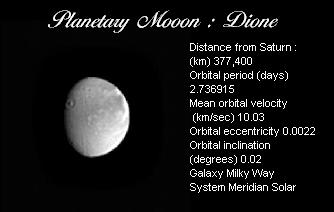
Dione was discovered in 1684 by Giovanni Cassini. It is an icy body similar to Tethys and Rhea. Its density is 1.43 gm/cm3, which makes it the densest moon of Saturn other than Titan. Dione is probably composed of a rocky core making up one-third of the moon's mass, with the rest water-ice. Its ice coverage is less than that of Tethys and Rhea.
Dione's icy surface includes heavily cratered terrain, moderately cratered plains, lightly cratered plains, and wispy material. The heavily cratered terrain has numerous craters greater than 100 kilometers in diameter. The plains area tends to have craters less than 30 kilometers in diameter. Some of the plains are heavily cratered while others are not. Much of the heavily cratered terrain is located on the trailing hemisphere, with the less cratered plains area existing on the leading hemisphere. This is opposite from what some scientists expected. Shoemaker and Wolfe proposed a cratering model for a tidally locked satellite with the highest cratering rates on the leading hemisphere and the lowest on the trailing hemisphere. This suggests that during the period of heavy bombardment, Dione was tidally locked to Saturn in the opposite orientation. Because Dione is relatively small, an impact causing a 35 kilometer (21 mile) crater could have spun the satellite. Since there are many craters larger than 35 kilometers (21 miles), Dione could have been repeatedly spun.
Titans Orbit & Other Moons Of Saturn
Saturn's Satellites & Data
Satellite
Distance
(000Km)
Radius
(Km)
Mass (Kg)
Discoverer
Date
Pan
134 Km
10Km
?
Showalter
1990
Atlas
138Km
14Km
?
Terrile
1980
Prometheus
139Km
46Km
2.70e17
Collins
1980
Pandora
142Km
46
2.20e17
Collins
1980
Epimetheus
151
57
5.60e17
Walker
1980
Janus
151
89
2.01e18
Dollfus
1966
Mimas
186
196
3.80e19
Herschel
1789
Enceladus
238
260
8.40e19
Herschel
1789
Tethys
295
530
7.55e20
Cassini
1684
Telesto
295
15
?
Reitsema
1980
Calypso
295
13
?
Pascu
1980
Dione
377
560
1.05e21
Cassini
1684
Helene
377
16
?
Laques
1980
Rhea
527
765
2.49e21
Cassini
1672
Titan
1222
2575
1.35e23
Huygens
1655
Hyperion
1481
143
1.77e19
Bond
1848
Iapetus
3561
730
1.88e21
Cassini
1671
Phoebe
12952
110
4.00e18
Pickering
1898
Copyright © Wingmakers.co.nz - All rights reserved.