← The Wingmakers Ways · Astronomy & Exoplanets
Archived page · Checkable
Lupus
Lupus.html · captured from wingmakers.co.nz
Lupus 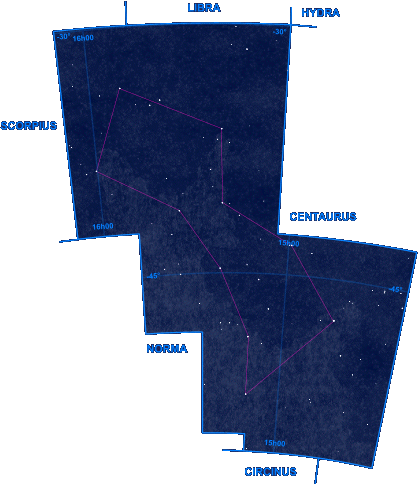
The Wolf
The constellation of Lupus, the Wolf, is found at the south of typical constellation in summer, Scorpius. Lupus has fairly lower altitude of meridian; it's not noticeable very well at Japan. But actually, the constellation lies in the Milky Way it is packed with many bright stars.
Lupus is narrowly squeezed between Centaurus to the west, Scorpius to the northeast. The constellation itself is fairly difficult to separate from Centaurus; in fact, Lupus had been the part of Centaurus in antiquity. It's considered that almost all of bright stars included in Lupus are belonged to the "Scorpius-Centaurus moving cluster", and they're traveling toward west all in one body. It's very young stellar-group less than five millions years old.
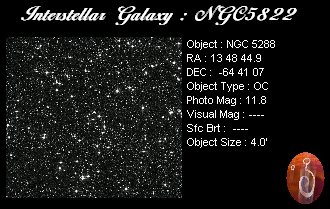
NGC5822 (in Lupus, at the top) and Caldwell 88 (NGC5823, at the bottom in Circinus). The Lupus cluster is very large (40'), not condensed, and rich, containing about 150 stars from mags. 9-12.
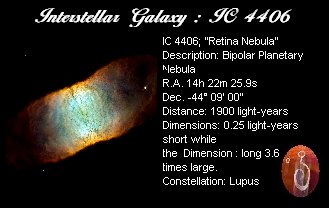
A dying star, IC 4406, dubbed the "Retina Nebula" is revealed in this Hubble Heritage image.
Like many other so-called planetary nebulae, IC 4406 exhibits a high degree of symmetry; the left and right halves of the Hubble image are nearly mirror images of the other. If we could fly around IC 4406 in a starship, we would see that the gas and dust form a vast donut of material streaming outward from the dying star. From Earth, we are viewing the donut from the side. This side view allows us to see the intricate tendrils of dust that have been compared to the eye's retina. In other planetary nebulae, like the Ring Nebula (NGC 6720), we view the donut from the top.
The donut of material confines the intense radiation coming from the remnant of the dying star. Gas on the inside of the donut is ionized by light from the central star and glows. Light from oxygen atoms is rendered blue in this image; hydrogen is shown as green, and nitrogen as red. The range of color in the final image shows the differences in concentration of these three gases in the nebula.
One of the most interesting features of IC 4406 is the irregular lattice of dark lanes that criss-cross the center of the nebula. These lanes are about 160 astronomical units wide (1 astronomical unit is the distance between the Earth and Sun). They are located right at the boundary between the hot glowing gas that produces the visual light imaged here and the neutral gas seen with radio telescopes. We see the lanes in silhouette because they have a density of dust and gas that is a thousand times higher than the rest of the nebula. The dust lanes are like a rather open mesh veil that has been wrapped around the bright donut.
The fate of these dense knots of material is unknown. Will they survive the nebula's expansion and become dark denizens of the space between the stars or simply dissipate?
Deep Sky Objects in Lupus:
The constellation has no outstanding deep sky objects, with the following clusters being perhaps the best examples.
NGC 5822 is a very large open cluster of about a hundred stars. The cluster is about 6000 light years away, and is located 3º SW of zeta Lupi.
NGC 5986 is a globular cluster about 45,000 light years distant. It is 2.5º WNW of eta Lupi.
MAPPING TECHNIQUE
VISUAL EXERCISE : Two Person Exercise.
DESTINATION : Your Choice
STEP ONE
Traveller : Get comfortable and relax.
STEP TWO
Traveller : Charge your physical body with light energy.
STEP THREE
Traveller : See your visual body standing in front of your physical body and prepare your visual body for interstellar travel with a Interstellar Protection Shield.
STEP FOUR
Traveller : See your visual body filling with light energy.
STEP FIVE
Traveller : Focus your mind on teleporting your visual body to the Your Destination.
STEP SIX
Traveller : Then see your visual body teleporting to the Your Destination.
STEP SEVEN
Traveller : When you arrive in the destination Look around can you see any planets or moons in the System? If not use the Interstellar Planetary Detection Rapid and see if you can detect any planets or moons in that system.
STEP EIGHT
Traveller : If you can see or detect a planet or moon using Telekinesis or Teleportation move towards the planetary body.
STEP NINE
Traveller : When you arrive at the outer atmosphere of the planet or moon stop and ask your spiritual guide to tell you the name of this planet or moon.
Traveller : Tell the mapper the name of the planet or moon. Also tell the mapper all you can about the planet or moon.
STEP TEN
Then us the Core Comparison Crystal Technique to perform a core reading on this planet or moon and give the mapper your reading on this planet or moon
STEP ELEVEN
Traveller : Then levitate or Teleport your visual body to the surface of the planet or moon.
STEP TWELVE
Mapper : When the traveller arrives on the surface ask the following questions.
Is there any plant life or water on the surface of the planet or moon that you can see? Is there an atmosphere around this planet or moon? Is the atmosphere an match with earths atmosphere?
Mapper : Write down the answers to these questions.
PLANETARY DATA FILE 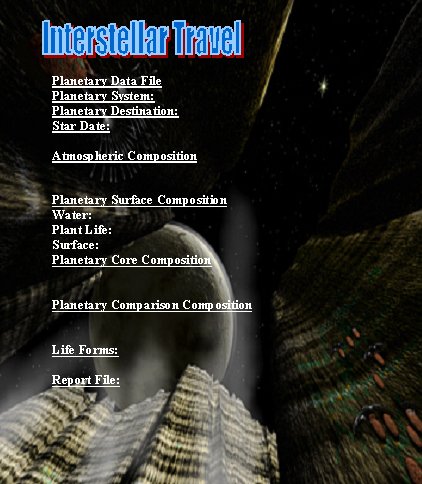
STEP THIRTEEN
Traveller : When you are finished on the surface teleport your visual body to the nearest planetary body that you can see in that Galaxy.
STEP FOURTEEN
Traveller and Mapper : Follow steps nine through to twelve again till you have mapped out the whole Galaxy.
STEP FIFTEEN
Traveller : When you have finished mapping the Galaxy teleport your visual body back to your physical body back on earth.
REMEMBER
When you are travelling if you come across an alien race that you think may be friendly feel free to make contact with that alien race.
IMPORTANT
When you are contacting alien races always be ready to teleport if there is trouble.
MAPPER
Make a note of any planets or moons with an atmospheric match with earths. That way you both know which planets can support human life forms.
MAPPER & TRAVELLER
To check that your mapping of that Galaxy is correct by changing roles and do this exercise again. Also remember to check for life force energy around the planets or moons that you visit on your journeys. Because if you can feel life force energy that means the planet or moons is a real planet or moon.