← The Wingmakers Ways · Astronomy & Exoplanets
Archived page · Checkable
Pictor
Pictor.html · captured from wingmakers.co.nz
Pictor 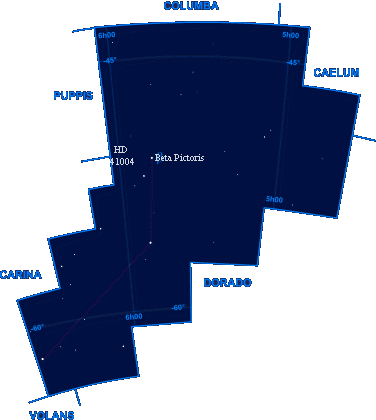
The Painter or The Painter�s Easel
A small and faint constellation lying between the brilliant star Canopus and the Small Magellanic Cloud. Though it contains few bright stars or other objects, it is a relatively strong radio source.
Deep Sky Objects:
Kapteyn's Star is a fairly faint (8.8) red dwarf known for its large proper motion, which is second only to Barnard's Star (in Ophiuchus).
The star's discovery was made nearly a century ago, in 1897, by Professor Jacobus Cornelius Kapteyn (1851-1922) of the University of Groningen in Holland.
Kapteyn's lasting discovery was that all stars which have a measurable proper motion are part of one of two streams which move in different directions at different speeds.
Kapteyn's Star has a radial velocity of 242 km/s and a distance of 12.73 light years (=parallax of 0.256" or 3.91 pc). The star has a luminosity of only 0.004 suns (i.e. an absolute magnitude of 10.85). It is found roughly 8.5 degrees NW of beta Pictoris (Burnham, p. 1463, has a finder's chart).
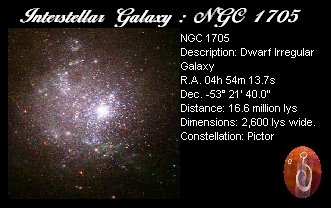
The central region of the small galaxy NGC 1705 blazes with the light of thousands of young and old stars in this image, taken by NASA's Hubble Space Telescope.
At 17 million light-years away, the individual stars of the dwarf irregular galaxy NGC 1705 are out of range of all but the sharp eye of Hubble. NGC 1705 is an ideal laboratory to conduct investigations on star formation history. Young, blue, hot stars are strongly concentrated toward the galaxy's center, while older, red, cooler stars are more spread out. This galaxy has been forming new stars throughout its lifetime, but a burst of star-formation activity occurred as recently as 26 to 31 million years ago. This "starburst" is responsible for many of the young stars on the outskirts of the galaxy's core, as well as the central giant star cluster.
NGC 1705 is classified as a dwarf irregular because it is small and lacks any regular structure. Many astronomers now believe that dwarf galaxies, like NGC 1705, were the first systems to collapse and start forming stars in the early universe. They represent the building blocks from which more massive objects (spiral and elliptical galaxies) were later formed through mergers and accretion. Nearby small galaxies are thought to be the leftovers of the galaxy-formation process.
Dwarf irregulars are similar in many ways to very young galaxies, but they are much nearer and easier to study. These galaxies seem to have consumed only a tiny percentage of their reservoir of gas. Their stars have a much lower fraction of heavy elements than does the Sun. These are all indications that only a few generations of stars have formed there over time. Current star formation is taking place at a fairly high rate in starburst episodes. All these characteristics make dwarf irregular galaxies the ideal local analogues to young galaxies from the early universe. Understanding their evolution is extremely useful and sheds light on the many processes related to galaxy formation and evolution.
Dwarf irregulars play a key role in astronomers' attempts to unravel the history of galaxies in the early universe. These galaxies are probably best described as fairly old stellar systems whose chemical and physical properties can be ascribed to a process of slow evolution. The Hubble observations of the stars in NGC 1705 and other close irregulars have demonstrated that these galaxies are several billion years old. NGC 1705 could be as old as 13.5 billion years.
Planetary Destinations In Pictor
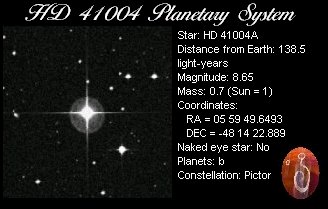
Beta Pictoris Planetary System
Beta Pictoris b is almost certainly a world of wonders, assuming it exists at all. Currently, we don't know much about it. What we do know is that beta Pictoris is surrounded by a disk of dust and gas similar to the disk which our own solar system formed from. In many ways, beta Pictoris may be a solar system in the making.
MAPPING TECHNIQUE
VISUAL EXERCISE : Two Person Exercise.
DESTINATION : Your Choice
STEP ONE
Traveller : Get comfortable and relax.
STEP TWO
Traveller : Charge your physical body with light energy.
STEP THREE
Traveller : See your visual body standing in front of your physical body and prepare your visual body for interstellar travel with a Interstellar Protection Shield.
STEP FOUR
Traveller : See your visual body filling with light energy.
STEP FIVE
Traveller : Focus your mind on teleporting your visual body to the Your Destination.
STEP SIX
Traveller : Then see your visual body teleporting to the Your Destination.
STEP SEVEN
Traveller : When you arrive in the destination Look around can you see any planets or moons in the System? If not use the Interstellar Planetary Detection Rapid and see if you can detect any planets or moons in that system.
STEP EIGHT
Traveller : If you can see or detect a planet or moon using Telekinesis or Teleportation move towards the planetary body.
STEP NINE
Traveller : When you arrive at the outer atmosphere of the planet or moon stop and ask your spiritual guide to tell you the name of this planet or moon.
Traveller : Tell the mapper the name of the planet or moon. Also tell the mapper all you can about the planet or moon.
STEP TEN
Then us the Core Comparison Crystal Technique to perform a core reading on this planet or moon and give the mapper your reading on this planet or moon
STEP ELEVEN
Traveller : Then levitate or Teleport your visual body to the surface of the planet or moon.
STEP TWELVE
Mapper : When the traveller arrives on the surface ask the following questions.
Is there any plant life or water on the surface of the planet or moon that you can see? Is there an atmosphere around this planet or moon? Is the atmosphere an match with earths atmosphere?
Mapper : Write down the answers to these questions.
PLANETARY DATA FILE 
STEP THIRTEEN
Traveller : When you are finished on the surface teleport your visual body to the nearest planetary body that you can see in that Galaxy.
STEP FOURTEEN
Traveller and Mapper : Follow steps nine through to twelve again till you have mapped out the whole Galaxy.
STEP FIFTEEN
Traveller : When you have finished mapping the Galaxy teleport your visual body back to your physical body back on earth.
REMEMBER
When you are travelling if you come across an alien race that you think may be friendly feel free to make contact with that alien race.
IMPORTANT
When you are contacting alien races always be ready to teleport if there is trouble.
MAPPER
Make a note of any planets or moons with an atmospheric match with earths. That way you both know which planets can support human life forms.
MAPPER & TRAVELLER
To check that your mapping of that Galaxy is correct by changing roles and do this exercise again. Also remember to check for life force energy around the planets or moons that you visit on your journeys. Because if you can feel life force energy that means the planet or moons is a real planet or moon.