← The Wingmakers Ways · Astronomy & Exoplanets
Archived page · Checkable
PSR 1257+12
Pulsar_Planetary_System_1257_12.html · captured from wingmakers.co.nz
PSR 1257+12
Pulsar Planetary System 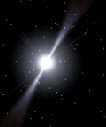
Star Statistics
Distance from Sun: 2630 Light Years
Right Ascension: 13 00 01.00
Declination: +12 40 00.0
Mass: 0.29874213836478 Solar Masses
Age: 800 Million Years
Rotation: 0.00621853193177 Seconds
CONSTELLATION: Virgo
Interstellar Card 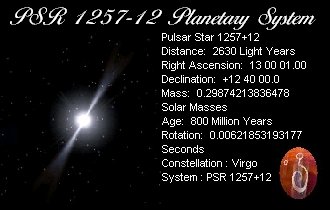
System Components
(Mass in Multiples of Jupiter's Mass)
Position in Sky 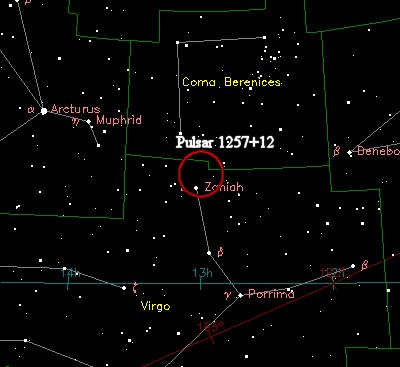
Velocity Curve
PSR 1257+12 a
Pulsar Planet 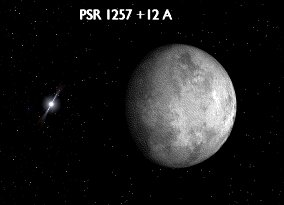
Statistics
Star System : PSR 1257+12
Discovery Status : Unconfirmed
Mass : 0.015 Earths
Average Distance : 0.19 AUs
Period : 25.34 Days
Orbital Eccentricity : 0
Detection Method : Pulsar Timing
Discovered By : A. Wolszczan
Year Discovered : 1992
Speculations
It is somewhat odd that the first extrasolar planets to be discovered would orbit a distant pulsar. Planets are usually associated with yellow main sequence stars, like our sun, and most of the newly discovered planets do orbit such stars. But the three worlds of pulsar PSR 1257 +12 are a different story. A cold, dark, and lonely trio, they may have been much like the planets of our solar system at one time. But luck had it that they would orbit a star which would die young in a colossal explosion, a supernova. Now, atmospheres stripped, surfaces melted and then supercooled, these planets are dark and unspeakably barren.
There is some controversy as to whether these worlds are indeed survivors at all, or were formed more recently. If they were always in orbits close to their star (the farthest of the three is only a little more distant than Mercury is from the sun) then they would have been swallowed and incinerated when the star entered its red giant stage. So if they are survivors, they must have migrated from more distant orbits akin to the gas giants of our solar system. It's possible that these worlds are gas giants of a sort.
If our sun went supernova (which it won't because it is not massive enough) then the inner solar system would be vaporized. The more massive and the more distant the planet, the greater the chance of survival. So Jupiter and Saturn, for example, might survive such a catastrophe. Their atmospheres may be almost totally burned away, their moons annihilated, but their cores would survive, as would some atmosphere. As the destroyed sun collapsed and cooled into a neutron star or pulsar, Jupiter and Saturn's surface would freeze, and their atmospheres would fall to the ground as hydrogen frost.
The orbits of Jupiter and Saturn planets might even decay as they lost energy due to friction with the gases released in the supernova in a process similar to how giant planets may fall into epistellar orbits as they loose momentum to the protoplanetary disk that formed them. The planets of PSR 1257+12 may have been subject to the same forces that pulled 51 Pegasi b into its star hugging orbit.
Thus our solar system of 9 planets is reduced to two or three deep frozen worlds huddled close around a dead star.
Just like the planets of PSR 1257 +12. It's possible that these three worlds are what's left of gas giants, stripped of their atmospheres and left bare by a supernova except for a smattering of hydrogen frost. Planet A may have once resembled Uranus or Neptune. But, closer in than the others, it was reduced to the size of our moon. The other two were farther out and more massive, so they retained more material. Perhaps Planet B was once the size of Jupiter, but is now only 3 times more massive than Earth. And Planet C, farther still, may have been like Saturn.
Planetary Orbit
PSR 1257+12 b
Pulsar Planet 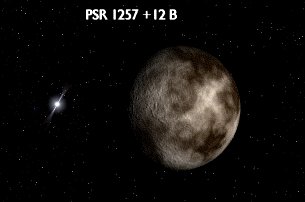
Statistics
Star System : PSR 1257+12
Discovery Status : Unconfirmed
Mass : 3.4 Earths
Average Distance : 0.36 AUs
Period : 66.54 Days
Orbital Eccentricity : 0.0182
Detection Method : Pulsar Timing
Discovered By : A. Wolszczan
Year Discovered : 1992
Speculations
It is somewhat odd that the first extrasolar planets to be discovered would orbit a distant pulsar. Planets are usually associated with yellow main sequence stars, like our sun, and most of the newly discovered planets do orbit such stars. But the three worlds of pulsar PSR 1257 +12 are a different story. A cold, dark, and lonely trio, they may have been much like the planets of our solar system at one time. But luck had it that they would orbit a star which would die young in a colossal explosion, a supernova. Now, atmospheres stripped, surfaces melted and then supercooled, these planets are dark and unspeakably barren.
There is some controversy as to whether these worlds are indeed survivors at all, or were formed more recently. If they were always in orbits close to their star (the farthest of the three is only a little more distant than Mercury is from the sun) then they would have been swallowed and incinerated when the star entered its red giant stage. So if they are survivors, they must have migrated from more distant orbits akin to the gas giants of our solar system. It's possible that these worlds are gas giants of a sort.
If our sun went supernova (which it won't because it is not massive enough) then the inner solar system would be vaporized. The more massive and the more distant the planet, the greater the chance of survival. So Jupiter and Saturn, for example, might survive such a catastrophe. Their atmospheres may be almost totally burned away, their moons annihilated, but their cores would survive, as would some atmosphere. As the destroyed sun collapsed and cooled into a neutron star or pulsar, Jupiter and Saturn's surface would freeze, and their atmospheres would fall to the ground as hydrogen frost.
The orbits of Jupiter and Saturn planets might even decay as they lost energy due to friction with the gases released in the supernova in a process similar to how giant planets may fall into epistellar orbits as they loose momentum to the protoplanetary disk that formed them. The planets of PSR 1257+12 may have been subject to the same forces that pulled 51 Pegasi b into its star hugging orbit.
Thus our solar system of 9 planets is reduced to two or three deep frozen worlds huddled close around a dead star.
Just like the planets of PSR 1257 +12. It's possible that these three worlds are what's left of gas giants, stripped of their atmospheres and left bare by a supernova except for a smattering of hydrogen frost. Planet A may have once resembled Uranus or Neptune. But, closer in than the others, it was reduced to the size of our moon. The other two were farther out and more massive, so they retained more material. Perhaps Planet B was once the size of Jupiter, but is now only 3 times more massive than Earth. And Planet C, farther still, may have been like Saturn.
Planetary Orbit
0.72 AUs
PSR 1257+12 c
Pulsar Planet 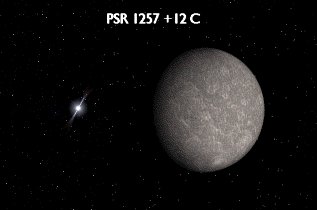
Statistics
Star System : PSR 1257+12
Discovery Status : Unconfirmed
Mass : 2.8 Earths
Average Distance : 0.47 AUs
Period : 98.22 Days
Orbital Eccentricity : 0.0264
Detection Method : Pulsar Timing
Discovered By : A. Wolszczan
Year Discovered : 1992
Speculations
It is somewhat odd that the first extrasolar planets to be discovered would orbit a distant pulsar. Planets are usually associated with yellow main sequence stars, like our sun, and most of the newly discovered planets do orbit such stars. But the three worlds of pulsar PSR 1257 +12 are a different story. A cold, dark, and lonely trio, they may have been much like the planets of our solar system at one time. But luck had it that they would orbit a star which would die young in a colossal explosion, a supernova. Now, atmospheres stripped, surfaces melted and then supercooled, these planets are dark and unspeakably barren.
There is some controversy as to whether these worlds are indeed survivors at all, or were formed more recently. If they were always in orbits close to their star (the farthest of the three is only a little more distant than Mercury is from the sun) then they would have been swallowed and incinerated when the star entered its red giant stage. So if they are survivors, they must have migrated from more distant orbits akin to the gas giants of our solar system. It's possible that these worlds are gas giants of a sort.
If our sun went supernova (which it won't because it is not massive enough) then the inner solar system would be vaporized. The more massive and the more distant the planet, the greater the chance of survival. So Jupiter and Saturn, for example, might survive such a catastrophe. Their atmospheres may be almost totally burned away, their moons annihilated, but their cores would survive, as would some atmosphere. As the destroyed sun collapsed and cooled into a neutron star or pulsar, Jupiter and Saturn's surface would freeze, and their atmospheres would fall to the ground as hydrogen frost.
The orbits of Jupiter and Saturn planets might even decay as they lost energy due to friction with the gases released in the supernova in a process similar to how giant planets may fall into epistellar orbits as they loose momentum to the protoplanetary disk that formed them. The planets of PSR 1257+12 may have been subject to the same forces that pulled 51 Pegasi b into its star hugging orbit.
Thus our solar system of 9 planets is reduced to two or three deep frozen worlds huddled close around a dead star.
Just like the planets of PSR 1257 +12. It's possible that these three worlds are what's left of gas giants, stripped of their atmospheres and left bare by a supernova except for a smattering of hydrogen frost. Planet A may have once resembled Uranus or Neptune. But, closer in than the others, it was reduced to the size of our moon. The other two were farther out and more massive, so they retained more material. Perhaps Planet B was once the size of Jupiter, but is now only 3 times more massive than Earth. And Planet C, farther still, may have been like Saturn.
Planetary Orbit
0.94 AUs
PSR 1257+12 d
Sub-Giant 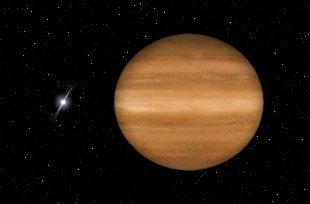
Statistics
Star System: PSR 1257+12
Discovery Status : Unconfirmed
Mass : 95 Earths
Average Distance : 35 AUs
Period : 170 Years
Detection Method : Pulsar Timing
Discovered By : A. Wolszczan
Year Discovered : 1992
Planetary Orbit