← The Wingmakers Ways · Astronomy & Exoplanets
Archived page · Checkable
Virgo
Virgo.html · captured from wingmakers.co.nz
Virgo 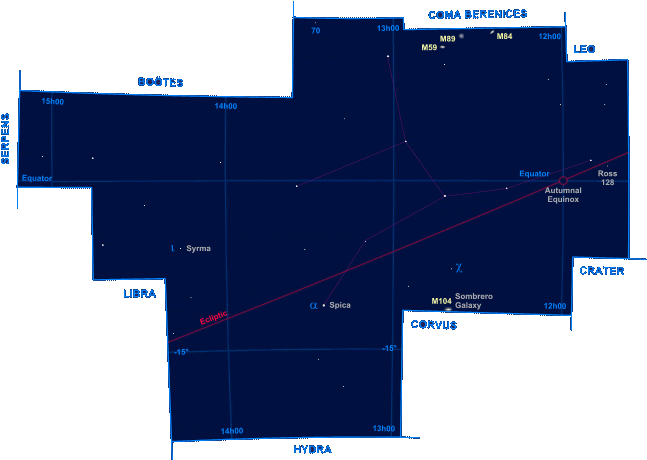
The Virgin
The Virgo is the second largest constellation after Hydra. The constellation is very hard one to identify its shape because most of stars are fainter than third magnitude excepting Spica, alpha Virginis. And it's positioned far away from the milky way, so you can observe lots of galaxies over two thousand visible with medium-sized telescopes. The name of Spica with white color has meaning of "ear of wheat" carried by the goddess, and has an another name of the pearl star in Japan.
Second Cosmic Ray : Linking Through Jupiter
"These subjects are motivated by their emotions stemming from a desire to raise themselves to the heights, so that they can enjoy a unifying relationship with their Maker. They exemplify the passive, feminine quality that is in direct opposition to the positive, masculine assertion of the first ray subjects. They are strongly attracted to all things, whether people or concepts, that they feel are above them. Consequently, they often use love, the strongest human emotion, in their efforts at drawing themselves upwards. But wisdom is very important to these subjects also, so awareness or consciousness is a necessity in their relationships. Therefore, they usually play the more passive role. They are affectionate, friendly, kind, quiet, and often endowed with an attractive appearance and disposition.
This three-color composite image of spiral galaxy NGC 4402 shows several key lines of evidence for the galaxy being stripped bare of its star-forming material by its violent ongoing encounter with the hot gas in the center of the Virgo galaxy cluster, as NGC 4402 falls into it.
First, the galaxy�s dust disk appears to be truncated; second, the dusty disk appears to be �bowed� upward, bent by the wind of hot gas blowing from the southeast (from the lower left of the image); third, it appears that the light emitted by the north side of the stellar disk has been reddened and dimmed by dust that has been pushed up in front of it by the pressure of the cluster gas; and fourth, the linear filaments of dust to the south of its main disk are being �ablated,� or stripped away, in an outside-in fashion.
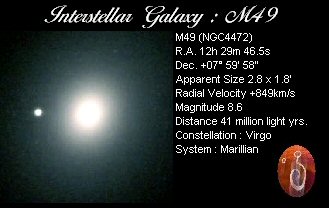
Around the center of the constellation of Virgo, M49 is a member elliptic galaxy of The Virgo Cluster in where the galaxy is positioned at fairly southern part. You can appreciate the galaxy fairly clearly because of its brightness of 8.6. And diameter of the galaxy can be classed under considerably larger ones, only small telescopes can show you M49 as an elliptic light stretched toward north-south direction. M49 is estimated about 41 millions light years away.
This image has captured a bared galaxy of M58 in the Virgo Cluster. You can find it about 6 degrees west of epsilon Vir. And there are two elliptic galaxies of M59 and M60 just east of M58. The galaxy shows you only dimmed nuclei by using of scopes, actually very fine two arms are coiled up in east-west direction. You can barely detect two lumps sticked to the nuclei in this image although taken under bad conditioned night. You can see M58 with M59 and M60 in low powered field of view, M58 is the most striking and brightest in the trio.
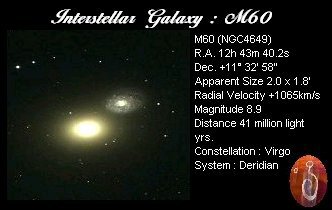
These galaxies are positioned at the most eastern region of the Virgo Cluster in all member galaxies with Messier's numbers. You can catch these galaxies as two dimmed lights around five degrees west of epsilon Virginis. Galaxies on the right and left hand sides are M59 and M60 respectively.
And M60 has small companion spiral galaxy of NGC4647 just north west of it. Both galaxies are simple elliptic, so they show you only nebula like images, and it can be realized that M59 is a bit stretched in north-south direction.
NGC4647 just NW of M60 & stretched out, nearly perpendicularly to M60 and looked more like a spiral . It was very close to M60..
nearly touching.
There are 16 galaxies with Messier's numbers in Virgo Cluster in which some thousands of galaxies are contained. This M61 is a typical spiral positioned at the most southern region of the huge galactic group. Although there are few bright stars around the galaxy, you can search it from gamma Virginis and trace about 7.6 degrees northwest from the star. M61 has a bit small diameter of 6 arc minutes, but two clear arms can be detected on long exposed films. The galaxy has fairly low visual magnitude in spite of registered in the Messier's catalogue, so you cannot detect the spiral structure through telescopes with your own eyes. At most very dimmed light surrounding a stellar like nucleus will be shown.
These elliptic galaxies are positioned around center of the Virgo Cluster paralleling only 17 arc minutes in interval. Right and left ones have the Messier's numbers of M84 and M86, respectively. Both look like simple dimmed lump of light without any striking structures.Those galaxies are positioned at the western edge of a famous galactic line, the Markarian's chain that is formed from ten or more galaxies. You can detect many faint galaxies around this field.
M87 is a big elliptical galaxy positioned at the center of Virgo Cluster. You can find it around midway of Denebola, beta Leonis and epsilon Virginis. Only small scopes show you a round and dimmed light clearly. M87 has a real diameter of about 130 thousand light years, a bit larger than our Galaxy. And the galaxy is well known as a strong radio source of "Virgo A". Big telescopes can capture a huge jet structure stretching toward WNW with visible ray. It's considered that M87 is a very active galaxy, and a gigantic black hole in center is supplying the energy of its activity.
This picture shows you M88, a northern galaxy of Virgo Cluster. The galaxy has a long axis of 7 arc minutes and 10.7 in visual brightness, a bit stretched nebula like light can be recognized with small telescopes. M88 is a typical spiral galaxy being a bit slant from edge-on, the picture shows you a dark lane surrounds the nucleus. And big telescopes can capture dimmed and fine arms coiled up.
A small-sized elliptical around the central region of Virgo Cluster is M89. The galaxy is lying about 1.2 degrees apart from a radio galaxy of M87 in east. And it has an apparent diameter of about 5 arc minutes, telescopes can show you M89 as a dimmed light spot. Another spiral galaxy of M90 is positioned about 40 arc minutes north of the galaxy, you can detect those galaxies in same field of view with low magnifying power, and it may be interesting to compare the differences of those shapes.
M90 is a member of Virgo Cluster just 40 arc minutes north of M89 in previous. The galaxy has an apparent shape of elliptic a bit stretched in north-south direction. Although M90 has a long axis of 10 arc minutes, it's fairly dimmed because of its brightness of 10. So it's difficult to resolve detailed structures with amateur telescopes. Actually M90 is a spiral galaxy classified as Sc type, a dark lane is striking around the central nucleus.
M104 (NGC4594) can be found out in the south sky in spring, near the boundary between Virgo and Corvus. The name "Sombrero Nebula" comes from, you can understand easily, its shape that resembles a Mexican hat. A dark lane that crosses the center can be seen through medium sized scopes, I think it's one of interesting galaxies to appreciate. Distance is estimated about 65 million light years, and it has a diameter of 140 thousand light years, a little larger than that of our Galaxy. And additionally, the galaxy is well-known as one of the brightest radio galaxies in the heavens. If you have radio-detectable eyes, M104 will be seen equivalent to about 6th magnitude.
NGC4216 is a member galaxy of the Virgo Cluster, positioned almost just on a border between constellations of Virgo and Coma Berenices. You can find it about 6 degrees and 40 arc minutes ESE from Denebola, beta Leo. We're overlooking the galaxy from almost edge-on angle; clear central nucleus and dark lane being crossing can be recognized. The galaxy has an apparent thickness and length of 1.8 and 8 arc minutes respectively. The NGC4216 is one of easy-appreciating galaxies in Virgo Cluster in which uncountable galaxies are scattered. And it's the brightest one in all member galaxies without Messier's number. You can see other two fine edge-on galaxies in NE and SW of NGC4216. They have numbers of NGC4222 and NGC4206 respectively; both have brightness about 13 to 14th magnitudes.
This picture shows you a unique-shaped galaxy of NGC4536 lying around the southeastern edge of Virgo Cluster. The galaxy can be found about 4 degrees northwest of gamma Vir, Porrima. The galaxy has a long axis of 7 arc minutes and 11th magnitude brightness, it has two arms just like stretched out. NGC4536 has been classified in between spirals and bared galaxies. The galaxy is fairly large one but very faint, it's difficult to recognize its shape through telescopes with your own eyes.
This image shows you two tiny spiral galaxies positioned around southern region of Virgo Cluster. Right one is NGC4567 and left one has a number of NGC4568. Both spirals are very dimmed and have brightness of about 12th magnitude. And apparent sizes are 3 or 4 arc minutes or so. This pair looks snuggling each other, this noticeable view has attracted our attention. These two galaxies are being close, it's considered that they're just colliding. We can observe other several examples of colliding galaxies in heavens like the Antennae in the constellation of Corvus. It's not rare case that plural galaxies have near miss or collision.
This set of two images show you two small galaxies in the southern region of Virgo. NGC4697 is positioned about 5.5 degrees west of theta Vir, and NGC4699 is found at about 3 degrees south from NGC4697. Although both galaxies have no striking characteristics, you can see that NGC4697 has an apparent shape of ellipse. The galaxy has a span of about 7 arc minutes in east west direction, you can appreciate this shape clearly through medium-sized telescopes.
NGC4699 looks like a simple round shape and has a diameter of a bit smaller than 4 arc minutes. There are plenty of galaxies around the constellations of Virgo and Corvus but almost all of them are faint difficult to appreciate with amateur telescopes. You can find out the Sombrero Galaxy (M104) only 3.5 degrees SSW of NGC4699
Evidence of the galaxy's youthfulness can be seen in the burst of newborn stars and its disturbed shape. This evidence indicates that the galaxy, called POX 186, formed when two smaller clumps of gas and stars collided less than 100 million years ago (a relatively recent event in the universe's 13-billion-year history), triggering more star formation. Most large galaxies, such as our Milky Way, are thought to have formed the bulk of their stars billions of years ago.
POX 186 is a member of a class of galaxies called blue compact dwarfs because of its small size and its collection of hot blue stars. [The term "POX" is derived from the French "prism objectif," or objective prism, a device that astronomers place in front of a telescope to photograph spectra of all objects in its field of view.] POX 186 was discovered 20 years ago, but ground-based telescopes resolved few details of the galaxy's structure because it is so tiny. To probe the galaxy's complex structure, astronomers used the sharp vision of the Hubble telescope. The Hubble pictures reveal that the system is puny by galaxy standards, measuring only about 900 light-years across, and containing just 10 million stars. By contrast, our Milky Way is about 100,000 light-years across and contains more than 100 billion stars.
Confirming the presence of yet another super-massive black hole in the universe, astronomers using the Hubble telescope have found unexpected mysteries. The black hole and an 800-light-year-wide, spiral-shaped disk of dust fueling it are slightly offset from the center of the host galaxy, NGC 4261.
Prior to Hubble observations, astronomers did not think dust was common in elliptical galaxies like NGC 4261, which were thought to have stopped making stars long ago due to the absence of the requisite raw materials: gas and dust. However, Hubble is showing that dust and dust disks are common in the centers of elliptical galaxies.
Mankarian Chain
Name R.A. (2000.0) Dec. (2000.0) Size Magnitude
NGC4374(M84) 12h 25m 3.7s +12° 53' 15" 6.4 x 5.6' 10.0
NGC4406(M86) 12h 26m 11.7s +12° 56' 49" 9.0 x 5.8' 9.8
NGC4438 12h 27m 45.5s +13° 00' 36" 8.6 x 3.2' 10.9
NGC4435 12h 27m 40.5s +13° 04' 48" 2.8 x 2.0' 11.7
NGC4461 12h 29m 3.0s +13° 11' 08" 3.5 x 1.4' 12.1
NGC4473 12h 29m 48.8s +13° 25' 49" 4.4 x 2.5' 11.1
NGC4477 12h 30m 2.4s +13° 38' 11" 3.8 x 3.4' 11.3
This picture captured the central region of the Virgo cluster in which some thousand galaxies contained. You can see two bright elliptic galaxies of M84 and M86 on the right hand side. And as a start point at these galaxies, a gentle curve is stretched to northeast formed by several fine galaxies. Though this picture shows you only bright ones because taken with a small telescope, actually this noticeable curve consists of over ten galaxies with various sizes. The curve is called "The Markarian's chain" from a name of observer who noticed it at first. The Markarian's chain is a very characteristic row of galaxies in the Virgo cluster; you can enjoy jumping galaxies into your field of view one after another by tracing telescope along the curve. Now it's considered that members of Markarian's chain have no special gravitational interactions, in short, these galaxies are paralleling apparently by chance. Same as various constellations formed by connecting characteristic stars, the Markarian's chain is , as it were, like a kind of constellation composed of galaxies.
This image shows you two member galaxies of the Virgo Cluster with an interval of 10 arc minutes lying at about 2.3 degrees west of epsilon Vir. An edge-on galaxy in left is NGC4762 and another right galaxy is NGC4754. The galaxy of NGC4762 is one of well-proportioned edge-on galaxies although smaller than a famous one of NGC4565. NGC4754 has a length of 9 arc minutes and a clear central bulge. This pair cannot be taken an attention because those are positioned in eastern edge of Virgo Cluster, maybe you can enjoy the pair of different shaped galaxies with an interest.
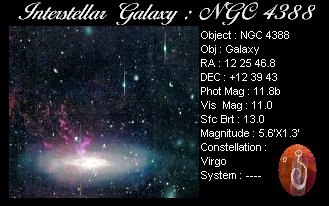
QSO 3C273 / Quasar
R.A. 12h 29m 6.9s (2000.0)
Dec. +02° 03' 07" (2000.0)
Apparent Size less than 20"
Red Shift 0.158
Magnitude 12.8
Distance about 2.5 billion light yrs. *
I'd like to show you probably one of most distant objects can be captured with amateur telescopes. This field shows you around north west of gamma Vir, Porrima, which is one of most beautiful double stars in spring skies. An arrow indicates a deep-deep sky object of the "Quasar (QSO)". This word is an abbreviation of the "Quasi-stellar object". Almost all of quasars show the red shift over 90% of light velocity; this fact tells us that quasars must be over some billions light years away. The quasar "3C273" was discovered at the first time and has a visual magnitude of 12.8, it's the brightest in all quasars. Distance from the Galaxy is estimated about 2.5 billion light years.
It's considered that quasars are emitting gigantic energy because they're extremely bright in spite of their stupendous distance. Their quantities of emitting energy is imagined about some thousands or some ten thousands times of that of whole of our Galaxy. Some astronomers have proposed that they may be "eggs" of very active galaxies formed in the early of universe's history. But we don't know what they really are yet, one of greatest mysteries in contemporary astronomy.
Planetary Destinations In Virgo
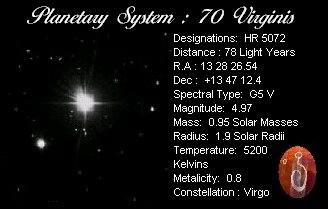
MAPPING TECHNIQUE
VISUAL EXERCISE : Two Person Exercise.
DESTINATION : Your Choice
STEP ONE
Traveller : Get comfortable and relax.
STEP TWO
Traveller : Charge your physical body with light energy.
STEP THREE
Traveller : See your visual body standing in front of your physical body and prepare your visual body for interstellar travel with a Interstellar Protection Shield.
STEP FOUR
Traveller : See your visual body filling with light energy.
STEP FIVE
Traveller : Focus your mind on teleporting your visual body to the Your Destination.
STEP SIX
Traveller : Then see your visual body teleporting to the Your Destination.
STEP SEVEN
Traveller : When you arrive in the destination Look around can you see any planets or moons in the System? If not use the Interstellar Planetary Detection Rapid and see if you can detect any planets or moons in that system.
STEP EIGHT
Traveller : If you can see or detect a planet or moon using Telekinesis or Teleportation move towards the planetary body.
STEP NINE
Traveller : When you arrive at the outer atmosphere of the planet or moon stop and ask your spiritual guide to tell you the name of this planet or moon.
Traveller : Tell the mapper the name of the planet or moon. Also tell the mapper all you can about the planet or moon.
STEP TEN
Then us the Core Comparison Crystal Technique to perform a core reading on this planet or moon and give the mapper your reading on this planet or moon
STEP ELEVEN
Traveller : Then levitate or Teleport your visual body to the surface of the planet or moon.
STEP TWELVE
Mapper : When the traveller arrives on the surface ask the following questions.
Is there any plant life or water on the surface of the planet or moon that you can see? Is there an atmosphere around this planet or moon? Is the atmosphere an match with earths atmosphere?
Mapper : Write down the answers to these questions.
PLANETARY DATA FILE 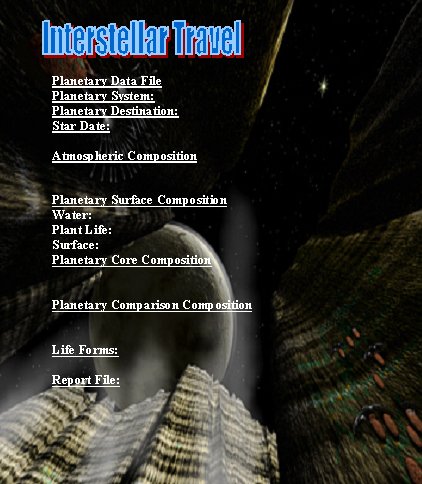
STEP THIRTEEN
Traveller : When you are finished on the surface teleport your visual body to the nearest planetary body that you can see in that Galaxy.
STEP FOURTEEN
Traveller and Mapper : Follow steps nine through to twelve again till you have mapped out the whole Galaxy.
STEP FIFTEEN
Traveller : When you have finished mapping the Galaxy teleport your visual body back to your physical body back on earth.
REMEMBER
When you are travelling if you come across an alien race that you think may be friendly feel free to make contact with that alien race.
IMPORTANT
When you are contacting alien races always be ready to teleport if there is trouble.
MAPPER
Make a note of any planets or moons with an atmospheric match with earths. That way you both know which planets can support human life forms.
MAPPER & TRAVELLER
To check that your mapping of that Galaxy is correct by changing roles and do this exercise again. Also remember to check for life force energy around the planets or moons that you visit on your journeys. Because if you can feel life force energy that means the planet or moons is a real planet or moon.