← The Wingmakers Ways · Astronomy & Exoplanets
Archived page · Checkable
Sagittarius
sagittarius.html · captured from wingmakers.co.nz
Sagittarius 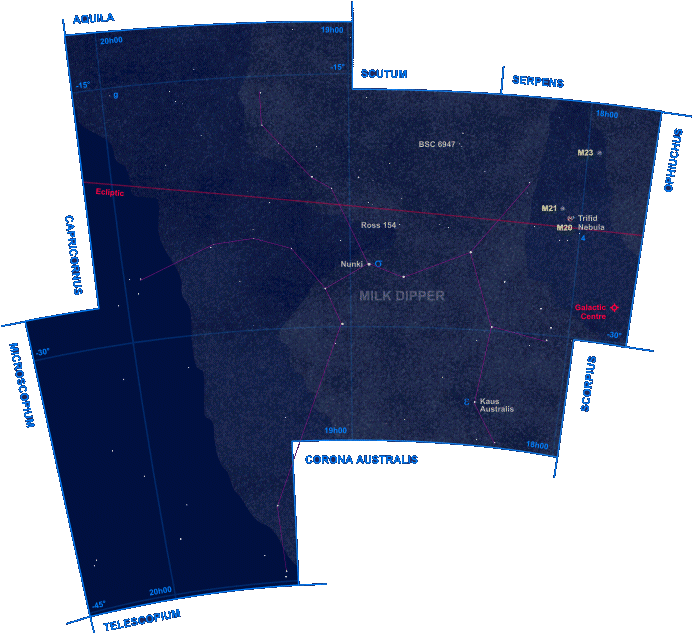
The Archer The Sagittarius ("Sagitta" is Latin for "arrow") is a member of zodiac just west of Scorpius, bathed in the summer's Milky Way, so includes plenty of attractive nebulae and star clusters. The constellation also includes the center point of our Galaxy. Sagittarius represents Cheiron who has a body of half-man and half-beast, taking a stance to shot an arrow at the scorpion. The asterism of that is well known as "the teapot" in the west, and ancient Chinese had regarded that as another dipper (of course for the Big Dipper in Ursa Major). 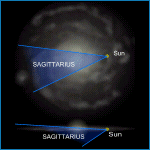
Due to its large size and fortunate position in the sky, the region of Sagittarius contains almost one quarter of the matter in our galaxy.
Sixth Cosmic Ray : Linking Through Mars
"These subjects are motivated by a deep and intense devotion to high ideals, accompanied by a longing for absorption into eternal bliss. Intensely emotional, they act mainly on faith which they trust far more than logic. They are very persistent and cannot be deterred from following their own path and any kind of sacrifice is seen only as a steppingstone towards their aspirations. Deep involvement, loss of self-identity and single-minded idealism keep them solidly fixed on far distant goals. Unfortunately, they may appear gullible and meek to others and often suffer as a result. They are devoted and loyal to their friends, easily become emotionally involved in relationships and are quite often hurt. Consequently, such subjects sometimes assume a brash facade which barely covers their inner lack of peace and security.
M8 (NGC6523) is a beautiful diffused nebula known as the "Lagoon Nebula", this name came from its figure that associates us a tropical island surrounded by a coral reef. This naked eye object is considered to be about 2500 light years away. There are plenty of stellar eggs, "Globules", in this reddish nebula detected as small lumps of dark cloud. You can appreciate an open cluster of NGC6530 being on top of M8, the contrast with the nebula would be splendid. Actually the cluster is lying much farther than M8. And the very fine reddish nebula of IC1274-5 can be photographed like the diluted red ink around east of M8 under the sufficient clear and dark sky.
M17 is a diffused nebula in Sagittarius positioned about 2.5 degrees south of M16(Eagle Nebula) . M17 has several nicknames of "Swan Nebula" or the "Omega Nebula", this name came because the shape of the deep part of nebula resemble a Greek letter of omega. And occasionally, the nebula is known as the "Horseshoe Nebula". We can observe the nebula with a size of about 40arc minutes and 3300 light years away.
M18 is a small-scaled open cluster buried under the summer's Milky Way around Sagittarius. The cluster is positioned just 1 degree south of the Omega Nebula (M17). And the Star Cloud of Sagittarius shows you a splendid view at still more southern region. It can be said that the cluster is fairly modest deep sky object compared with those vast and beautiful scenic spots in the Milky Way. Perhaps you may get an impression of M18 as a simple striking part of the Milky Way rather than an open cluster. The cluster has small apparent size of 9 arc minutes or so, normal binoculars might be a bit insufficient to enjoy the object. M18 is floating in the Galaxy about 5000 light years away containing ten or more fine stars.
M20 (NGC6514), "The Trifid Nebula", is another delight in the Milky Way of Sagittarius, but visible only with larger scopes. Three Dark lanes devide this nebula into three parts, familiar on photographs. Distance is about 2200 light years. These vast clouds are brightening by activated hydrogen molecules receiving energy from stars inside. And this image includes a small open cluster of M21, found about 40 arc minutes northeast of M20. The cluster has a diameter of 10 arc minutes and contains about 50 fine member stars, can be enjoyed only with binoculars.
M21 is a cluster which shows quite a strong concentration toward its center. Therefore, it is classified by Woldemar Götz as of Trumpler class I 3 r (strong concentration to the center, large range in brightness, i.e. bright and faint stars, and richly populated), while Trumpler, according to Kenneth Glyn Jones, classified it I 3 p (i.e., poor, or under 50 stars).
M22 (NGC6656) is a fine globular cluster, lies two degrees NE of lambda Sgr. The cluster is detected by naked eye under good condition, and looks like a dimmed nebula with binoculars. It is a highly concentrated group of about 70 thousand stars in total, about 10,000 light years away.
The cluster and M13, a great globular cluster in Hercules, have the culmination about simultaneously, It'll be very interesting to compare views of those clusters through a telescope.
M23 is a medium sized open cluster in northern region of Sagittarius. You can find the cluster around a bit mu Sgr side on the midway between xi Oph and mu Sgr. And you can use another way of 5.5 degrees NNW of the Lagoon Nebula (M8). As this image shows you, there is a star with 6th magnitude just northwest of the cluster, the star can be a good mark to search M23 with finder scopes. The cluster has member stars of very same brightness, and you may be fascinated by the scenic beauty of the cluster like twinkling grains of sand scattered in the Milky Way. About 150 fine stars with 12th or 13th magnitudes are gathered.
M24 is a bright "star cloud" at the center of Milky Way in Sagittarius, and you can see reddish Omega Nebula (M17) in upper side of image. Strictly speaking, this object is not nebula nor star clusters, but Messier had registered this in the catalogue as a cluster with a size of 1.5 degree.
This naked eye cloud perhaps reminds you of a horse face turning upper left. Two dark nebulae in the cloud look like the eyes of horse are Barnard 92 (west side), and Barnard 93 (east side).
You can find a medium-sized open cluster of M25 (no NGC number, IC4725) being buried under the Milky Way around the northern region of Sagittarius. Gamma Sgr is a good mark to catch the cluster about 6 degrees north from the star. The cluster has a diameter of 40 arc minutes and contains 50 fine stars. And you can enjoy many other attractive celestial objects around this field like the Star Cloud in Sagittarius, the Omega Nebula (M17) and so on. Perhaps you'll notice that M25 has a dark lane dividing the cluster into north and south regions; it's one of characteristics of the cluster. M25 is estimated about 1800 light years away.
M28 is a tiny and dense globular cluster positioned just 1 degree WNW of lambda Sgr. Another striking globular of M22 can also be found about 2.5 north of same star. Both clusters can be recognized as nebula like images only with small binoculars, and you will be able to catch those in your field of view easily. M28 has an apparent size of about 5 arc minutes, less than one third of that of M22. It might be difficult to resolve member stars with small telescopes. The distance is estimated about 15 thousand light years, 1.5 times farther than M22.
M54 is a quite conspicuous cluster (also the author wonders that Messier found it "very bright" from his location in Paris). It is easy to find as it is close to Zeta Sagittarii, the southernmost star of Sagittarius' "dipper" asterism of 4 or 5 stars (also called the "Milky Dipper" or "Teapot"), namely 0.5 degrees south and 1.5 degrees west. It is bright but small so that it may be overlooked in smaller binoculars (i.e. taken for a star), its bright core being only 2.1' in diameter, while the outlayers reach out to 6' on photos, or even to 9.1' at very long exposures. Herschel could resolve its outer regions in 15th and some 14th magnitude stars. It is not easy to resolve its core, however. M54 has at least 82 known variables, the majority being of RR Lyrae type, but there are also two semi-regular red variables with periods of 77 and 101 days.
Its distance, for years, was estimated to be about 50-65,000 light years. However, in 1994, the exciting discovery was made that M54 was probably not a member of our Milky Way at all, but of a newly discovered dwarf galaxy ! This galaxy is now called SagDEG, for Sagittarius Dwarf Elliptical Galaxy, and one of the most recently discovered Local Group galaxies.
M54 coincides with one of two major concentrations of the SagDEG galaxy, and is receding from us at a very similar velocity (about 130 km/sec). This makes it probable that M54 is within this galaxy, which was estimated at a distance of 80-90,000 light years; a recent estimate for M54 was given at 88,700 light years. At this distance, M54 would be one of the most luminous known globular clusters, outshined only by spectacular Omega Centauri in our Milky Way. Also, its diameter would become as large as about 200 light years. And perhaps most interesting, it would make M54 the first extragalactic globular cluster ever discovered, by Charles Messier on July 24, 1778, and thus add an extra first to Messier's list of fame
M69, similar as its neighbor M70, is one of the smaller and fainter globular clusters in Messier's catalog. It can just be seen in a dark night with a 7x50 or 10x50 pair of binoculars, if the observing location is not too much north. However from Paris, Messier's observing place, it is a difficult object.
M69 was discovered by Abbe Nicholas Louis de la Caille, who included it in his catalog of southern objects as Lacaille I.11. Messier missed this southern cluster when he first looked for it in 1764, but found it with the better scope he had in 1780.
M69 is only 7.1 arc minutes in diameter in long exposure photos, corresponding to roughly 55 light years at its 28,000 light years distance. The visually bright compact core is less than half, only about 3'. Its stellar concentration is about average for a globular cluster, as it is of concentration class V. It is one of the metal-richest globulars, meaning that its stars show a relatively high abundance of elements heavier than Helium. Nevertheless, this value is still significantly lower than that for the younger (Population I) stars like our Sun, indicating that even this globular was formed at early cosmic times when the universe contained less heavier elements, as these elements still had to be formed in the stars.
M69 is poor in variable stars: Shapley found not a single one at all, and the number of known variables is now still as low as 8, 2 of them being Mira-type variable stars with periods of about 200 days.
Appearing approximately as bright and big as its neighbor M69, globular star cluster M70 is indeed only a little more luminous and little bigger, and a bit more remote (29,400 light years). Both are quite close to the galactic center, so they are both subject to quite strong tidal gravitational forces. As it is also at about the same southern declination, it is a difficult object from Paris where Messier observed it.
M70 is 7.8 arc minutes in apparent angular and roughly 65 light years in linear diameter, its bright visual core being only about 4'. It is rapidly receding from us, at about 200 km/sec. Only 2 variables are known in this stellar swarm.
The core of M70 is of extreme density, as it has undercone a core collapse somewhen in its history, similar to at least 21 and perhaps up to 29 of the 147 known Milky Way globulars, including M15, M30, and possibly M62.
Globular cluster M70 became famous in 1995 when the great comet Hale-Bopp was discovered near it by Alan Hale and Thomas Bopp as they were observing this globular.
Around the eastern edge of Sagittarius, M75 is very small-scaled globular cluster near the border to Capricornus. Actually it's fairly troublesome to search the tiny deep sky object because there are few bright stars suitable for a road sign around this star field. You can use no ways except about 13.5 degrees ENE of tau Sgr, or about 8 degrees SSW of beta Cap. M75 has the highest density class of type I, so the cluster don't show individual stars in central region even if you see the cluster with large-scaled telescopes. The cluster has a visual size of only 2 arc minutes or so, one of the poorest Messier's objects. But it's natural that it should have turned out that way, to say, M75 is estimated about 79 thousand light years away, it's the most distant Messier's object in all inner galactic. The cluster is lying at the far side of the Galaxy beyond the central bulge region.
NGC6723 is a medium sized globular cluster positioned in northern region of Corona Austrina. But this cluster is belonging to the constellation of Sagittarius. The globular has an apparent diameter of about 6 arc minutes; you will be able to detect it as a nebula-like image by using of binoculars.
You can enjoy the flow of dark nebulae around the cluster because NGC6723 is lying near the Milky Way in summer.
NGC6822 is located approximately 1.63 million light-years from Earth, in the constellation Sagittarius. Giant gas clouds in NGC 6822 have held a special attraction for astronomers since their discovery by the visual observer E. E. Barnard in 1881. Edwin P. Hubble, after whom the HST is named, used the then-new 100-inch telescope at Mount Wilson Observatory in 1925 to make the first detailed photographic investigation of NGC 6822. The Hubble image reveals details too fine to be resolved from telescopes on the ground.
Stars form in groups from enormous clouds of gas and dust called giant molecular clouds. Once star formation begins in a molecular cloud, its rate accelerates until the process is stopped when one or more very massive hot stars are formed. At that point the clouds change from near darkness into the brightly glowing objects such as seen in Hubble-X. It is the intense ultraviolet radiation from the massive stars that causes the residual gas to glow. Radiation and gas outflows, called stellar winds, then cause the gas to disperse, bringing further star formation to an abrupt end.
The Hubble-X image was taken with Hubble's Wide Field Planetary Camera 2 (WFPC2) in September 1997, by astronomers C. Robert O'Dell of Vanderbilt University, Paul W. Hodge of the University of Washington, and R. C. Kennicutt, Jr. of Steward Observatory at the University of Arizona.
The image shows a nearly circular bright cloud at the core of Hubble-X. The cloud's diameter is about 110 light-years, and contains many thousands of newly formed stars in a central cluster. The brightest of these young stars are easily visible in the Hubble image, where they appear as numerous bright white dots.
Hubble-X is many times brighter and larger than the Orion Nebula, the brightest nearby star formation region in our own Milky Way galaxy. In fact, the tiny cloud just below Hubble-X, barely resolved even by HST, has about the same size and brightness as the Orion Nebula.
Sixth Cosmic Ray
"These subjects are motivated by a deep and intense devotion to high ideals, accompanied by a longing for absorption into eternal bliss. Intensely emotional, they act mainly on faith which they trust far more than logic. They are very persistent and cannot be deterred from following their own path and any kind of sacrifice is seen only as a steppingstone towards their aspirations. Deep involvement, loss of self-identity and single-minded idealism keep them solidly fixed on far distant goals. Unfortunately, they may appear gullible and meek to others and often suffer as a result. They are devoted and loyal to their friends, easily become emotionally involved in relationships and are quite often hurt. Consequently, such subjects sometimes assume a brash facade which barely covers their inner lack of peace and security.
The Pistol Star lies about 25,000 light-years away from Sol. From the perspective of Earth, the region containing the star lies at the western edge (17:46:15.3:-28:50:4, ICRS 2000.0) of Constellation Sagittarius
Planetary Destination In Sagittarius
MAPPING TECHNIQUE
VISUAL EXERCISE : Two Person Exercise.
DESTINATION : Your Choice
STEP ONE
Traveller : Get comfortable and relax.
STEP TWO
Traveller : Charge your physical body with light energy.
STEP THREE
Traveller : See your visual body standing in front of your physical body and prepare your visual body for interstellar travel with a Interstellar Protection Shield.
STEP FOUR
Traveller : See your visual body filling with light energy.
STEP FIVE
Traveller : Focus your mind on teleporting your visual body to the Your Destination.
STEP SIX
Traveller : Then see your visual body teleporting to the Your Destination.
STEP SEVEN
Traveller : When you arrive in the destination Look around can you see any planets or moons in the System? If not use the Interstellar Planetary Detection Rapid and see if you can detect any planets or moons in that system.
STEP EIGHT
Traveller : If you can see or detect a planet or moon using Telekinesis or Teleportation move towards the planetary body.
STEP NINE
Traveller : When you arrive at the outer atmosphere of the planet or moon stop and ask your spiritual guide to tell you the name of this planet or moon.
Traveller : Tell the mapper the name of the planet or moon. Also tell the mapper all you can about the planet or moon.
STEP TEN
Then us the Core Comparison Crystal Technique to perform a core reading on this planet or moon and give the mapper your reading on this planet or moon
STEP ELEVEN
Traveller : Then levitate or Teleport your visual body to the surface of the planet or moon.
STEP TWELVE
Mapper : When the traveller arrives on the surface ask the following questions.
Is there any plant life or water on the surface of the planet or moon that you can see? Is there an atmosphere around this planet or moon? Is the atmosphere an match with earths atmosphere?
Mapper : Write down the answers to these questions.
PLANETARY DATA FILE 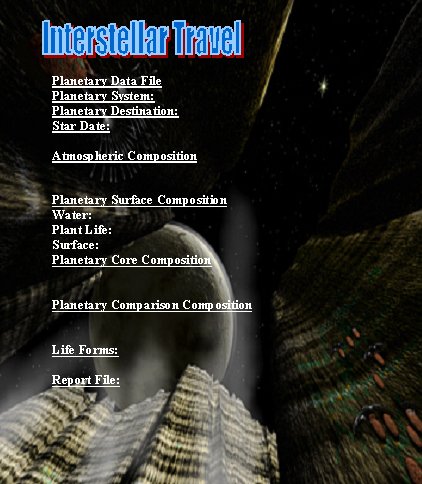
STEP THIRTEEN
Traveller : When you are finished on the surface teleport your visual body to the nearest planetary body that you can see in that Galaxy.
STEP FOURTEEN
Traveller and Mapper : Follow steps nine through to twelve again till you have mapped out the whole Galaxy.
STEP FIFTEEN
Traveller : When you have finished mapping the Galaxy teleport your visual body back to your physical body back on earth.
REMEMBER
When you are travelling if you come across an alien race that you think may be friendly feel free to make contact with that alien race.
IMPORTANT
When you are contacting alien races always be ready to teleport if there is trouble.
MAPPER
Make a note of any planets or moons with an atmospheric match with earths. That way you both know which planets can support human life forms.
MAPPER & TRAVELLER
To check that your mapping of that Galaxy is correct by changing roles and do this exercise again. Also remember to check for life force energy around the planets or moons that you visit on your journeys. Because if you can feel life force energy that means the planet or moons is a real planet or moon.