← The Wingmakers Ways · Astronomy & Exoplanets
Archived page · Checkable
Vela
Vela.html · captured from wingmakers.co.nz
Vela 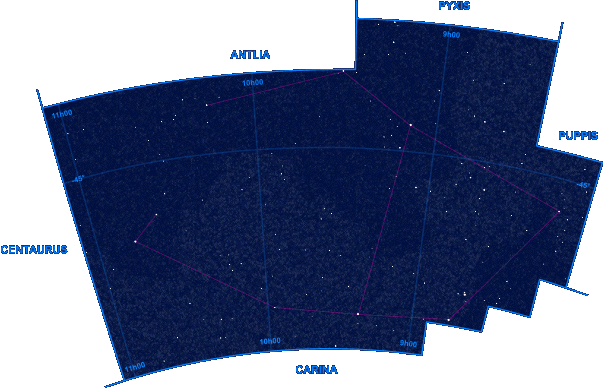
Myth
The constellations now known as Carina (the Keel), Puppis (the Stern), Pyxis (Compass), and Vela (the Sails) all belonged to a gigantic constellation called Argo. Its story goes like this.
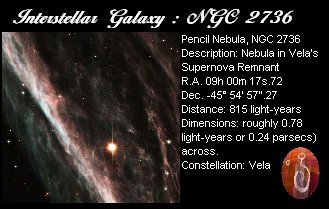
Officially known as NGC 2736, the Pencil Nebula is part of the huge Vela supernova remnant, located in the southern constellation Vela. Discovered by Sir John Herschel in the 1840s, the nebula's linear appearance triggered its popular name. The nebula's shape suggests that it is part of the supernova shock wave that recently encountered a region of dense gas. It is this interaction that causes the nebula to glow, appearing like a rippled sheet.
The nebula's luminous appearance comes from dense gas regions that have been struck by the supernova shock wave. As the shock wave travels through space [from right to left in the image], it rams into interstellar material. Initially the gas is heated to millions of degrees, but then subsequently cools down, emitting the optical light visible in the image.
The colors of the various regions in the nebula yield clues about this cooling process. Some regions are still so hot that the emission is dominated by ionized oxygen atoms, which glow blue in the picture. Other regions have cooled more and are seen emitting red in the image (cooler hydrogen atoms). In this situation, color shows the temperature of the gas. The nebula is visible in this image because it is glowing.
The supernova explosion left a spinning pulsar at the core of the Vela region. Based on the rate at which the pulsar is slowing down, astronomers estimate that the explosion may have occurred about 11,000 years ago. Although no historical records of the blast exist, the Vela supernova would have been 250 times brighter than Venus and would have been easily visible to southern observers in broad daylight. The age of the blast, if correct, would imply that the initial explosion pushed material from the star at nearly 22 million miles per hour. As the Vela supernova remnant expands, the speed of its moving filaments, such as the Pencil Nebula, decreases. The Pencil Nebula, for example, is moving at roughly 400,000 miles per hour.
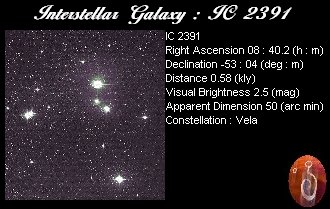
Caldwell 85 (IC2391) is the large open cluster. Dreyer calls it very large (50') and bright (mag. 2.5), consisting of 30 stars, 10 of them bright (about mag. 4 or brighter). The brightest is Omicron Velorum. It sits 1.8° NNW of Delta Velorum.
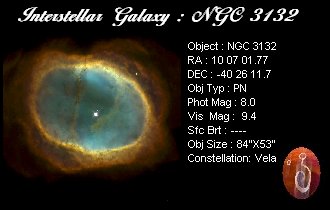
NGC 3132 is a striking example of a planetary nebula. This expanding cloud of gas, surrounding a dying star, is known to amateur astronomers in the southern hemisphere as the "Eight-Burst" or the "Southern Ring" Nebula.
The name "planetary nebula" refers only to the round shape that many of these objects show when examined through a small visual telescope. In reality, these nebulae have little or nothing to do with planets, but are instead huge shells of gas ejected by stars as they near the ends of their lifetimes. NGC 3132 is nearly half a light year in diameter, and at a distance of about 2000 light years is one of the nearer known planetary nebulae. The gases are expanding away from the central star at a speed of 9 miles per second.
This image, captured by NASA's Hubble Space Telescope, clearly shows two stars near the center of the nebula, a bright white one, and an adjacent, fainter companion to its upper right. (A third, unrelated star lies near the edge of the nebula.) The faint partner is actually the star that has ejected the nebula. This star is now smaller than our own Sun, but extremely hot. The flood of ultraviolet radiation from its surface makes the surrounding gases glow through fluorescence. The brighter star is in an earlier stage of stellar evolution, but in the future it will probably eject its own planetary nebula.
In the Heritage Team's rendition of the Hubble image, the colors were chosen to represent the temperature of the gases. Blue represents the hottest gas, which is confined to the inner region of the nebula. Red represents the coolest gas, at the outer edge. The Hubble image also reveals a host of filaments, including one long one that resembles a waistband, made out of dust particles which have condensed out of the expanding gases. The dust particles are rich in elements such as carbon. Eons from now, these particles may be incorporated into new stars and planets when they form from interstellar gas and dust. Our own Sun may eject a similar planetary nebula some 6 billion years from now.
Other Destinations In Vela
NGC2547 is a mag. 4.7 open cluster located 2° south of Regor (Gamma Velorum). Described as bright, large (20'), and little condensed, it contains about 80 stars of mag. 7-16 in a nice, powdery field. The nebulosity is the reflection type, and not visible visually.
IC2395 and NGC2670 are two open clusters that occupy the same low power field (they are separated by 56'). IC2395, located 5.3° east of Regor (Gamma Velorum), is reported variously as having an overall magnitude from 4.6-6, and with individual brightest stars ranging from mag. 5.5 to mag. 9. Estimated numbers of stars range from 16 to 40. There appears to be some confusion between the actual, fainter cluster, and a brighter grouping of stars 15' to the east.
NGC2670 is a mag. 7.8 open cluster that resembles a globular. The description is: Fairly large (9'), sparse (about 20 stars), little condensed, with stars mag. 13 and fainter. An orange star lies 2.7' to the south.
Two clusters occupy this one degree area of northern Vela 4° WNW of Suhail, Lambda Velorum. NGC2671 (Bennett 40a, mag. 12, 4') is the more northerly cluster found at the top of the image), described as fairly rich in stars, little compressed toward the middle, and containing about 40 stars of magnitude 12 to 13. Trumpler 10 extends over an area as large as 30', with a combined magnitude of 4.6. It contains about 40 stars, mag. 6.4 and fainter. The combination of the fine textured NGC2671 and the coarse Trumpler 10 is quite striking in scopes as small as 6".
Planetary Destinations In Vela

MAPPING TECHNIQUE
VISUAL EXERCISE : Two Person Exercise.
DESTINATION : Your Choice
STEP ONE
Traveller : Get comfortable and relax.
STEP TWO
Traveller : Charge your physical body with light energy.
STEP THREE
Traveller : See your visual body standing in front of your physical body and prepare your visual body for interstellar travel with a Interstellar Protection Shield.
STEP FOUR
Traveller : See your visual body filling with light energy.
STEP FIVE
Traveller : Focus your mind on teleporting your visual body to the Your Destination.
STEP SIX
Traveller : Then see your visual body teleporting to the Your Destination.
STEP SEVEN
Traveller : When you arrive in the destination Look around can you see any planets or moons in the System? If not use the Interstellar Planetary Detection Rapid and see if you can detect any planets or moons in that system.
STEP EIGHT
Traveller : If you can see or detect a planet or moon using Telekinesis or Teleportation move towards the planetary body.
STEP NINE
Traveller : When you arrive at the outer atmosphere of the planet or moon stop and ask your spiritual guide to tell you the name of this planet or moon.
Traveller : Tell the mapper the name of the planet or moon. Also tell the mapper all you can about the planet or moon.
STEP TEN
Then us the Core Comparison Crystal Technique to perform a core reading on this planet or moon and give the mapper your reading on this planet or moon
STEP ELEVEN
Traveller : Then levitate or Teleport your visual body to the surface of the planet or moon.
STEP TWELVE
Mapper : When the traveller arrives on the surface ask the following questions.
Is there any plant life or water on the surface of the planet or moon that you can see? Is there an atmosphere around this planet or moon? Is the atmosphere an match with earths atmosphere?
Mapper : Write down the answers to these questions.
PLANETARY DATA FILE 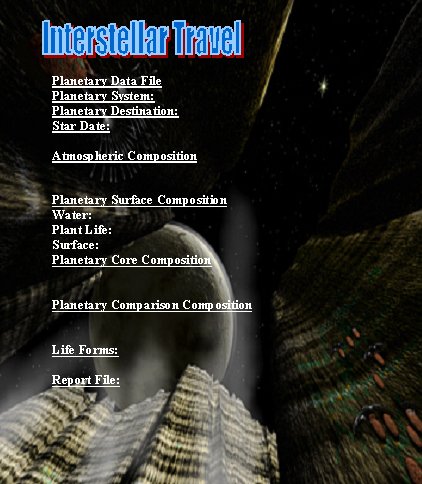
STEP THIRTEEN
Traveller : When you are finished on the surface teleport your visual body to the nearest planetary body that you can see in that Galaxy.
STEP FOURTEEN
Traveller and Mapper : Follow steps nine through to twelve again till you have mapped out the whole Galaxy.
STEP FIFTEEN
Traveller : When you have finished mapping the Galaxy teleport your visual body back to your physical body back on earth.
REMEMBER
When you are travelling if you come across an alien race that you think may be friendly feel free to make contact with that alien race.
IMPORTANT
When you are contacting alien races always be ready to teleport if there is trouble.
MAPPER
Make a note of any planets or moons with an atmospheric match with earths. That way you both know which planets can support human life forms.
MAPPER & TRAVELLER
To check that your mapping of that Galaxy is correct by changing roles and do this exercise again. Also remember to check for life force energy around the planets or moons that you visit on your journeys. Because if you can feel life force energy that means the planet or moons is a real planet or moon.
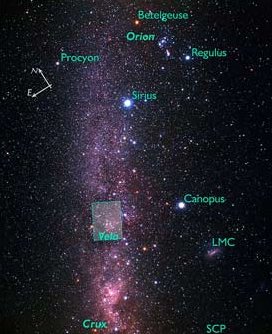
Vela's Sky Position