← The Wingmakers Ways · not in the site's own index
Archived page · Asserted
Chakras and the Channels Of Energy
Chakras_and_the_Channels_Of_Energy.html · captured from wingmakers.co.nz
Chakras And The Channels Of Energy
1st Chakra
In the beginning of evolution, the first amoeba-like single cell organisms were formed. Thereafter organisms became more and more complex, with the development of multi-cellular plants and animals and ultimately humankind.
The Mooladhara Chakra is made of the earth element and represents the beginning of life. When awakened and nourished, this association with the earth element manifests as a magnetic force within the person. For instance, a person with a strong Mooladhara center has a good inner sense of direction (in more ways than one). This chakra is at the root or foundation of the subtle system, and the Mooladhara is situated below the abode of the Kundalini, at the very base of the subtle body. In Sanskrit, "moola" means root (which is the Kundalini) and "adhara" means the support�so Mooladhara translates into supporter of the Kundalini.
The fundamental quality of the chakra is innocence, which forms the basis of every righteous character. This innocence is the quality which is evident in babies and small children. It represents action without motive or desire for gross personal gain. This innocence is accompanied by the innate wisdom of a child. A baby knows fundamental aspects of nature instinctively�it knows how to show discomfort by crying or how to suck to obtain food. This root wisdom, if left undisturbed, would develop into a balanced set of priorities in the adult. Unfortunately, the influence of human society tends to muddy this innocence and so obscure the wisdom that goes with it.
By awakening the qualities of the Mooladhara through our meditations, we learn again to be more innocent beings, to be less motive-led in our actions and to make the correct decisions in our lives. Two good examples of the power of this child-like innocent wisdom are the tale The Emperor's New Clothes and the saying "out of the mouths of babes." The pure state of Mooladhara Chakra also manifests as the wisdom of the heart�that is the ability to perceive the true meaning of what people say and do (i.e. what is really in their heart). Children again naturally have this ability as they often tune in to the feelings and subtle signals communicated rather than the face value of what is said. This center contains the potential for us to become an eternal divine child who bubbles with enthusiasm, playfulness, and love.
The Mooladhara Chakra governs the excretory and reproductive organs, and as such has a direct bearing on the sexual aspects of the human being. Some seekers have attempted to awaken the Kundalini through sexual practice (also witness the tantric sexual ritual in practices such as witchcraft and voodoo around the world). This is obviously very dangerous and can cause great harm to the chakra itself. If one remembers that the Mooladhara provides the foundation for the Kundalini, then it is easy to understand how anything which is not innocent can harm it. Sex has its place in human life as the most sublime physical expression of love within the marriage. Through the birth channel creation continues its course. However, it is something else to allow sex to dominate our lives and bring us out of balance.
After realization one learns to develop respect and proper esteem for one's own chastity and the chastity of others. This sense of right conduct is essential for the development of our own gravity and power. This power of incorruptible innocence is the foundation of all of us as human beings.
A weakened Mooladhara may show up in a number of ways: poor sense of direction, poor memory, poor sense of balance (gravity), certain "incurable" diseases, or mental problems.
2nd Chakra
The Swadisthan Chakra is suspended like a satellite on a cord from the Nabhi Chakra, and moves around the Void area giving sustenance to the ten petals of the Void (which represent the Ten Commandments). When the Kundalini rises, it passes into the Nabhi Chakra first and then along the cord to enlighten the Swadisthan and then returns to the Nabhi Chakra to continue the journey to the crown of the head.
In the course of evolution, man translated his need for shelter into the building of homes. As his sense of aesthetics developed he continued to improve on these forms of shelter until eventually architecture came about. This creativity evolved into abstract form, where he could imagine, project, and create an image which had no previous material counterpart. From this burgeoning aestheticism came the creative arts.
The fundamental quality of the Swadisthan Chakra is that of creativity. It is here that the energy for our creativity is generated. After our realization we discover that the true key to creativity is in achieving the state of thoughtless awareness (nirvichara samadhi) through our meditations. From this we discover that all the beauty of creation is reflected within us like a still and silent lake. Once we locate this pool of beauty we can become the channel for it. We become the creative instrument of the collective unconscious, without ego to distort the purity of the art. We become, as William Wordsworth observed, "a heart that watches and receives."
The process of creativity in any form draws on the qualities of the Swadisthan Chakra. If this process is accomplished in a balanced state (i.e. using the energies of the central or Sushumna Channel in the subtle system) then the result is spiritually enhanced; we can say the creation has "heart." After realization this is emphasized, and the resulting creation can be an inspired work. We can see this by looking at the classic works from artists of the past such as Mozart and Michelangelo who were born as evolved realized souls. Works of this quality are immortal and provide joy and beauty that define the whole epoch.
If artistic endeavor starts out "with heart," there can be a tendency for the artist to produce later works which are flat, lifeless, or even exploitative. The primary cause of this tendency is the ego of the artist. As the artist becomes more successful, he or she works harder to maintain or grow this success. This requires more exhaustive use of the right channel (the Pingala Nadi or channel of action). A by-product of the exhaustion of this channel is that the ego of the artist becomes inflated. Note that in subtle terms the ego is actually situated at the end of the action channel (in the balloon-like shape on the left hand side of the head). If the artist comes to believe that he is the creator of all his works (thus denying divine inspiration) the process is accelerated and the ego expands to such an extent that the spiritual content of these works is lost completely.
The most important physical function of this center is that it breaks down fat particles in the abdomen to replace the grey and white cells in the brain, and so generates the energy which fuels our thinking. Excessive thinking and planning overworks this process and exhausts this center. The Swadisthan also looks after the liver (along with the Nabhi Chakra). If the chakra is coping with excessive thinking, then the other organs it is supposed to look after are neglected. The liver is particularly susceptible to this neglect because it serves so many functions. Problems here are indicated by tingling in the thumb and middle finger of the right hand, or by prickling sensations in the hands. The liver has particular importance because it is the seat of our Attention.
Attention should not be confused with thought, which comes from Ego (our I-ness) and Superego (our past conditionings and upbringing). Attention is pure concentration without thought or mental activity. For example, when we look at a flower we put our attention on it (i.e. observe it). However we will also think about it ("that's pretty� I wonder what it is called" etc.) Attention has no associated thoughts�it is pure concentration / observation / witnessing. A balanced liver sustains and nourishes our Attention and filters it by scanning out any impurities and external clutter. From this purified Attention comes the peace and stillness that we obtain in our meditation. The liver is susceptible to overheating (via alcohol or other stimulants) which has a detrimental effect on our Attention, which ultimately weakens our meditations.
A weakened Swadisthan may show up in a number of ways: diabetes, heart disease and associated problems, difficulty meditating, or irritability. Interest in spiritualism and occult practices will also have a detrimental effect on this center. If we delve into these realms we lead the Attention into the collective subconscious areas, and we leave ourselves open to increased lethargy, and possibly even hallucinations and increased overall negativity.
3rd Chakra
The evolutionary growth of humankind mirrors the ascending chakras of our subtle system, and our corresponding spiritual growth. The Nabhi Chakra represents the evolutionary point when man's shelter became "home," when the family unit became a source of satisfaction in itself rather then just a channel of reproduction. This domestic satisfaction translates into the satisfaction that we feel with life in general after our spiritual awakening through Self-Realization.
Satisfaction is actually a key word for the Nabhi Chakra. Some "hot livered" people are naturally irritable. For them life without worry is an impossibility, and they will express their discontent at the slightest excuse. When our Spirit manifests, we can put things into their true perspective, and worry becomes an unusual occurrence. In the peace of thoughtlessness, we can only be content. We realize that the Spirit is not concerned with passing trends and fashions or a button missing here or there.
The Nabhi is the center of welfare, both physical and financial. As man developed his creative powers further he also learned to harness nature's resources to his advantage�and thus grew prosperous. Prosperity is a necessary step in evolution, and money is a valid medium of exchange in order to obtain the essential needs and desires of man. If we do not have the means of satisfying the basic needs then they will continue to preoccupy our attention, diverting us from the true direction. We have been blessed with intelligence and a versatile body through which we can work to raise the means to fulfill our needs. When these needs are satisfied, then these mundane matters no longer occupy us or block our growth.
4th Chakra
When a child is born, the first thing that it responds to is the Spirit of its mother. At the moment of his birth he is not aware of his body or that of this mother, but he is aware of the Spirit. The moment he comes out of the womb he suffers a shock, and his first reaction is to get back to the womb. At this stage his mind, conditionings, and ego aspects are not developed. He is pure Spirit, and it is this pure Spirit that finds comfort in the Spirit of this mother and through that comfort, sustenance in the new alien environment. This response is true love or unconditional love; it is not a conditioned response, but the sheer joy of the fusion of two Spirits.
The Heart Chakra is the home of the Self, the Spirit, Atman�all mean the same thing. Time and again Shri Mataji has stressed that "You are nothing but an eternal Spirit." In this way she is telling us that we have to realize and become our Spirit, and leave behind the futility of the illusion we live in. We start the process of becoming our Spirit after realization, as we start to lose our false identifications with our body, mind, and feelings. Only after this enlightenment can we take our Attention to our heart and cleanse it. The Spirit can only manifest when our heart is open and clean, at which point we feel the eternal joy of creation and the meaning and purpose of our place in it. We clean our heart through our pure desire and through our Attention. Saying affirmations such as "I am the Spirit" are effective in this process, but it must be from the heart and not a mechanical action.
Pure love, which enlightens us all, is the real quality of the Heart Chakra. In the unrealized state we rarely love for love's sake. Because of our conditionings we confuse feelings of love with those of possession, sex, and selfishness. Pure love is detached, it gives without interest. Like the tree which gives shade to one and all, it is without prejudice or motive. True love is the quality that emanates from the Spirit and not from the body or mind. When we talk of loving someone, we should understand the direction in which this love is flowing. Bodily attraction is physical. It can arise out of sex appeal or even from an artist's or marketer�s projection. There are even those who exercise seductive arts to ensnare a good "catch." We can see this in those who indulge in excessively trendy fashions. These people are especially at risk in their relationships because they relate not as two Spirits, but as two fashionable physical forms. This kind of physical attraction is not true love because it comes from the mind, and the mind does not love�it merely wants. When the want of the mind is attained, the novelty wears off and the mind just wants something else.
Love is often mistakenly thought of as being restricted to male-female relationships. In fact, love is the flow of life in all limbs, between children and parents, brothers and sisters, friends, old people, etc. Where many people share and care, then the whole society opens up its heart center. It becomes a collective society and changes the world. This is the power of love. Love is the principle behind all creation, all vibrations. We say that God is love and love is God, because in its depths we cease to be. In true love there is no "I" and "You," there is simply the merging in the Spirit. Where there is love there is growth, celebration, joy, and evolution.
Most problems arise from fear. If we live in fear, then our natural immune system is weakened and we become vulnerable to allergies and disease. If we have self-confidence, the basis of which is love, we have strong defenses which protect against base desires and negative outside influences. Our personality grows and shines when our heart is strong, and we approach life with a will to win like a warrior. It is the love which becomes compassion which makes us reach out without thinking to help mankind. This is a spontaneous act, not an intellectual decision, and arises when fear is healed by love.
Our relationships with our parents have their place in the Heart Chakra. Our physical mother has her place in the left heart, and our father has his place in the right heart. Once we realize that our parents have this place within us, we don't try to run away from any problems in any way and we face our responsibilities. At all times we should treat our parents with the love and respect which is their due.
Parents should likewise raise their children in a pure life, which will encourage their spiritual development. They should love them without attachment and fear, knowing that they are the trustees of their children. If parents do not practice what they preach, they cannot set a proper example to their offspring. How we get along with our spouse is also a matter of the heart. If one partner dominates the other or is possessive, then the love is stifled and the relationship is disturbed. Vibrations of the Spirit's love must have the freedom to flow, and each partner must respect one another and not block the other's growth by force of personality or will.
The family unit is important to society, and the foundation of this unit is respect, love, and duty between the members�parents and children. If the family ideal collapses, society is soon to follow. We just have to witness the problems of violence and substance abuse amongst children in societies where the family has been neglected to see this connection. The seat of the Heart Chakra is located in the Brahmarandra at the crown of the head (in the Sahasrara chakra). This is where the Kundalini energy unites with the all-pervading energy of the universe.
5th Chakra
The Vishuddhi Chakra represents that time in the evolution of humanity when the need for harmony and collective living became important. It represents everything to do with the cohesive nature of the human race and the ability of human beings to rise above petty differences and strive to experience the unity of the Spirit.
One of the qualities that we need to develop for our spiritual growth is that of staying detached from the problems we face every day while trying to survive in the modern world. The flowering of the Vishuddhi Chakra provides us with a sense of detachment which lets us witness the "play" of life to survive in the modern world. As a result we can avoid being brought down by things which seem traumatic, but are in fact simply "events" which we pass through to reach the other side. This does not mean that we stop accepting responsibility for our actions or that we "give up" on life. It simply gives us a means to maintain a sense of perspective when we are faced with overwhelming emotional situations. We become a witness of the game, and can keep a distance from our involvement and thoughts, from our planning and conditionings, and from our emotions.
After realization our ability to be a witness matures, and we see all of these things as existing outside ourselves. These things, these events, are not of our Spirit, they are of the external world. In this way we strip away the layers of identity to reveal our fundamental and indivisible essence, the Spirit. Shri Mataji says that "we see our own acting, and the whole world becomes like a drama," in the same way that Shakespeare likened the whole world to a stage, and us as actors on it.
The truth is that our problems are only really solved when we can "see the forest for the trees." It is a fact that most people find that they cannot solve their own problems because they are too involved in them. That is why they seek advice from their friends (who can give a detached view of the best course of action) or in extremes from counseling agencies who may act as dispassionate witnesses. After our realization we develop this ability within ourselves, and no matter what tests we face we start to see our role in the drama and the possible solutions with that much more clarity.
The Vishuddhi Chakra also embodies those qualities which govern our relationship with other members of the human race. Our diplomacy in word and action is directly affected by the state of this center, as is our sense of respect, both for others and for ourselves. If we do not respect others, then we will not be able to practice a relationship of brotherhood and diplomacy with them, and so it is a very important chakra for our growth into a collective spiritual being.
Lack of respect for ourselves (which manifests as guilt) lodges itself deep in our left Vishuddhi if we let it, and this can be very harmful to our growth. A lot of guilt is the result of our upbringing, whether through moralistic or pious pressures. These external pressures are not us. We must learn to not cling to guilt or hide ourselves in its cloak and thereby put off the day when we must face up to our weaknesses and do something about them. The Spirit does not accumulate guilt, it is Pure. After realization we learn to face and overcome our weaknesses, and thus conquer guilt once and for all. The affirmation for the left Vishuddhi is "I am not guilty."
Our growth into a collective being is very easy to chart through our deepening awareness of vibrations. As we start to become one with the whole (as the microcosm awakens and becomes an integral part of the macrocosm) we begin to feel the direct evidence of the subtle system or our chakras and on the chakras of others. This is what is meant by the actualization of Sahaja Yoga, this actual evidence of our enlightenment which we experience on our fingertips and in our bodies. It is a fact that as we become a collectively conscious person, we can work on the spiritual systems of others simply by recording the state of their chakras on our fingers and directing our vibrations to their areas of need as required. It is rather like acquiring a new perception, a natural new sense�that of subtle vibrations. This brotherhood of humanity is the goal that seekers have been searching for over many lifetimes, and it is starting its manifestation at this point in time, not just as myth or concept, but through direct evidence.
The Vishuddhi Chakra has sixteen petals, each with different qualities and functions. On the physical side it looks after the throat, arms, face, mouth, teeth, etc. These should therefore be taken care of properly. For instance, we should protect ourselves from extremes of cold and avoid tobacco and other pollutants which can damage the throat. We should take proper care of our teeth and ensure that we respect everything we do in our communication with others. Our hands, also, can be a source of grace and beauty or coarseness if used improperly. We should therefore take care to exhibit sweetness in all our actions.
6th Chakra
The 6th (Agnya) Chakra is situated in the center of the brain area, and represents the sixth stage of man�s evolution. We can identify its position as the middle of the forehead. It is the gateway to the Sahasrara Chakra, and so will not allow the Kundalini to rise above if there are any impurities in the mind. When the Kundalini passes through this Chakra, our thought waves elongate so that the space between the two thoughts grows wider. This space is silence, and as the petals of the Chakra open up, silence blossoms in the center and spreads outwards, pushing our thoughts to the periphery of our awareness. This is where the state of "thoughtless awareness" happens. In this state we actually feel the beautiful silence, the stillness, which is at the heart of creation.
The primary quality of the Agnya Chakra is forgiveness. At this point in our evolution man had developed a sophisticated society, but with this sophistication came the problem of ego - the idea that he was doing it all. This problem of I-ness was accelerated by the continuing success of these material gains - flourishing civilizations, world trade routes and other such trappings. The natural result of this could only be an inflated Ego, and this arrogance was further fuelled by the conditionings of upbringing and environment (e.g. from parents and friends), the perils of the Superego.
The human mind is divided into an Ego and Superego. These are located at the uppermost endpoints of the channels of Ida Nadi (the Moon Line or Left Channel) and Pingala Nadi (the Sun Line or Right Channel). These two channels cross over at the Agnya Chakra. Everything which relates to the past (such as memories, conditionings, and emotions) accumulates as a residue in the Superego on the right - having crossed over from the Left Channel. Everything which relates to the future (such as thinking, planning, action, etc.) likewise accumulates as a residue, but in the Ego on the left side of the brain. We can liken these residues to hot exhaust gasses which come from too much activity in the particular channel.
So, for instance, as we overexert ourselves in planning for the future (next years holidays, next years birthdays, etc.) we generate an excess of energy in the Right Channel. This is actually a process of exhausting the channel as it takes away the natural balance of the channels by emphasizing one at the expense of the other. This excess energy rises like a smog obstructing our Spiritual growth. Before our Realisation each of us are in varying states of imbalance in our channels, and the result is a varied smog consisting of Ego and Superego exhaust, which drift together to obstruct our Spiritual ascent up through the Central (Sushumna) Channel. The Kundalini simply cannot penetrate the combined smog to complete our Yoga at the Sahasrara Chakra.
It is because of this state of affairs that the fontanel area (the soft area on our skull that we are born with) calcifies and hardens at a fairly early age, and we begin to develop our separate identities and our concept of I. As the Heart then starts to become enveloped by the Ego, we lose sight of the Spirit and identify only with the one we call I. It is not that we should want to destroy our Ego, it has a very useful place in our being. Without it we would not be able to act at all. But we need to bring it into balance with the Superego in order to create a space through which the Kundalini can ascend to pass into the Sahasrara. And controlling Ego is a hard task to master.
Forgiveness (and forbearnance) and humour are perhaps the most effective methods. The Ego is a creature of action. It thrives on doing - on punishing for a wrong, on effecting a change, on obtaining a desire. By practising forbearance, we slow down the fuel of the Ego, we force the Ego to wait. By so doing our Spirit then has the time to shine through in our action, and the true course becomes manifest.
Humour also provides a strong dose of medicine for an Ego in full flight. It is easy to deflate the balloon of Ego and pull it back into proportion by pricking it with a pin of humour. By watching the Ego as a witness, we can begin to see its subtle tricks and manipulations, and then we see the joke of it all. We can never fight the Ego, that is a contradiction of terms (fighting requires action, the action is Ego, Ego fights Ego...?) We can only bring it down with our laughter, and then our Heart will break through its stranghold.
The Ego and the Superego border the outlying regions of the subtle universe. The Superego is in the Individual Subconscious realm, where all of our past knowledge and experience is stored. Beyond this is the Collective Subconscious, which is the area where spiritualists and mediums ply their trade of the past. The Ego is in the Individual Supraconscious, the realm of the future. It is in the Collective Supraconscious that clairvoyants, visionaries and seekers of power conduct their business of the future. Exploration of any of these realms is extremely dangerous. Shri Mataji says they are essentially the same: "It makes no difference if it is the black fumes of the coal (subconsciuos), or the yellow fumes of the Benzol (supraconscious). Both are equally suffocating."
Amongst other things, the Agnya Chakra governs our sight. We should therefore respect our eyes as a gift with which the beauty of the Divine creation is revealed to us. We should not waste or abuse that gift. To stop the eyes from wandering, or from suffering from attention on gross things, we should look at the natural things like sky and grass
7th Chakra
In the 7th (Sahasrara) Chakra the whole instrument is integrated. Each Chakra has its place here. At the point of the Sahasrara we go beyond the relative, to the Absolute, and into the Absolute realization of Heaven on Earth. This is a country far beyond our wildest imaginings, so much more than our words can even begin to imply. This is our ultimate destination, stretching out forever. Our progress toward this goal is a living process. When a seed matures it naturally sprouts. William Blake described it perfectly:
"Thou perceivest the flowers put forth their precious odours, and none can tell how so small a center comes such sweets. Forgetting that within that center eternity expands."
When the Kundalini reaches the Sahasrara, the lotus petals open and enlightenment takes place (samadhi). You may feel a powerful pulsation in the crown of the head, followed by a melting sensation and a flow of cool vibrations from the fontanel area. This is the baptism by which you know that you are truly born again.
Vibratory awareness begins at this point. As the Kundalini unites our individual consciousness to the universal consciousness, we are suddenly tuned in to the universal wavelength of vibrations. These vibrations pervade the cosmos, but before realization, while we are still in the egg form, we know nothing of them. When the Kundalini breaks the shell of the egg, we emerge into God's Kingdom, the collective unconscious. At this point we are singing the song of the unconscious, the vibrations are playing through the instrument that we have become.
As human awareness is united to the Divine, we move into the subtlest level of communication, into collective consciousness. In becoming vessels for that universal power we become one with all the other vessels. We learn to appreciate the real depth and beauty of another person in vibrations. The beauty of art and nature now manifest themselves as vibrations. Just ask the question and a positive answer comes as a flow of cool vibrations. It is conversation at its most sublime.
When our Kundalini is awakened, our eternal Spirit is enlightened and we feel vibrations. We also can awaken the Kundalini of others after our own awakening. We can give Self-Realization to others, we can cure sickness and we can share the message of Divine Love with the entire world. Lord Jesus said, "I will send you a Comforter, a Counselor and a Redeemer, The Holy Spirit, who will teach you all things."
When human consciousness tunes into the infinite, it becomes infinite. Enlightenment develops spontaneously. The sages have sung the praises of this space and have described it poetically as the union between the lover and his beloved. The Buddha called it the Void, Mahavira termed it Nirvana, the Vedas called it Moksha, and the Christ referred to it as the Kingdom of Heaven. Shri Mataji describes it thus: "The limited capacity of the brain becomes unlimited in its capacity to realize God. If you are the sun and the sunlight, if you are the moon and the moonlight, where is duality? Only when there is separation there is duality and because of that separation you feel attachment... a distance between you and yours; that's why we get attached to it. Everything is we; who is the other? When the brain has lost its identity, the so called limited brain becomes the unlimited Spirit."
The Channels Of Energy
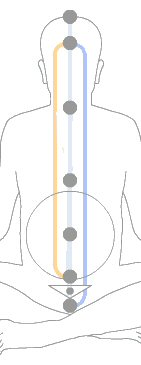
Pingala Nadi
The right channel (�Pingala Nadi� in Sanskrit) is also called the Sun Channel. It begins at the Swadisthan Chakra (2nd center) and travels up the right side. It crosses over to the left temple (ego) at the Agnya Chakra. It provides the conduit for our active energy. This energy is comprised of our mental and physical activities.
When the demand for energy on this side is too great, the left side is weakened; the desire to have joy of the Spirit evaporates. When the right side dominates, the personality becomes very dry and aggressive. Excess pressure shoots up into the left temple and into the ego, causing it to inflate into a balloon that blocks the central channel. The entire system is thrown off balance. Blinded by ego, sensitivity to our own emotions is diminished. Decisions and actions are taken that dominate or disrupt the lives of others with a firm belief that they are necessary and logical. Taken to this extreme, right-sided behavior leads to heart disease. The high-tech, high-powered, "fast-track" environments of the Western world's cities and suburbs are generating predominantly right-sided citizens. It is difficult to maintain equilibrium between emotions and action when work, school, and shopping environments are aggressive and stressful. It is difficult to maintain a peaceful home where the imbalances and negativities can be corrected and purified. Instead, most of us go back to work or school with the accumulated negativities of the past clinging to our systems.
Sahaja Yoga practices are effective at removing negativity and balancing the chakras and channels. Using simple meditation and techniques such as footsoaking, lying on the ground, sweeping the aura, and shoebeating, you can begin each day with joy from the open chakras and energetic power from a balanced system. You can revitalize yourself and the relationships around you simply by working on yourself from the inside out.
The state of the right channel is felt on the right side of the body. In the beginning, it is most easily felt on the right palm.
Ida Nadi
The left channel (�Ida Nadi� in Sanskrit) is also called the Moon Channel. It begins at the Mooladhara (1st chakra) and runs up the left side, crossing over at the Agnya Chakra (6th center) into the temple and superego on the right side of the brain. It provides the conduit for the energy of our desire.
The left channel (�Ida Nadi� in Sanskrit) is also called the Moon Channel. It begins at the Mooladhara (1st chakra) and runs up the left side, crossing over at the Agnya Chakra (6th center) into the temple and superego on the right side of the brain. It provides the conduit for the energy of our desire.
From these desires or wishes, our emotions are triggered. Emotions are actually desires that have not yet materialized. These desires and the attendant feelings about them travel through this left channel to the appropriate places in the body to bring about the actions of fulfillment. Our desires are essential for action. Without their impetus we would have nothing to act upon.
The greatest quality of the left side is to provide joy which is the steady condition of the Spirit. You may remember having this joy as a child, or you may have observed it in small two- or three-year-old children. They usually wake up in the morning happy. While they may experience physical and emotional pain once in a while throughout their day, they do not cling to it with memory. Rather, they cry, recover, and resume the steady state of joy. The desire for this joy is still alive inside us the same as it was when we were infants. It may be blocked or covered with "tarnish" from emotional or physical injuries experienced in living life. Before Sahaja Yoga, we did not have effective techniques for clearing away the hurts and blows that are normal in living active life. The practice of Sahaja Yoga helps us remove those old tensions and recover that joy as a steady state of being.
Problems of the left side tend to result in passivity or emotional extremism whereby we are thrown between elation and depression. With this type of imbalance, self-discipline becomes difficult and bad habits become hard to correct. In the worst case, we become lethargic and self-obsessed. Because this channel feeds also into the skull area, pressure on the brain becomes excessive. This cycle is what causes such problems as mental breakdown, epilepsy, and senility (decay of the brain).
The state of the left channel is felt on the left side of the body. In the beginning it is most easily felt on the left palm.
Sushumna Nadi
The central channel (�Sushumna Nadi� in Sanskrit) is also called the Middle Path. It begins at the place where the Kundalini resides and passes straight up the spine to the highest charka (the 7th or Sahasrara Chakra).
As the conduit for the parasympathetic nervous system, the central channel coordinates our involuntary or autonomic nervous system activities. We do not have conscious control over these activities. Our heart beats, our lungs breathe, our blood system manufactures plasma, our brain centralizes and coordinates communication, our mind performs "word processing"... all of these incredible functions, and more, operate more powerfully than forty billion computers. These operations are performed regardless of where our attention is focused. They seem to have no need for our conscious control. Yet, miraculously, the involuntary activities of our body function according to an organized operating plan with such complex interactions, syntheses, and communications that our deepest medical scientific research, which is now even probing into the DNA, recognizes that still we have only revealed the tip of the iceberg. We have discovered that the human system is so vast and so ingenious that even to get some type of rudimentary understanding of it requires recognition of our ignorance of it. We are at a new frontier. This is what Sahaja Yoga is about.
The activities that take place through the parasympathetic system are spontaneous happenings. They happen naturally, without our doing anything. The rising of the Kundalini and her work, as well as all spiritual activities, are spontaneous. Hence the term Sahaja was selected to label this type of yoga because it means spontaneous. The implication of the parasympathetic nature of the Middle Path is that the rise of the Kundalini is totally beyond our own volition or control. This is why in actuality Shri Mataji acts as a catalyst.
Once our Kundalini has been awakened and has traveled through this central channel and out the top of the head, we can begin to become aware of the vast internal galaxy of our subtle system. This initial "enlightenment" or realization is only the beginning of our greatest adventure.ns at the Swadisthan Chakra (2nd center) and travels up the right side. It crosses over to the left temple (ego) at the Agnya Chakra. It provides the conduit for our active energy. This energy is comprised of our mental and physical activities.
When the demand for energy on this side is too great, the left side is weakened; the desire to have joy of the Spirit evaporates. When the right side dominates, the personality becomes very dry and aggressive. Excess pressure shoots up into the left temple and into the ego, causing it to inflate into a balloon that blocks the central channel. The entire system is thrown off balance. Blinded by ego, sensitivity to our own emotions is diminished. Decisions and actions are taken that dominate or disrupt the lives of others with a firm belief that they are necessary and logical. Taken to this extreme, right-sided behavior leads to heart disease. The high-tech, high-powered, "fast-track" environments of the Western world's cities and suburbs are generating predominantly right-sided citizens. It is difficult to maintain equilibrium between emotions and action when work, school, and shopping environments are aggressive and stressful. It is difficult to maintain a peaceful home where the imbalances and negativities can be corrected and purified. Instead, most of us go back to work or school with the accumulated negativities of the past clinging to our systems.
Sahaja Yoga practices are effective at removing negativity and balancing the chakras and channels. Using simple meditation and techniques such as footsoaking, lying on the ground, sweeping the aura, and shoebeating, you can begin each day with joy from the open chakras and energetic power from a balanced system. You can revitalize yourself and the relationships around you simply by working on yourself from the inside out.
The state of the right channel is felt on the right side of the body. In the beginning, it is most easily felt on the right palm.
Other Links