← The Wingmakers Ways · not in the site's own index
Archived page · Asserted
Sagitta
Ursa_Major_Constellation.html · captured from wingmakers.co.nz
Ursa Major 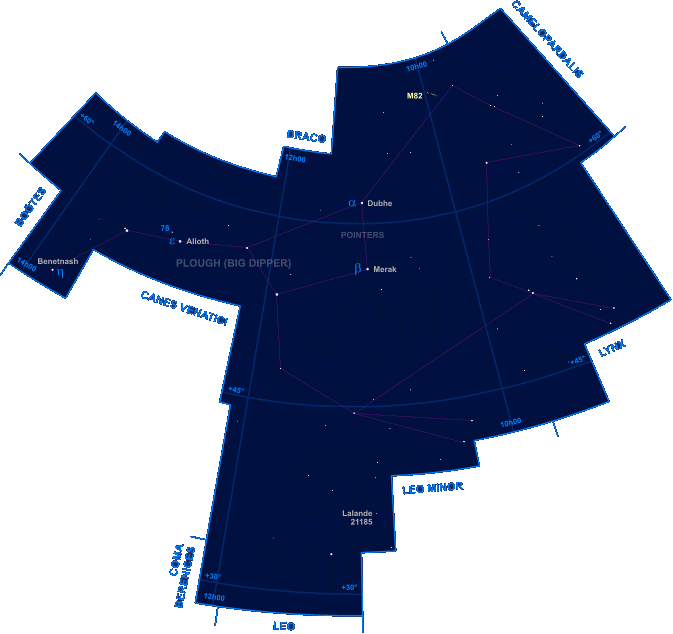
The Great Bear
The Big Bear, Ursa Major, is the third largest constellation in the skies, seen at northern sky in evening of spring. The constellation has no first magnitude stars, but the Big Dipper that forms the bear's tail is a rough guide on the clarity of the evening's sky.
Though Ursa Major contains no bright celestial objects, it has plenty of galaxies in outer space.
Ursa Major Energy Centre Of Life
1. Triangles of Energy - Constellations
Lying behind all the many interlocking triangles in our solar system and conditioning them to a very large extent (though today more potentially than expressively) are three energies coming from three major constellations. They are the emanations from the Great Bear, from the Pleiades and from Sirius. It might be pointed out that: [416]
- The energies coming from the Great Bear are related to the will or purpose of the solar Logos and are to this great Being what the monad is to man. This is a deep mystery and one which even the highest initiate cannot yet grasp. Its sevenfold unified energies pass through Shamballa.
- The energies coming from the sun, Sirius, are related to the love-wisdom aspect or to the attractive power of the solar Logos, to the soul of that Great Being. This cosmic soul energy is related to the Hierarchy. You have been told that the great White Lodge on Sirius finds its reflection and a mode of spiritual service and outlet in the great White Lodge of our planet, the Hierarchy.
- The energies coming from the Pleiades, an aggregation of seven energies, are connected with the active intelligent aspect of logoic expression, and influence the form side of all manifestation. They focus primarily through Humanity.
Connected with this major triangle and affecting powerfully our entire solar system is a triple interrelation of great interest, which has a special and peculiar relation to humanity. This triangle of forces relates one of these major constellations, one of the zodiacal signs and one of the sacred planets within our solar system.
First Triangle: The Pleiades - Cancer - Venus. Humanity.
Second Triangle: The Great Bear - Aries - Pluto. Shamballa.
Third Triangle: Sirius - Leo - Jupiter. Hierarchy.
I wonder if you can grasp at least partially and symbolically the fact that these triangles must not be thought of as placed, static and eternally the same, or even as three dimensional. They must be regarded as in rapid movement, revolving eternally in space and ceaselessly moving onward and as of fourth and fifth dimensional extension. There is no way of depicting them or of bringing them visually to your attention, for only the inner eye of vision can imagine their progression, position or appearance. These three major triangles are only partially as yet in expression as far as our solar system is concerned and only one point of the great triangle - as for instance one point of the Great Bear - constitutes with Aries a related line of force; only one point of Aries - within itself or within its own range of interplay with Leo and Capricorn (see Tabulation VIII) is related to Pluto. Therefore the entire cosmic web and solar system is an intricate, constantly moving, interwoven series of triangles wherein each point of a triangle emanates three lines or streams of energy (nine in all); it is likewise responsive to and receptive of the energies - likewise triple in nature - which lie within its periphery or sphere of influence and vibratory activity.
It is useless for students to attempt to unravel this aggregation of interlacing streams of energy. All that is now possible for man with his present equipment is to accept hypothetically these statements anent certain major triangles which affect humanity and seek to prove their effect and to endeavor to arrive at some understanding of that intricate, interwoven network which he himself possesses and to which [418] he gives the name "etheric body." Thus he may succeed in proving the accuracy of a statement by the demonstrated quality of the life aspect, its conditioning and results in the microcosmic life history and events. This astrology has sought to do in connection with tangible happenings on the outer plane of existence; we, however, will see to it that our effort lies along the line of psychological life history and events and not along the line of physical occurrences. This difference is basic and must ever be borne in mind. Astrologers have begun to grasp a dim idea of the interlocking triangles of energy as far as our Earth is concerned in the rather arbitrary division of the twelve constellations into four triplicities, covered by such qualifying terms as earthy triplicity or fiery triplicity, composed each of a cardinal, a fixed and a mutable sign. They thus divide up the entire zodiac into a fourfold group of interlacing and interrelated triads, each conditioned by one of the basic elements and thus qualified. These constitute a series of basic triangles with a definite reference to our planetary life. Owing to the constant movement everywhere, inherent in the solar system and the zodiac - onward, interior and revolving - some idea can be grasped of the intricacy of the entire pattern. A further aid to the grasping of this essential beauty of coordinated and organized movement and its power to qualify and condition the entire universal pattern can be gained by those students who have studied somewhat the various triangles to be found in the etheric body of man through the interrelation of the seven centers to which I have referred elsewhere in my various books. These centers, when awakened and alive, are swept finally within the radius of each others' sphere of action; from the point of view of living energy, the circumference of these wheels or vortices of force becomes so enlarged that they eventually [419] overlap and touch, presenting on a tiny scale a condition analogous to the contacting and interlocking series of triangles such as those referred to above.
One of Messier's celestial bodies M40 is positioned about 1.5 degrees north east of delta UMa, one of stars that forms the Big Dipper. But the number of M40 is informal one, we cannot find out any noticeable nebulae nor star clusters where Messier had recorded. In present, some star charts or guidebooks provide minor double stars of "W4" as M40. This double stars with 9th magnitude is inconspicuous one without worthy of mention. Incidentally the double stars have a separation of about 50 arc seconds.
You can see two small and faint galaxies just west (on right hand side of this picture) of M40, brighter one is NGC4290 and dimmed one has a number of NGC4284.
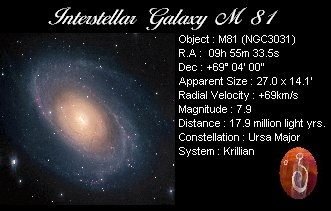
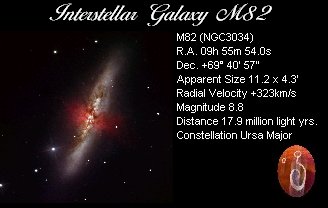
This image presents two bright galaxies just above the Big Bear's head. This pair float about 18 million light years away, can be recognized only with binoculars as two tiny light points. M82 (NGC3031) seen at the lower is a superb spiral galaxy, and forms a splendid pair with M82 (NGC3034). M82 at the upper isn't a spiral on edge, but is considered as spindle shaped.
The galaxy is rather mysterious; it's thought that an explosion about 1.5 million years ago made the odd shape, M82 is famous as "The Exploding Galaxy". It's known that those galaxies had drawn near some ten millions years ago. And it's considered that the gigantic gravitational interaction in that time made the activity in M82.
NGC 3077 is a smaller member of the M81 group, located 45' ESE of M81. It looks like an elliptical galaxy, but is peculiar because of two reasons: First, it shows whispy edges and scattered dust clouds similar to M82, probably a result of gravitational interaction with its larger neighbors - similar reason as for M82. This appearance is the reason for classifying at as E2p, p for "peculiar", or irregular of type II. Second, this galaxy has an active nucleus which caused Carl Seyfert in 1943 to include it in his list of galaxies, later called Seyfert Galaxies. However, NGC 3077, though an emission line galaxy, is now no more classified as a Seyfert galaxy.
NGC 3077 was discovered, together with NGC 2976 another faint M81 group member, by William Herschel on November 8, 1801, who assigned it the catalog number H I.286. He remarked that "On the nf (NE) side, there is a faint ray interrupting the roundness." Admiral Smyth described it as "A bright-class round nebula; it is a lucid white, and lights up in the centre. .. between these [stars,] the sky is intensely black, and shows the nebula as if floating in awful and illimitable space, at an inconceivable distance."
You can find out a reddish planetary nebula of M97 at about 2 degrees southeast of beta UMa (Merak). The nebula is called "Owl Nebula" for its two dark central areas that resemble an owl's eye. The eye is revealed only in the larger telescopes. The expanding shell of its central star forms the planetary nebula. Although its size is only 3 arc minutes or so, easily detectable because of its unexpectedly bright surface. You will be able to appreciate pretty owl's face with high magnifying power over 100. The nebula is estimated about 7460 light years.
And you can see another noticeable celestial body of M108 only 50 arc minutes NW of M97.
101 (NGC5457) is a vast galaxy with open spirals, equivalent size to about two-third of the Moon and about 22 million light years away. Although seen face on, it's dim and it takes a large scope and a good sky to see this nebula at its best.
The galaxy is located 4 degrees east of zeta UMa (Mizar), the second star from the tip of the Big Dipper's handle, and the usual method given to find M101 is to the hop of several stars with fifth or sixth magnitude from Mizar.
M108 is a faint irregular galaxy about 2 degrees southeast of beta UMa (Merak), it shows us its edge being on, and you can see a long ellipse via telescopes. It lookes like a shrinked M82, a irregular and bright galaxy in Ursa Major. The galaxy M108 has a length of about 8 arc minutes, but faint with a magnitude of 10.7, it's hard to enjoy the shape unless you have a high magnification and extremely good conditioned night.
You can find out a famous planetary nebula of M97, Owl Nebula, about 50 arc minutes southeast from M108. The distance is estimated about 23 million light years.
M109 (NGC3992) is a small galaxy only 40 arc minutes SE of gamma Ursae Majoris with second magnitude that marks one of the cup of Big Dipper. The bright star can be seen in this photo in the upper right hand side. The galaxy has a size of about 8 arc minutes and a magnitude of only 10.6; it's one of the most indistinct objects in the Messier's Catalogue. Now, the major catalogue of celestial objects has 110 members. But M110 (one of satellite galaxies of the Andromeda Galaxy, M31) is unauthorized number; in short, it can be said that M109 is the "genuine" last object in Messier's.
You can detect the galaxy as a normal dimmed light with naked eyes through medium-sized telescopes. And the bar-like structures stretching from central bright region can be taken in long exposure photographs.
NGC2841 is a bright spiral at a claw of Big Bear's forefoot. This picture shows you a dimmed figure like a elliptic galaxy, and bright nucleus and dark lane crossing in slant can be seen. Big telescopes will give you an image with arms coiled up tightly. The galaxy has a long axis of about 8 arc minutes and a visual magnitude of 10.
NGC3079 is a galaxy at around the root of Big Bear's forefoot. You can find out it about 8.3 degrees west of beta UMa. The galaxy has been classified in spiral galaxy, but it's an edge-on and has an irregular structures. The galaxy has a length of over 7 arc minutes, its slender shape can be enjoyed with a medium-sized telescopes.
NGC3184 is a dimmed spiral galaxy positioned at only 45 arc minutes west of mu Ursae Majoris that forms the tip of Big Bear's one of hind legs. It's almost on a boundary on Leo Minor. The galaxy has a visual brightness of 10.5, but it looks fainter than this magnitude so it's fairly difficult to distinguish its detailed structure through telescopes. Though this picture is a bit noisy, you can see NGC3184 as a typical face-on galaxy and two arms coiled up loosely. And the galaxy is about 7 arc minutes in diameter.
NGC 3718 is a highly disturbed galaxy in Ursa Major. Astronomers originally thought that NGC 3718 was a Lenticular Galaxy. However later photos showed two faint extensions that emerge from the envelope on opposite sides of the periphery, showing that it is most likely a spiral galaxy. The galaxy forms an interacting pair with NGC 4753 (outside of the Kopernik image above). The distance to NGC 3718 is roughly 52 Million Light Years.
Some astronomers include NGC 3718 in the class of galaxies with active nuclei known as LINERs (Low-Ionization Nuclear Emission-line Regions). Others classify it as Seyfert galaxy. Many astronomers believe that active galactic nuclei are powered by giant black holes lurking in the center.
NGC 3718 is also known as Arp 214, and is in Arp's class of "galaxies with irregularities, absorption and resolution". Arp noted that the galaxy is a "Barred spiral, (with a) sharp nucleus, narrow absorption lanes through center".
Lalande 21185 Planetary System
Lalande 21185 is the fourth system closest to Sol after Alpha Centauri 3, Barnard's Star, and Wolf 359. The star is located only about 8.3 light-years away in the southeastern corner (11:03:20.19+35:58:11.55, ICRS 2000.0) of Constellation Ursa Major, the Great Bear which also encompasses the Big Dipper -- northwest of Alula Borealis (Nu Ursae Majoris). It is about three times too faint to be seen with the naked eye.
NGC2787 is a spiral galaxy lying in northwest region of Ursa Major. The galaxy can be found out about 3 degrees west from the Bode's Galaxies (M81 & M82). NGC2787 has a round apparent shape, and no major features. A dimmed light is surrounding bright core.
NGC3945 is a minor galaxy with a long axis of 5 arc minutes positioned near midway between alpha and beta UMa. The galaxy is classified in indistinct bared galaxies. A bright nucleus is surrounded by rather dimmed region and furthermore very indistinct light encircles inner structures. Medium-sized telescopes can show you only central features, it's difficult to detect outer dimmed part.
This is a compact but unique-shaped galaxy NGC4088. You can find out the galaxy around the midway of M106 and M109. The galaxy has a long axis of 6 arc minutes, a dimmed elliptic light can be detected through medium-sized telescopes.
This galaxy has been classified in spiral galaxies but it has also some features of bared galaxies. It can be seen that NGC4088 has a pair of S-shaped stretched arms and another pair coiled up tightly.
NGC4157 is an edge-on galaxy in the constellation of Ursa Major. You can find out uncountable small galaxies in this star field, it's difficult to identify individuals. You can catch this minor one around midway of M109 and M106, two major galaxies with Messier's ID.
The galaxy has an apparent size of 6 x 1 arc minutes and fainter than 12th magnitude. This image shows you a very inconspicuous central nucleus.
IC2574 lying northern region of Ursa Major. The galaxy has a long axis of 13 arc minutes and has no major structures. It's a minor deepsky object floating 3 degrees ESE of Bode's Galaxies (M81 & M82).
Planetary Destinations In Ursa Major
MAPPING TECHNIQUE
VISUAL EXERCISE : Two Person Exercise.
DESTINATION : Your Choice
STEP ONE
Traveller : Get comfortable and relax.
STEP TWO
Traveller : Charge your physical body with light energy.
STEP THREE
Traveller : See your visual body standing in front of your physical body and prepare your visual body for interstellar travel with a Interstellar Protection Shield.
STEP FOUR
Traveller : See your visual body filling with light energy.
STEP FIVE
Traveller : Focus your mind on teleporting your visual body to the Your Destination.
STEP SIX
Traveller : Then see your visual body teleporting to the Your Destination.
STEP SEVEN
Traveller : When you arrive in the destination Look around can you see any planets or moons in the System? If not use the Interstellar Planetary Detection Rapid and see if you can detect any planets or moons in that system.
STEP EIGHT
Traveller : If you can see or detect a planet or moon using Telekinesis or Teleportation move towards the planetary body.
STEP NINE
Traveller : When you arrive at the outer atmosphere of the planet or moon stop and ask your spiritual guide to tell you the name of this planet or moon.
Traveller : Tell the mapper the name of the planet or moon. Also tell the mapper all you can about the planet or moon.
STEP TEN
Then us the Core Comparison Crystal Technique to perform a core reading on this planet or moon and give the mapper your reading on this planet or moon
STEP ELEVEN
Traveller : Then levitate or Teleport your visual body to the surface of the planet or moon.
STEP TWELVE
Mapper : When the traveller arrives on the surface ask the following questions.
Is there any plant life or water on the surface of the planet or moon that you can see? Is there an atmosphere around this planet or moon? Is the atmosphere an match with earths atmosphere?
Mapper : Write down the answers to these questions.
PLANETARY DATA FILE 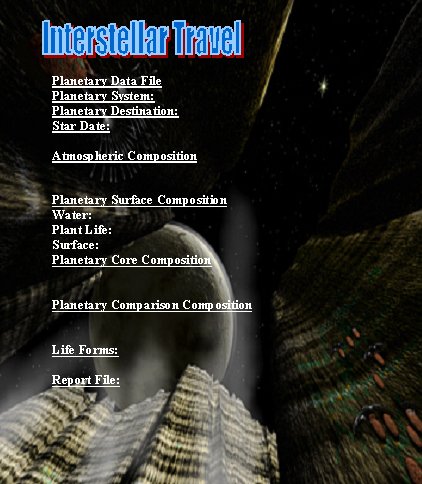
STEP THIRTEEN
Traveller : When you are finished on the surface teleport your visual body to the nearest planetary body that you can see in that Galaxy.
STEP FOURTEEN
Traveller and Mapper : Follow steps nine through to twelve again till you have mapped out the whole Galaxy.
STEP FIFTEEN
Traveller : When you have finished mapping the Galaxy teleport your visual body back to your physical body back on earth.
REMEMBER
When you are travelling if you come across an alien race that you think may be friendly feel free to make contact with that alien race.
IMPORTANT
When you are contacting alien races always be ready to teleport if there is trouble.
MAPPER
Make a note of any planets or moons with an atmospheric match with earths. That way you both know which planets can support human life forms.
MAPPER & TRAVELLER
To check that your mapping of that Galaxy is correct by changing roles and do this exercise again.
Also remember to check for life force energy around the planets or moons that you visit on your journeys. Because if you can feel life force energy that means the planet or moons is a real planet or moon.