← The Wingmakers Ways · Astronomy & Exoplanets
Archived page · Checkable
Cancer
Cancer.html · captured from wingmakers.co.nz
Cancer
The Cancer is a compact constellation squeezed between Leo and Gemini, members of zodiac. The constellation is in the shape of a monster of crab crushed by Hercules.
Navigation
The Universe
Mapping Technique
Sky Maps
The Constellations
Andromeda ....
Antila .....
Apus .....
Aquarius ....
Aquila .....
Ara .....
Aries .....
Auriga
Caelum .....
Camelopardalis ....
Cancer .....
Canes Venatici .....
Canis Major .....
Canis Minor
Capricornus ....
. Carina .....
Cassiopeia .....
Centaurus .....
Cepheus ....
. Cetus .....
Chamaeleon .....
Circinus
Columba .....
Coma Berenices .....
Corona Austrina .....
Corona Borealis .....
Corvus
Crater .....
Crux .....
Cygnus
Delphinus .....
Dorado .....
Draco
Hercules .....
Horogium .....
Hydra .....
Hydrus
Lacerta .....
Leo .....
Leo Minor .....
Lepus .....
Libra .....
Lupus .....
Lynx .....
Lyra
Mensa .....
Microscopium .....
Monoceros .....
Musca
Octans .....
Ophiuchus .....
Orion
Pavo .....
Pegasus .....
Perseus .....
Phoenix .....
Pictor .....
Pisces .....
Piscis Austrinus
Puppis .....
Pyxis
Saggita .....
Sagittarius .....
Scorpio .....
Sculptor .....
Scutum .....
Serpens Cauda
Serpens Caput .....
Sextans
Taurus .....
Telescopium .....
Triangulum .....
Triangulum Australe .....
Tucana
Ursa Major .....
Ursa Minor
Vela .....
Virgo .....
Volans .....
Vulpecula
Constellation Chart
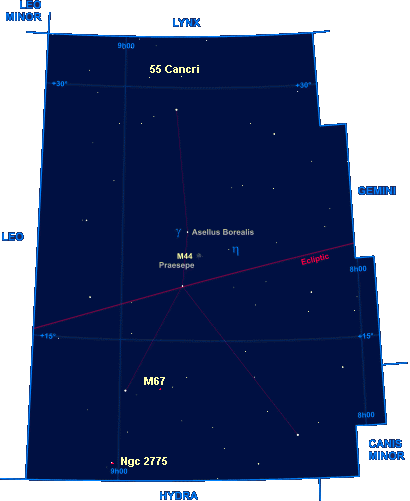
The Cancer is a compact constellation squeezed between Leo and Gemini, members of zodiac. The constellation is in the shape of a monster of crab crushed by Hercules. The constellation of Cancer has a famous and splendid open cluster of Praesepe (M44) at the shell of the crab.
M44 (NGC2632) is a bright open cluster clearly visible to the naked eye on a dark enough sky. The cluster is well-known as "The Praesepe", meaning of a crib, and also called "The Beehive Cluster" in English. It's best appreciated with binoculars or small scope, its 1.5 degree size is equivalent to about three full-moons end-to-end, and distance is estimated about 520 light years.
This grouping is so large it was known in antiquity, when it was thought to be something non-stellar object like a nebula. Japanese had regarded the cluster as a lump of souls in the ancient time, and the sight of it had terrified them.
M67 (NGC2682) is an open cluster about 9 degrees south-east of the Praesepe (M44), with a diameter of 15 arc minutes. The cluster is positioned just 2 degrees west of alpha Canicri, so it should be easy to find the figure like a nebula with binoculars. You can appreciate the individual stars with a telescope over 6cm (2.4"), plenty of faint stars with magnitude about 11 to 13 are scattered like gold dust, and detectable that the whole of shape is like a hemisphere. M67 consists of about 100 stars, and they're over ten billion years old. Distance from the solar system is estimated about 2700 light years.
NGC2775 is a small outer galaxy positioned at southeastern edge of the constellation of Cancer, near the border to Hydra. You can find out the galaxy about 4 degrees ENE of zeta Hydrae that forms the Hydra's head. The galaxy can be detected as a round dimmed light with a brightness of 11th magnitude and an apparent diameter of about 5 arc minutes, and a medium-sized telescope can catch a central nucleus.
Planetary Destinations In Cancer
Parent Star: iota Cancri, is 55 Cancri ( rho1 Cancri / HD 75732 )(G8 V) in the constellation of Cancer is located at a distance of 43.7 Light Years from our Solar system Co-ordinates are Right Ascension: 08 52 37.60 & Declination: +28 20 02.6. The apparent Magnitude of the star is 5.95. The Inner Edge of Habitability Zone is 0.42 AU & the Outer Edge of Habitability Zone: 1.32 AU . Orbiting around 55 Cancri are planetary objects of 55 Cancri e, 55 Cancri b, 55 Cancri c, 55 Cancri d. 55 Cancri Solar System
55 Cancri e is believed to be a Hot Super Earth and its exitence has been confirmed. The Planets Appearance is Silicate clouds over dark sodium haze. The planet is positioned out side of Habitability Zone at Mean Orbital Distance of 0.038 ± 0.001 AU . The planet Orbits around the star every 2.808 ± 0.002 Days. It's mass is 14.31 ± 3.18 Earths and was discovered by McArthur et al in 2004.
55 Cancri b is believed to be a Clarified Jovian and its exitence has been confirmed. The Planets Appearance is Blue and cloudless. The planet is positioned out side of Habitability Zone at Mean Orbital Distance 0.115 ± 0.003 AU. The planet Orbits around the star every 14.67 ± 0.0006 Days. It's mass is 0.784 ± 0.09 Jupiters and was discovered by Marcy and Butler in 1996.
55 Cancri c is believed to be a Clarified Jovian, Eccentric and its exitence has been confirmed. The Planets Appearance is Blue and cloudless. The planet is positioned out side of Habitability Zone at Mean Orbital Distance of 0.24 ± 0.005 AU. The planet Orbits around the star every 43.93 ± 0.021 Days. It's mass is 0.217 ± 0.04 Jupiters and was discovered by Butler et al in 2002.
55 Cancri d is believed to be a Ammonia Cloud Jovian, Eccentric and its exitence has been confirmed. The Planets Appearance is White ammonia and water ice clouds, brown hydrocarbon stains. The planet is positioned out side of Habitability Zone at Mean Orbital Distance of 5.257 ± 0.9 AU. The planet Orbits around the star every 4517.4 ± 77.8 Days. It's mass is 3.92 ± 0.5 Jupiters and was discovered by Butler et al. on 13 Jun 2002.
Double stars:Zeta Cancri is a notable triple system comprised of a close binary with a period of 59.5 years and a more distant star, component C, with a much longer period of 1115 years. (These values are recently published revisions; formerly the two orbits were thought to be 59.7 and 1150 years.)
This distant companion also has its own binary star, which revolves about zetaC every 17.6 years. It has never been seen, and its existence has only been discovered through a particular wobble of zetaC. The unseen star is thought to be a white dwarf.
Phi Cancri is a binary of two identical white stars (5.5m, 6m): the PA is 217º and separation is 5.1".
Iota Cancri is a wide binary (4.5, 6.5) with a striking colour contrast: yellow and blue. PA 307º separation 30.5".
Finally, for the perseverant, there are a number of binary systems visible in the Beehive Cluster (see below). We'll point out two of them, very close to each other.
The brightest is Struve 1254. The primary is a bright 6.5m, with a 9.0m companion B at 54º, 20.5". Then there are two more components: C: 8.0, 342º, 63.2"; D: 9.0, 43º, 82.6".
To find this group, first locate epsilon Cancri, which is near the centre of the Beehive Cluster and the brightest star in this cluster. Just to the northwest of this star, less than a minute's distance, you'll find this binary system.
In the same field (slightly west and less than a minute south of Struve 1254) is the nice quadruple called beta 584, comprised of 7.0, 12.0, 7.0, and 6.5 visual magnitudes.
AB is the most difficult to find, for the companion is a faint 12m star at 291º and separation of only 1.2". AC: 156º, 45"; AD: 241º, 93".
Variable stars:
Cancer has no outstanding variables, but there are two which might be of some interest.
Kappa Cancri is an alpha-CVn type variable: 5.22-5.27 every five days.
Alpha-Canum Venaticorum type stars are rotating variables which typically evince very little change in visual magnitude. These stars are generally A-type (that is, they have a spectrum range of B9-A5) but curiously enough they show an unusual abundance of a number of heavy metals and a corresponding lack in the more common elements.
These stars are divided into three groups: those with predominantly silicon spectral lines, those with manganese, and those with chromium-strontium lines. Kappa Cancri shows a strong manganese line.
R Cancri is a Mira-type variable with period of 361.6 days and a magnitude change from 6.07 to 11.8. In the year 2000 the maximum should arrive in the first week of October.
Copyright © Wingmakers.co.nz - All rights reserved.