← The Wingmakers Ways · Astronomy & Exoplanets
Archived page · Checkable
HD 149026 b
HD_149026_b.html · captured from wingmakers.co.nz
HD 149026 B
Orbiting around HD 149026 is planet HD 149026 b the planet is believed to be
a cloudy hot Jupiter and its exitence has been confirmed.
Planetary Systems
Solar Systems
Planets that transit their stars offer a unique glimpse into their composition and structure. HD 149026 is a Saturn mass planet in a tight orbit that takes it in front of its star, from the Earth's vantage point, once every 2.877 days. The dimming caused by these transits revealed that HD 149026 b's radius is only about 72 percent that of Jupiter, much smaller than expected. Already knowing the mass of the planet from radial velocity observations of its star, HD 149026 was found to have a density of 1.4 times that of water.
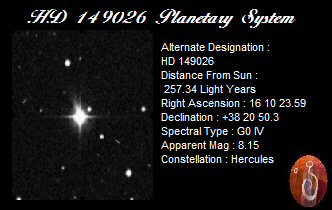
Location
Constellation:
Right Ascension:
16 30 29.6
Declination:
+38 20 50.3
Distance from Sol:
257.34 Light Years
Basic Data
Alternate Designations:
HD 149026
Spectral Type:
G0 IV
Apparent Magnitude:
8.15
B-V Color:
0.611
Radius:
1.45 Solar Radii
Effective Temperature:
6147 Kelvin
Habitability
Inner Edge of Habitability Zone:
0.82 AU
Outer Edge of Habitability Zone:
2.56 AU
HD 149026 b
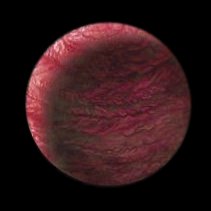
HD 149026 b Statistics
Object Type:
Cloudy Hot Jupiter
Parent Star:
HD 149026 (G0 IV)
Discovery Status:
Confirmed
Mass :
0.36 ± 0.03 Jupiters
Radius:
0.725 Jupiters
Mean Distance:
0.042 AU
Orbital Period:
2.8766 ± 0.001 Days
Eccentricity:
0
Planet Appearance:
Silicate clouds over dark sodium haze
Year Discovered:
2005
Detection Method:
Doppler Spectroscopy, Transit
Discovered By:
SATO B., FISCHER D., et al
Hot jovians are expected to have low density due to the intense stellar heating they receive. But HD 149026 b's density is high for a gas giant, especially one so close to its star. To explain this high density, theorists believe that between one half and two thirds of the planet's mass is composed of heavy elements. Several attempts to model the interior of HD 149026 b suggest that the planet has a rocky metallic core of about 65 Earth masses surrounded by a layer of superdense water under a mantle of liquid metalic hydrogen.
A planet with such a large rocky core was unexpected and immediately raised questions on how the planet was able to accumulate so much heavy material during its formation. According to theory, a massive rocky protoplanet should have quickly acquired a thick envelope of gas, becoming a gas giant, well before it could accumulate 65 Earth masses of heavy material.
One possibility is that the gigantic core is the result of a colision between two planets. Such a collision would probably have knocked the resulting planet out of its original orbital plane. To test this theory, observations are currently under way to determine if the planet is orbiting in a different plane than its star is rotating.
Another possibility is that the planet formed in a region of the star's protoplanetary disk that was gas-poor, allowing it to accrete more rocky material than normally possible.
Also possible is that the massive core was formed by the absorption of many smaller bodies over time. Planets in such close in orbits cannot scatter would be impactors like outer planets can. It is possible that HD 149026 b has been a magnet for smaller rocky planets and planetoids, causing its core to expand over time.
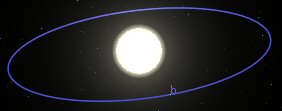
Planetary Orbit Of HD 149026 b
Greeting cards, poetry, santa letters, gifts books, and more!
Books
Reflections Of the Heart
Whispers of the soul
Silhouette
Seasons-Change
Online Books Stores
NZ.bookshop.co.nz
The Book Depository.co.uk
Fishpond.co.nz
Directories
Christchurch Business N.Z
International Business Directory
Australian & New Zealand Classified Directory