← The Wingmakers Ways · Astronomy & Exoplanets
Archived page · Checkable
OGLE-2005-BLG-390L
OGLE-2005-blg-390Lb.html · captured from wingmakers.co.nz
OGLE-2005-blg-390
-----------------------------------
Navigation
Solar System
Sun
Mercury
Venus
Earth
Mobius
Mars
Jupiter
Saturn
Uranus
Neptune
Pluto
2004 DW
Quaoar
Sedna
2002 AW197
2003 UB313
Comets
Meteorites
Asteroids
Planetary Moons
Earth
The Moon
Saturn
Titan
Tethys
Enceladus
Dione
Extra Solar Planets
Lensing Galaxy - Einstein Cross
Interstellar Card
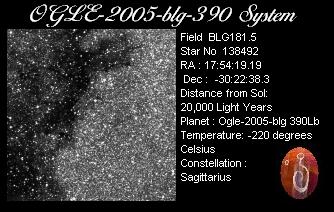
CONSTELLATION : Sagittarius
Basic Data
OGLE-2005-BLG-390
Field BLG181.5
Star No 138492
RA (J2000.0) 17:54:19.19
Dec (J2000.0) -30:22:38.3A new planet-hunting technique has detected the most Earth-like planet yet around a star other than our sun, raising hopes of finding a space rock that might support life, astronomers reported on Wednesday.
"This is an important breakthrough in the quest to answer the question 'Are we alone?'" said Michael Turner of the National Science Foundation.
"The team has discovered the most Earth-like planet yet, and more importantly, has demonstrated the power of a new technique that is sensitive to detecting habitable planets," Turner said in a statement.
In the last decade, astronomers have detected more than 160 planets orbiting stars outside our solar system. The vast majority of these have been gas giant planets like Jupiter, which are hostile to life as it is known on Earth.
But an international team has detected a cold planet about 5-1/2 times more massive than Earth -- still small enough to be considered Earth-like -- orbiting a star about 20,000 light-years away in the constellation Sagittarius (The Archer), close to the center of the Milky Way.
A light-year is about 6 trillion miles (10 trillion km), the distance light travels in a year.
To find this new planet -- named OGLE-2005-BLG-390Lb -- the team used a technique called gravitational microlensing.
This method uses a network of telescopes to watch for changes in light coming from distant stars. If another star passes between a distant star and a telescope on Earth, the gravity of the intervening star acts like a lens and magnifies the incoming light.
When a planet is circling the closer star, the planet's gravity can add its own signature to the light, the scientists said in research being published in the current edition of the journal Nature.
This kind of light signature was observed on July 11 by a group of telescopes participating in a project known as OGLE, short for Optical Gravitational Lensing Experiment, which sees more than 500 microlensing events each year.
At first, OGLE scientists did not know that a planet was responsible for the change in the light.
They went to two other groups of telescope-using scientists, RoboNet and PLANET (Probing Lensing Anomalies NETwork), who eventually confirmed the presences of a previously unknown planet.
The Planet
Parent Star: OGLE-2005-BLG-390 in the constellation of Sagittarius is located at a distance of 20,000 Light Years from our Solar system Co-ordinates of Right Ascension: 17:54:19.19 & Declination: -30:22:38.3. The apparent Magnitude of the star is unknown. The Inner Edge of Habitability Zone is unknown & the Outer Edge of Habitability Zone: unknown. Orbiting around 2003-BLG-235 is planet OGLE-2005-BLG-390Lb the planet is believed to be a Earth Like planet and is the first planet like earth found outside of our solar system and its exitence has been confirmed. The Planets Appearance is rock and ice. The planet Orbital Distance is unknown at this time. The temperature is approximately -220 degrees Celsius. The planet mass is approximately 5 earths and was discovered on 26/01/2006.
System Components
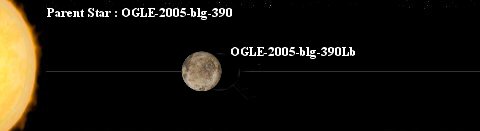
Planetary Data File
Planet Surface : The planet is made up of rock and large areas of ice and is very cold.
Atmosphere : There is a light atmosphere on the planet.
Plant Life : There seems to be no life forms on the surface of the planet.
Water : There are large masses of ice on the planet there doesn't seem to be any rivers how ever there may be a under ground water system beneath the rock and ice surface.Planetary Orbit
Copyright Wingmakers.co.nz - All rights reserved.