← The Wingmakers Ways · Astronomy & Exoplanets
Archived page · Checkable
HD 62509
HD62509.html · captured from wingmakers.co.nz
New Found Solar System in gemini orbiting around HD 62509, Pollux-Beta Geminorum
HD 62509
Solar System
Our solar system is one of natural beauty and the home of the human race as wingmakers.
The Planets
Sun
Mercury
Venus
Earth
Earth & Moon
Mobius
Mars
Jupiter
Saturn
Uranus
Neptune
Pluto
2004 DW
Quaoar
Sedna
2002 AW197
2003 UB313
Comets
Meteorites
Asteroids
Planetary Moons
Earth
The Moon
Saturn
Titan
Tethys
Enceladus
Dione
Space & Beyond
Directories
International Business Directory
Interstellar Card 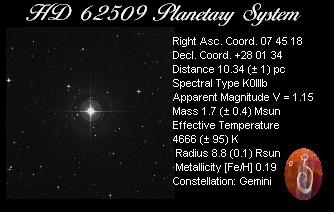
Parent Star : HD 62509
Distance : 10.34 (± 1) pc
Spectral Type : K0IIIb
Apparent Magnitude : V = 1.15
Mass : 1.7 (± 0.4) Msun
Effective Temperature : 4666 (± 95) K
Radius : 8.8 (± 0.1) Rsun
Metallicity [Fe/H] : 0.19
Right Asc : Coord. 07 45 18
Decl. Coord : +28 01 34
Constellation : Gemini
The Ninth Creative Hierarchy
Fourth Kumara
Name : HD 62509 / Pollux Solar System
Cosmic Ray : VI
Energy : Desire for duality
Sign : GeminiHD 62509 / POLLUX (Beta Geminorum). In northern spring evenings, the "twin" stars Castor and Pollux of the constellation Gemini descend the northwestern sky looking like a pair of eyes staring down at the Earth. They are twins only in mythology, these warriors, Pollux fathered by Zeus and divine, Castor mortal, both placed in the sky to allow them to be together for all time. The northernmost of the zodiacal constellations, Gemini is also among the brightest, helped by first magnitude Pollux and second magnitude Castor. An exception to the rule, brighter Pollux, the sky's 17th brightest star, was given the Beta designation by Bayer, while somewhat fainter Castor is known as Alpha Geminorum. In fact, Pollux and Castor are nothing like twins, Castor a white quadruple star with fairly hot components (actually sextuple if you count a distant pair of companions) and Pollux an orange-colored cool giant, the nice pairing with Castor making Pollux's color more vivid. From its distance of 34 light years, we calculate a visual luminosity for Pollux 32 times that of the Sun, and coupled with its 4500 degree-Kelvin temperature, a diameter some 11 times solar, making it smaller than most of its cool giant brethren and only a quarter the dimension of Aldebaran. Direct measures of angular size, however, yield a somewhat smaller diameter 8.3 times that of the Sun. As a warmer kind of giant star, Pollux emits X-rays and seems to have a hot, outer, magnetically supported corona perhaps similar to that surrounding our Sun.
Solar System
HD 62509A 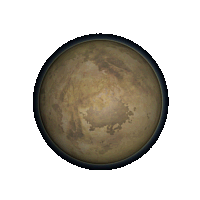
Planetary Data File
Planet Appearance: Thin or No Atmosphere
Atmosphere : No Match
Plant Life : No the Planet is Lifeless
Water : No Water
Life Forms : No Life Forms
Parent Star: HD 62509
Planetary Number : HD 62509A Planet
Year Discovered : 2 July 2006
BY : Darryn 732
HD 62509B 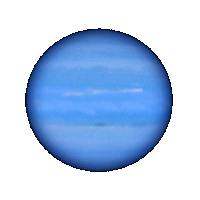
Basic Data
Parent Star: HD 62509 ( Spectral Type K0IIIb ) in the constellation of Gemini is located at a distance of 3 10.34 (± 1) pc from our Solar system Co-ordinates of Right Ascension: 07 45 18 & Declination: +28 01 34 . The apparent Magnitude of the star is V = 1.15 . The Inner Edge of Habitability Zone is unknown & the Outer Edge of Habitability Zone: Unknown orbiting around HD 62509 is planet HD 62509b the planet is believed to be a Clarified Jovian planet and its exitence has been confirmed. The Planets Appearance is Sulfur stained clouds of water at Mean Orbital Distance most likely outside the habitability zone. The planets Orbits around the star every 589.64 (± 0.81) days . The mass of the planetary body is 2.3 (± 0.45) MJ and was Discovered in 2006. Additional Designations: BET Gem
Planetary Data File
Planet Appearance: Sulfur stained clouds of water
Atmosphere : No Match
Plant Life : No the Planet is Lifeless
Water : No Water
Life Forms : No Life Forms
Parent Star: HD 62509
Planetary Number : HD 62509b Planet
Year Discovered: 2006Planetary Orbit Of HD 62509
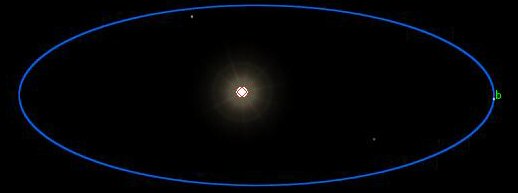
Orbital Data
Semi major axis 1.64 (± 0.27) AU
Orbital period 589.64 (± 0.81) days
Eccentricity 0.02 (± 0.03)
HD 62509C 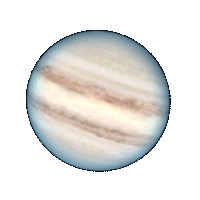
Planetary Data File
Planet Appearance: Thin or No Atmosphere
Atmosphere : No Match
Plant Life : No the Planet is Lifeless
Water : May Have Water on the surface
Life Forms : Unknown
Parent Star: HD 62509
Planetary Number : HD 62509c Planet
Year Discovered : 2 July 2006
BY : Darryn 732
HD 62509D 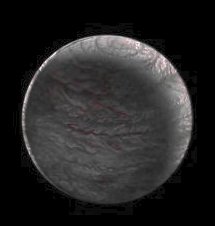
Planetary Data File
Planet Appearance: White ammonia and water ice clouds, brown hydrocarbon stains
Atmosphere : No Match
Plant Life : No the Planet is Lifeless
Water : No Water
Life Forms : No Life Forms
Parent Star: HD 62509
Planetary Number : HD 62509d Planet
Year Discovered : 2 July 2006
BY : Darryn 732
HD 62509E 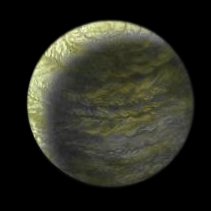
Planetary Data File
Planet Appearance:
White ammonia and water ice clouds, brown hydrocarbon stains
Atmosphere : No Match
Plant Life : No the Planet is Lifeless
Water : No Water
Life Forms : No Life Forms
Parent Star: HD 62509
Planetary Number : HD 62509e Planet
Year Discovered : 2 July 2006
BY : Darryn 732
HD 62509F 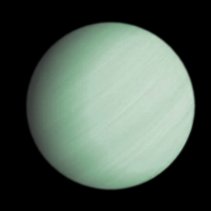
Planetary Data File
Planet Appearance: Blue with methane clouds and hazes
Atmosphere : No Match
Plant Life : Not Likely
Water : No Water
Life Forms : No Life Forms
Parent Star: HD 62509
Planetary Number : HD 62509f Planet
Year Discovered : 2 July 2006
BY : Darryn 732
HD 62509G 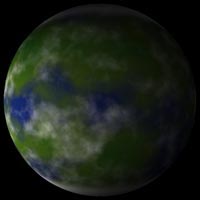
Planetary Data File
Planet Appearance : White water ice clouds
Atmosphere : May be a close match with earths atmosphere
Plant Life : Possible Planet Life
Water : Water in the way of oceans and rivers
Life Forms : May be Life Forms on the surface
Parent Star: HD 62509
Planetary Number : HD 62509g Planet
Habitability: Planet at Earthlike Temperatures at Mean Orbital Distance
Year Discovered : 2 July 2006
BY : Darryn 732
HD 62509 Solar System
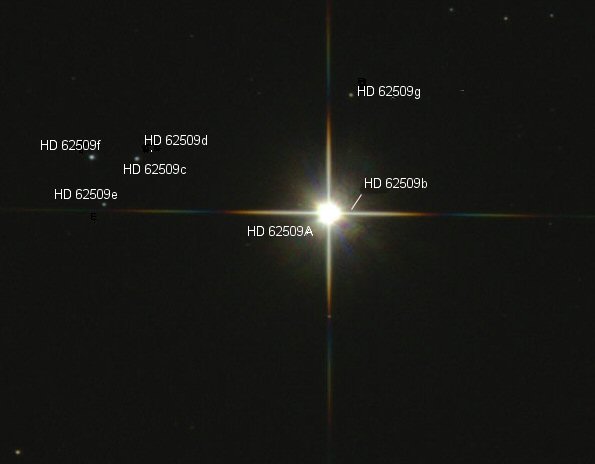
Location In Gemini 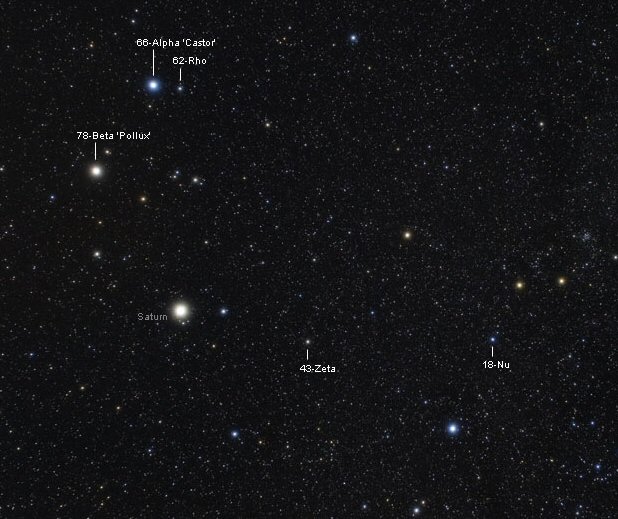
Extrasolar Planets
Lensing Galaxy - Einstein Cross
Planetary System : mu Ara / HD 160691
Copyright © 2006 Wingmakers.co.nz All rights reserved.