← The Wingmakers Ways · not in the site's own index
Archived page · Asserted
Gliese 876
universe_extrasolar_Gliese_876.html · captured from wingmakers.co.nz
Gliese 876
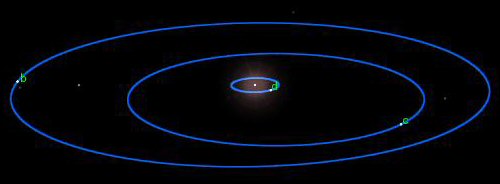
Orbiting around Gliese 876 in the constellation of Aquarius we find three extra solar planets orbiting. Gliese 876 d, Gliese 876 c, and Gliese 876 b
| Home | Contents | Christchurch Business N.Z | International Business Directory | Australian & New Zealand Classified Directory | Business Opportunity |
Interstellar
Interstellar TravelMilky Way
Solar System
Planets
Constellations
Planet's
Solar Systems
Parent Star: Gliese 876 (M4 V) in the constellation of Aquarius is located at a distance of 15.4 Light Years from our Solar system Co-ordinates of Right Ascension: 22 53 13.4 & Declination: -14 15 13. The apparent Magnitude of the star is 10.17. The Inner Edge of Habitability Zone is 0.06 AU & the Outer Edge of Habitability Zone: 0.2 AU and the estimated stellar lifespan of the star is 305175 million years. Orbiting around Gliese 876 are planet Gliese 876 b, Gliese 876 c, Gliese 876 d.
Location
Constellation:
Right Ascension:
22 53 13.4
Declination:
-14 15 13
Distance from Sol:
15.4 Light Years
Basic Data
Alternate Designations:
IL Aqr
Ross 780
HIP 113020
Spectral Type:
M4 V
Apparent Magnitude:
10.17
Mass:
0.32 Solar Masses
Radius:
0.42 Solar Radii
Effective Temperature:
3240 Kelvin
Habitability
Inner Edge of Habitability Zone:
0.06 AU
Outer Edge of Habitability Zone:
0.2 AU
Gliese 876 D
Gliese 876 D Statistics
Object Type:
Clarified Neptunian
Parent Star:
Gliese 876 (M4 V)
Discovery Status:
Confirmed
Mass :
7.314 + 0.954 Earths
Mean Distance:
0.02 + 0.0000005 AU
Orbital Period:
255.87 + 0.06 Days
Eccentricity:
0
Estimated Mean Temp:
642 Kelvin
Mean Angular Star Size:
11.17 Degrees
Year Discovered:
2005
Detection Method:
Doppler Spectroscopy
Discovered By:
Rivera et al.
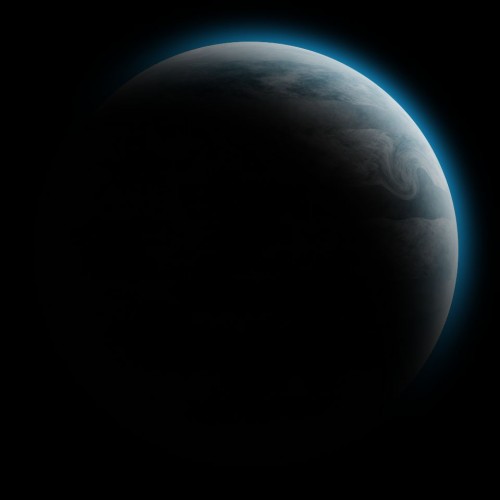
Gliese 876 d the planet is believed to be a Clarified Neptunium planet and its existence has been confirmed. The planets appearance is blue and cloudless . The planet is positioned out side of Habitability Zone at Mean Orbital Distance of 0.02 + 0.0000005 AU and the estimated radius of the planet is 7.314 1 0.954 Earths . The planet Orbits around the star every 255.87 + 0.06 Days and was discovered by Rivera et al in 2005.
Superearth Gliese 876 d is only 7.5 Earth masses, making it as of mid 2005 the smallest extrasolar planet known around a normal star. At such a low mass, it must be composed primarily of rock, although its rocky surface may lie beneath a thick layer of super condensed volatiles and a dense atmosphere. If, on the other hand, most of the planet's volatiles have been lost to early bombardment or were never present in large quantities, the rocky surface of Gliese 876 d may be visible from space. Baked both internally by the heat of radioactive decay and externally by its close proximity to its star, such a massive terrestrial world have a thin crust riddled with tectonic rifts and possibly even oceans of magma exposed on the surface.
Gliese 876 C
Gliese 876 C Statistics
Object Type:
Water Cloud Jovian, Eccentric
Parent Star:
Gliese 876 (M4 V)
Discovery Status:
Confirmed
Habitability:
Planet at Earthlike Temperatures at Mean Orbital Distance
Mass :
0.56 Jupiters
Mean Distance:
0.13 AU
Orbital Period:
30.12 Days
Eccentricity:
0.27
Planet Appearance:
White water ice clouds
Estimated Radius:
0.952 Jupiters
Estimated Mean Temp:
251 Kelvin
Mean Angular Star Size:
1.718 Degrees
Year Discovered:
2001
Detection Method:
Doppler Spectroscopy
Discovered By:
Marcy et al
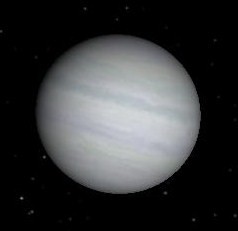
Gliese 876 c the planet is believed to be a Sulfurous Cloud Jovian planet and its existence has been confirmed. The planets appearance is White water ice clouds. The planet is at Earthlike Temperatures at Mean Orbital Distance of 0.13 AU and the estimated radius of the planet is 0.952 Jupiter's 1. The planet Orbits around the star every 30.12 Days and was discovered by Marcy et al in 2001.
Gliese 876 B
Gliese 876 B Statistics
Object Type:
Water Cloud Jovian
Parent Star:
Gliese 876 (M4 V)
Discovery Status:
Confirmed
Mass :
1.935 + 0.007 Jupiters
Mean Distance:
0.207 + 0.00003 AU
Orbital Period:
60.94 + 0.013 Days
Eccentricity:
0.0249 + 0.0026
Planet Appearance:
White water ice clouds
Estimated Radius:
1.026 Jupiters
Estimated Mean Temp:
199 Kelvin
Mean Angular Star Size:
1.079 Degrees
Year Discovered:
1998
Detection Method:
Doppler Spectroscopy
Discovered By:
Marcy and Butler, Confirmed by Delfosse and Mayor
Gliese 876 b the planet is believed to be locked in a 1:2 harmonic orbit with it's sibling Gliese 876 c and is a water cloud Jovian planet and its existence has been confirmed. The planets appearance is White water ice clouds. The planet is positioned at the outer edge of Habitability Zone at Mean Orbital Distance of 0.207 + 0.00003 AU and the estimated radius of the planet is 1.026 Jupiter's 1. The planet Orbits around the star every 60.94 + 0.013 Days and was discovered by Marcy and Butler, Confirmed by Delfosse and Mayor in 1998.
Planetary Orbit Around Gliese 876
Inspirational Writings
Greeting cards, poetry, santa letters, gifts books, and more!