← The Wingmakers Ways · not in the site's own index
Archived page · Asserted
Our Solar System
Solar_System~2006.html · captured from wingmakers.co.nz
Solar System
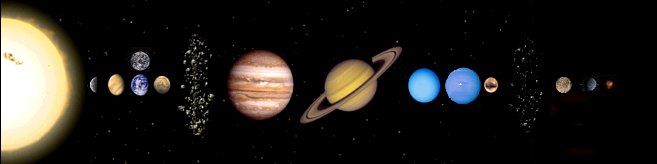 Our solar system is one of natural beauty and the home of the human race as wingmakers.
----------------------
Universe Page
The Planets
Sun
Mercury
Venus
Earth
Earth & Moon
Mobius
Mars
Jupiter
Saturn
Uranus
Neptune
Pluto
2004 DW
Quaoar
Sedna
2002 AW197
2003 UB313
Comets
Meteorites
Asteroids
Planetary Moons
Earth
The Moon
Saturn
Titan
Tethys
Enceladus
Dione
Space & Beyond
Directories
International Business Directory
Introduction
Our solar system is one of natural beauty and the home of the human race as wingmakers. We should start here in our solar system for there is no place like home out there anywhere. Learn more about your own backyard before travelling to other galaxies and solar systems.
System Components
(Mass In Multiples Of jupiter's Mass) 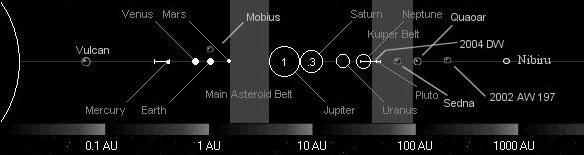
The Planets
The Planet Vulcan
On the day in question, March 26 1859, Dr Lescarbault entered the small observatory he�d built onto his house and trained his heliostatic-telescope at the sun. As he watched he saw a dot appear near the upper left-hand edge of the sun and move gradually
downwards. He was fascinated since, as an experienced solar observer he knew this was no sunspot. Soon afterwards, he was called away to see to a patient but, when he returned, the object was still there moving steadily across the sun. Lescarbault watched the object for several hours until it disappeared.
The planet Mercury is very difficult to study from the Earth because it is always so close to the Sun. Even at elongation, it is never more than 28 degrees from the Sun in our sky. It is the second smallest planet (it was believed to be the smallest until the discovery that Pluto is actually much smaller than originally thought), and also the fastest in its orbit since it is the innermost planet. In fact, the name Mercury derives from its speed in moving around its orbit.
Until the 1960s, Venus was often considered a "twin sister" to the Earth because Venus is the nearest planet to us, and because superficially the two planets seem to share many characteristics (image source).
The PlanetVenus
In earlier times, there was considerable speculation concerning the possibility of life on Venus, sometimes with rather elaborate characteristics. In 1686 a French "man of letters", Bernard de Fontenelle, wrote that I can tell from here. what the inhabitants of Venus are like; they resemble the Moors of Granada; a small black people, burned by the sun, full of wit and fire, always in love, writing verse, fond of music, arranging festivals, dances, and tournaments every day. (Quoted in National Geographic, June, 1975) Now apart from the fact that this description is rather unremarkable because it sounds like everyday student life around a great University like ours, it turns out that monsieur de Fontenelle was quite incorrect about Venus and its conjectured inhabitants. Modern views of Venus In the last 30 years we have learned a great deal about our "sister" planet, and we now know that almost nothing on Venus is like that on the Earth. Much of the previous misconception can be traced to the difficulty of observing Venus because it is always covered with a thick cloud layer. In the past 3 decades astronomers have learned how to peer through that cloud layer and unlock many of the secrets of this nearby but previously not well known planet.
The Planet Earth
The Earth is certainly the most familiar planet, though it has only been a few hundred years since we fully realized it was a planet. We begin our study of objects in the Solar System with the Earth because it is interesting in its own right, and it provides a test of many observing techniques that we wish to use for other objects in the Solar System. The Earth is, at least by human standards, a beautiful planet, as the following images indicate.
The Planet Mobius
Mobius is a beautiful blue and white ball that orbits the sun along the same orbitational flow as we do but it is hidden behind the sun opposite us and that is why we have not unable to see Mobius. and it is the sister planet of our own planet Earth and could be called the third planet from the Sun As well, it is the largest of the inner planets As well. Mobius & Earth are the only planet known to support life and are the only planets to have liquid water upon the surface.
The Planet Mars , the "Red Planet", is named after the Roman god of war because it commonly appears with a reddish tinge when viewed in our sky. It has always held a fascination for those interested in the possibility of life on other planets. In 1895 a professor of astronomy, Samual Leland Phelps, wrote in a book called World Making that with a new 40 inch telescope being built by the University of Chicago,
"It will be possible to see cities on Mars, to detect navies in [its] harbors, and the smoke of great manufacturing cities and towns... Is Mars inhabited? There can be little doubt of it ... conditions are all favorable for life, and life, too, of a high order. Is it possible to know this of a certainty? Certainly." (quoted in Feb., 1973 National Geographic)
The adjacent image shows a Viking 2 image of Mars. There is no evidence for the things that Professor Leland thought we would see with an earth-based telescope, but Mars is still of great interest to us, not the least reason being that it may once have harbored conditions favorable to the evolution of life.
The Planet Jupiter is shown in the adjacent Hubble Space Telescope true-color image (Ref). Jupiter is by far the largest of the planets. It is more than twice as massive as all other planets combined; if it had been only about 100 times more massive at birth (not so much by astronomical standards) it would have become a star instead of a planet. Then the Solar System might be a double star system instead of a single star with a planetary system. Jupiter has features very different from terrestrial planets. Its composition is more like that of stars, and if it has any solid surface it is hidden deep at its center: Jupiter is apparently almost entirely gas and liquid. It also has an internal energy source and enormous magnetic fields. Finally, the 4 largest moons of Jupiter (the Galilean Moons) are sufficiently interesting in their own right that they are among the most studied objects in the Solar System. We shall devote a separate section to studying their properties.
The Planet Saturn , the second most massive planet, and the most distant planet known to the ancients, is one of the most beautiful sites in the Solar System, as witnessed by the adjacent image. The most striking feature of Saturn is the spectacular ring system. Although this feature is no longer unique, since we now know that all the Gas Giant planets have rings, the rings of Saturn are much more elaborate than those of any of the other planets. Saturn shares many features with its even larger Gas Giant neighbor Jupiter, but has various unique features in its own right.
The Planet Uranus , the first planet discovered in modern times. It was found accidentally by William Herschel while he was searching the sky with a telescope in 1781. It had actually been seen many times before but dismissed as a star.
Uranus is largely hydrogen and helium, but (like Neptune) contains higher proportions of heavy elements than Jupiter or Saturn, and is covered with clouds. Our only direct spacecraft observation of Uranus came from Voyager 2 in 1986.
The Planet Neptune is like Uranus in many ways, but has its own unique features. Because of Pluto's highly elliptical orbit, it is currently the most distant planet from the Sun, at a separation of about 30 Astronomical Units. The full disk of Neptune in shown in the adjacent image (Ref).
Neptune has been particularly challenging to study from the ground because its disk is small and badly blurred by the Earth's atmosphere at that distance. In spite of this, ground-based astronomers had learned a great deal about this planet since its position was first predicted by Adams and Leverrier in 1845. However, our most detailed information about Neptune has come from the Voyager 2 flyby in 1989.
The Planet 2004 DW could even be larger than Pluto's moon, Charon which is 1,300km (810 miles) across. It has an orbit that is much larger than Pluto's, being, on average, 2.4 billion km (1.5 billion miles) further out. Astronomers believe that there are many more so-called "Kuiper Belt Objects" awaiting discovery in the cold, dark, outer reaches of the Solar System. The Kuiper Belt (KB) is a region inhabited by small worlds of rock and ice. It is similar in some ways to the Asteroid Belt - a region of rocky debris between Mars and Jupiter. However, the KB contains a hundred times more material than all the asteroids put together.
The Planet Pluto , which was discovered in 1930, is but a dot of light in even the largest Earth-based telescopes. Pluto is 2/3 the size of Earth's moon but 1,200 times farther away, which makes viewing surface detail as difficult as trying to read the printing on a golf ball located thirty-three miles away (more info). The adjacent movie made from recent Hubble Space Telescope computer enhanced images (Ref) indicates that we are finally beginning to resolve some detail on the surface of this distant planet.
The planet Quaoar is the 11th planet in the meridian solar system . Its orbit is different than the other planets in our solar system. The surface of Quaoar is barren it consists mainly of hard rock and ice there is a light atmosphere around the planet Quaoar but it's not fit for humans. There are no life forms on the surface of Quaoar it is a dead planet and you could say the planet Quaoar is a large rock trapped in the darkness of the Kuiper belt in a orbit around our sun.
The planet Sedna is the second most reddish planetary body in the Solar System, after Mars. Although inclined by only around 11.9 degrees from the ecliptic where the eight major planets orbit, Sedna's distant orbit is extremely elliptical indicating that its formation and orbit may have been influenced by by a passing nearby star during the early years of the Solar System, when Sol formed out of a molecular cloud with many other closeby stars around 4.6 billion years ago. There is indirect evidence (an unexpectedly slow 40-day rotation) that Sedna has its own moon, which astronomers hope to confirm with the Hubble Space Telescope (more information and images from NASA. The icy object will move closer to the Sun over the next 72 years -- to 76 AUs of Sol -- before receding back towards the inner Oort Cloud.
Icy Worlds Beyond Pluto
Roughly 1,000 Kuiper Belt objects have been discovered orbiting beyond Neptune since the first was found in 1992. Now researchers are suggesting that these icy objects -- considered to be leftover building blocks of the solar system -- are much smaller than was originally thought. The key is albedo, a measure of how much light an object reflects. Using a presumed albedo of four percent, which is the figure for comets, astronomers had calculated the size of the Kuiper Belt objects, and believed there were more than 10,000 KBOs with diameters greater than 100 kilometers (62 miles), compared to 200 asteroids known to be that large in the main asteroid belt between Mars and Jupiter.
But all these measurements depend on an accurate read on albedo. A higher albedo means a more reflective object, forcing a reassessment of how large the KBO objects really are.
The Planet 2002 AW197
Stansberry and colleagues found that a distant KBO designated 2002 AW197 reflects 18 percent of its incident light and is about 700 kilometers (435 miles) in diameter. 'That's considerably smaller and more reflective than expected, Stansberry said.' "
" '2002 AW197 is believed to be one of the largest KBOs thus far discovered,' he said. 'These results indicate that this object is larger than all but one main-belt asteroid (Ceres), about half the size of Pluto's moon, Charon, and about 30 percent as large and a tenth as massive as Pluto. Astronomers operating under the assumption that 2002 AW197 reflects four percent of its incident light would calculate that it is 1500 kilometers (932 miles) in diameter, or two-thirds as large as Pluto,' Stansberry said."
The current study shows 2002 AW197, one of the largest KBOs known, to be about one third as large (in diameter) as Pluto. Using previous reflectivity assumptions, the estimate was for 2002 AW197 being two thirds as large (diameter) as Pluto. So the gap between Pluto's size and the size of the next largest KBOs has been widened quite a bit, if this study proves correct.
The Milky Way Galaxy
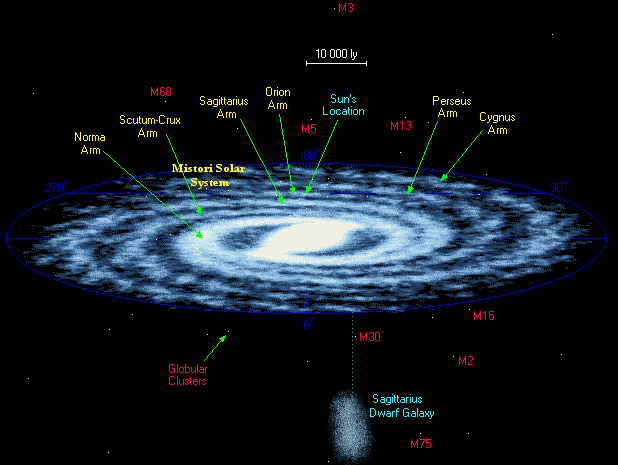
Our home galaxy is100,000 light years across. The Sun lies 20,000 ly from the center in the Orion arm.
The Creative Hierarchies
It might here be appropriate if I interpolated a chart or a tabulation which maybe found suggestive of some of these interlocking energies which play through, traverse, return, stimulate and energize every part of our solar system. They only evoke conscious response where the vehicle of expression and of response is adequate to the impact, and this statement is true of the solar Logos, the planetary Logoi, and of all forms in all the kingdoms upon our planet. [33] Unconscious reaction will of course exist, but it will be on a general or mass scale, and much of it pours through to us from these distant constellations, via the fifth Creative Hierarchy. This Hierarchy, being on the verge of liberation, is to be found on the intellectual level of consciousness and can, therefore, be used as a focal point and a transmitter of the higher energies to our solar system and to the planet. If you make a careful study of the chart of the twelve Creative Hierarchies, page 34, you will note that this Hierarchy is influencing, and is influenced by, the seventh Ray of Magical Order and of Ceremonial Organization. The basic function of this ray is to relate spirit and matter and produce the manifested form. The sign of the zodiac with which it is closely connected is that of Cancer, the Crab, which is a mass sign and one of the "gates" into manifested life.
The following information anent the Hierarchies may prove useful. It has been gathered from various sources.
I might here remind you that the seven planes of our solar system are the seven subplanes of the cosmic physical plane. The four Creative Hierarchies which have achieved liberation are now to be found focused upon the cosmic astral plane; hence their potency even when out of manifestation. The fifth Creative Hierarchy exists on the highest etheric level and will join the other four Hierarchies when the sixth Creative Hierarchy has measured up to cosmic opportunity and is itself nearing liberation. The following is a tabulation showing some of the astrological relationships in connection with
- The constellation of the Great Bear.
- The Pleiades or the Seven Sisters.
- Sirius.
- The seven solar systems.
The Twelve Creative Hierarchies
(The Five Kumaras)
Planets
Name
Ray
Energy
Comments
2
54 Piscium
III
Intelligent substance
None
2
HD 12661
IV
Unity through effort
None
3
HD 37124
V
Light through knowledge
None
10
HD 62509
VI
Desire for duality
None
5
55 Cancri
VII
Mass life
Veiling the Christ
Hierarchies 1 to 4 inclusive (12 to 9 inclusive) have reached liberation.
The 5th Creative Hierarchy is on the verge of liberation. It is active on the intellectual plane
The Seven Creative Hierarchies in active planetary expression
(The seven states of being - under karmic law)
Planets
Name
Ray
Sign
Energy
Comments
1
Divine FlamesDivine Lives.
HD 89307
I
1. Leo
Planet - Sun
Color - Orange
Parashakti
Supreme energy
Fire - AirLogoic Plane
4
Divine BuildersConferring soul(C.F. 605)Burning sons of desire. PSR1257+12
II
2. Virgo
Planet - Jupiter
Color - Blue
Kriyashakti
Materialising ideal
Ether
Monadic Plane
10
Lesser Builders
Conferring The triple flowers.
HD 136118
III
3. Libra
Planet - Saturn
Color - Yellow
Jnanashakti
Force of mind
Water
Atmic plane
1 maybe more
Vulcan Hierarchy
The InitiatesLord of Sacrifice.
Antares :
PSR B1620-26
IV
4. Scorpio
Planet - Mercury
Color - Yellow
Mantrikashakti
The WORD made flesh. Speech
Solar Angels
Agnishvattas
Buddhic
2 Could be 10 planets
Human Personality
The Crocodiles
Makara, the mystery
HD 202206
V
5. Capricorn
Planet - Venus
Color - Indigo
Ichchhashakti
Will to manifest
Fire
Mental Plane
2
Lunar Lords
Sacrificial Fires.
HD169830
VI
6. Sagittarius
Planet - Mars
Color - Red
Kundalinishakti
Energy of matterForm
Water
Astral Plane
3
Elemental lives
The Baskets of Nourishment.
The Blinded Lives.
Gliese 876
VII
7. Aquarius
Planet - the Moon
Color - Violet
meridians of planet Vulcan
Earth
Note: Much in this chart may seem obscure and even erroneous. For instance:The Sacred and non-sacred planets and the rays:
Sagittarius coming between Capricorn and Aquarius. This is a temporary emphasis and will change in another world cycle.The inactivity of the five Hierarchies who are out of incarnation, having achieved liberation, is only on the lower planes.
The Zodiac and the Rays - The Creative Hierarchies Sagittarius coming between Capricorn and Aquarius. This is a temporary emphasis and will change in another world cycle.
The inactivity of the five Hierarchies who are out of incarnation, having achieved liberation, is only on the lower planes.
Esoteric Astrology - The Zodiac and the Rays - The Creative Hierarchies
The Hierarchy of Creative Powers is divided esoterically into seven (4 and 3) within the Twelve Great Orders.
Three Hierarchies are - in this greater cycle - of profound significance, the fourth or human Creative Hierarchy and the two deva Hierarchies, the fifth and the sixth.
The fourth Creative Hierarchy is in reality the ninth and that is why it is called the Hierarchy of Initiates. This can be seen by referring to the chart.
We are told in A Treatise on Cosmic Fire that in the ninth, tenth and eleventh Hierarchies (counting from the bottom upwards) lies the clue to the nature of Agni, the Lord of Fire, the sumtotal of systemic vitality.
Much light can come to the earnest student through a study of the numbers connected with these Hierarchies.The first 5 are regarded as pure abstractions.
Hierarchy One has the numbers - 6.1.7.
Hierarchy Two has the numbers - 7.2.6.
Hierarchy Three has the numbers - 8.3.5.
Hierarchy Four has the numbers - 9.4.4.
Hierarchy Five has the numbers - 10.5.3.
Hierarchy Six has the numbers - 11.6.2.
Hierarchy Seven has the numbers - 12.7.1.It is necessary to take note of this as in The Secret Doctrine reference will be found to the Hierarchies under different numbers. This serves to conceal, but it will also confuse the student.
The first four Hierarchies achieved liberation in the first solar system. Their influence reached our Earth through the medium of the fifth Creative Hierarchy.
These are, therefore, related to the four rays which work as minor rays of Attribute under the great major third Ray of Active Intelligence.
Pisces is seen at the head of the list of zodiacal signs because it is governing the present great astrological world cycle of 25,000 years. It was also one of the dominant signs, influencing our planet at the time of individualization when the human kingdom came into being. It is basically related to the first or highest Creative Hierarchy which is, in its turn, related to the third Ray of Active Intelligence. It was the product of the first solar system. The development of illumination through an awakened intelligence is the first goal of humanity.
The fifth Creative Hierarchy (also numbered 8) is on the verge of liberation. It is peculiarly connected with the tenth Creative Hierarchy, with the constellation Capricorn and with the human personality which veils and temporarily hides the Christ principle behind both form and mind. Eight is, under some numerical systems, regarded as the number of the Christ.
The Greater Builders and the Lesser Builders, working on the second and third planes of our solar system, have their activities reflected in the work of the Lunar Lords and the elemental lives.You will note that the human Hierarchy (on chart 9-IV-4) is assigned no particular element as it has to fuse and synthesize them all. This is part of the great tests of initiation under Scorpio.
This chart is drawn up in relation only to the fourth Creative Hierarchy, the human. It is not drawn in relation to the other planetary manifestations.
The exoteric non-sacred planets are called in occult parlance "the outer round" or outer circle of initiates. Of these our Earth is one but being aligned in a peculiar fashion with certain spheres (or planets) on the inner round a dual opportunity exists for humanity which facilitates, whilst it complicates, the evolutionary process. The sacred planets are called often the 'seven grades of psychic knowledge' or the 'seven divisions of the field of knowledge'.
Planet
Human Principle
Color
Weekday
1. Mars
Kama-rupa
Red
Tuesday
2. The Sun
Prana, Life
Orange
Sunday
3. Mercury
Buddhi
Yellow
Wednesday
4. Saturn
Kama-Manas
Green
Saturday
5. Jupiter
Auric envelope
Blue
Thursday
6. Venus
Manas, Higher mind
Indigo
Friday
7. The Moon
Linga Sharira
Violet
Monday
Such "blinds" are frequent and necessary in the occult teaching but they will be used less and less as humanity becomes more spiritually perceptive.
Seven great psychological Lives, qualified by seven types of life force, are manifesting through the medium of seven planets. Five other Lives express themselves through five planets, of which two remain to be discovered.
The Sun (Substituted for Vulcan)
Jupiter
Saturn
Mercury
Venus
Mars
The Moon (Substituted for Uranus)
Pluto
Neptune
The Earth
Undiscovered
Undiscovered
This is the Exoteric division.
The Kingdoms of Nature and the Planets. In this cycle:
The mineral kingdom - Pluto and Vulcan
The vegetable kingdom - Venus and Jupiter
The animal kingdom - The Moon and Mars
The human kingdom - Mercury and Saturn
The kingdom of souls - Neptune and Uranus
Synthesizing these five - The Sun
The Rays and the Planets
Each of the seven sacred planets (of which our Earth is not one) is an expression of one of the seven ray influences. These seven planets may be enumerated as follows, and the rays working through them are accurately given. The student, however, must remember three things:
That every planet is the incarnation of a Life, or an Entity or Being.
That every planet, like a human being, is the expression of two ray forces - the personality and the egoic.
That two rays are therefore in esoteric conflict in each planet.
It should also be noted that until the mystery of the constellation of the Great Bear is revealed, and until the influence of the Pleiades is comprehended and the true significance of the cosmic triangle formed by:
The seven Rishis of the Great Bear.
The seven Planetary Logoi of our solar system.
The seven Pleiades or Sisters
Is also revealed, the destiny and true function of the seven sacred planets will remain unknown. Within this cosmic triangle are many lesser ones. Any one of the seven Rishis with one of our planetary Logoi and one of the seven Sisters can form subsidiary triangles and the combinations possible are many and intricate.
The Seven Planets, Centers or Schemes
Vulcan - the sun exoterically considered.
Venus.
Mars.
The Earth.
Mercury.
Saturn.
Jupiter.
The Three Synthesizing Planets
Uranus - 8.
Neptune - 9.
Saturn.
The One Resolver
The Sun.
The first one given above will be regarded as accurate for this world period and will be the basis of our astrological teaching. The informing Lives of the seven sacred planets are called by the following names:
The seven Planetary Logoi.
The seven Spirits before the throne.
The seven Kumaras.
The seven solar Deities.
The primordial Seven.
The seven Builders.
The seven intellectual Breaths.
The seven Manus.
The Flames.
Lords of Love, Knowledge and Sacrifice.
The Words for the Signs of the Zodiac
From the angle of form. Natural order. Retrogression through signs.
Pisces Through the Signs to Aries
Pisces - And the Word said: Go forth into matter.
Aquarius - And the Word said: Let desire in form be ruler.
Capricorn - And the Word said: Let ambition rule and the door stand wide.
Sagittarius - And the Word said: Let food be sought.
Scorpio - And the Word said: Let Maya flourish and let deception rule.
Libra - And the Word said: Let choice be made.
Virgo - And the Word said: Let matter reign.
Leo - And the Word said: Let other forms exist. I rule.
Cancer - And the Word said: Let isolation be the rule and yet the crowd exists.
Gemini - And the Word said: Let instability do its work.
Taurus - And the Word said: Let struggle be undismayed.
Aries - And the Word said: Let form again be sought.
From the angle of the soul. Spiritual order. Correct passing through sign.
Aries Through the Signs to Pisces
Aries - I come forth and from the plane of mind I rule.
Taurus - I see, and when the eye is opened, all is illumined.
Gemini - I recognize my other self and in the waning of that self I grow and glow.
Cancer - I build a lighted house and therein dwell.
Leo - I am That and That am I.
Virgo - I am the Mother and the Child, I God. I matter am.
Libra - I choose the way that leads between the two great lines of force.
Scorpio - Warrior I am, and from the battle I emerge triumphant.
Sagittarius - I see the goal. I reach the goal and see another.
Capricorn - Lost am I in light supernal, yet on that light I turn my back.
Aquarius - Water of life am I, poured forth for thirsty men.
Pisces - I leave the Father's Home and turning back, I save.
The Kuiper Belt
Extrasolar Planets
Lensing Galaxy - Einstein Cross
Planetary System : mu Ara / HD 160691
solar system, solar system picture, planet solar system, kid, solar system model, solar system fact, solar system map, solar system simulator, solar system diagram
information, solar system photo, sun solar system, solar system lesson plan, nine planet solar system
Copyright © 2006 Wingmakers.co.nz All rights reserved.