← The Wingmakers Ways · not in the site's own index
Archived page · Asserted
Uranus
The_planet_Uranus.html · captured from wingmakers.co.nz
Uranus
Uranus is the seventh planet from the Sun and is the third largest in the solar system. It was discovered by William Herschel in 1781. It has an equatorial diameter of 51,800 kilometers (32,190 miles) and orbits the Sun once every 84.01 Earth years
Navigation
Solar System
Sun
Mercury
Venus
Earth
Mobius
Mars
Jupiter
Saturn
Uranus
Neptune
Pluto
2004 DW
Quaoar
Sedna
2002 AW197
2003 UB313
Comets
Meteorites
Asteroids
Planetary Moons
The Moon
Europa
IO
Ganymede
Titan
Tethys
Extra Solar Planets
Lensing Galaxy - Einstein Cross
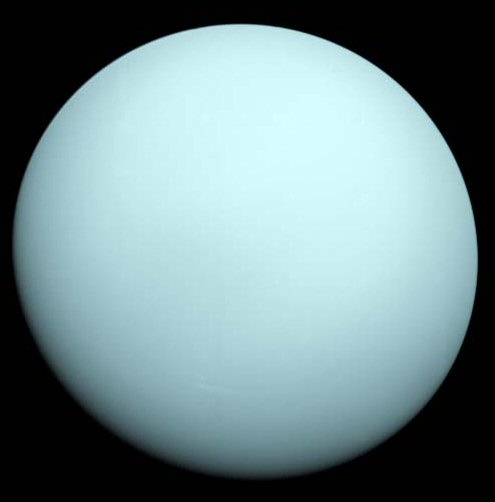
Sub-GiantUranus is the seventh planet from the Sun and is the third largest in the solar system. It was discovered by William Herschel in 1781. It has an equatorial diameter of 51,800 kilometers (32,190 miles) and orbits the Sun once every 84.01 Earth years. It has a mean distance from the Sun of 2.87 billion kilometers (1.78 billion miles). It rotates about its axis once every 17 hours 14 minutes. Uranus has at least 22 moons. The two largest moons, Titania and Oberon, were discovered by William Herschel in 1787.
Interstellar Card
Uranus Statistics
Discovered by William Herschel
Date of discovery 1781
Mass (kg) 8.686e+25
Mass (Earth = 1) 1.4535e+01
Equatorial radius (km) 25,559
Equatorial radius (Earth = 1) 4.0074
Mean density (gm/cm^3) 1.29
Mean distance from the Sun (km) 2,870,990,000
Mean distance from the Sun (Earth = 1) 19.1914
Equatorial surface gravity (m/sec^2) 7.77
Equatorial escape velocity (km/sec) 21.30
Visual geometric albedo 0.51
Magnitude (Vo) 5.52
Mean cloud temperature -193°C
Atmospheric pressure (bars) 1.2Uranus Interior
The plain aquamarine face of Uranus confirms the fact that Uranus is covered with clouds. The sameness of the planet's appearance shows that the planet's atmosphere is mostly composed of one thing, methane. The planet appears to be blue-green because the methane gas of the atmosphere traps red light and does not allow that color to escape. Beside clouds of methane crystals low in the atmosphere, smog, composed of ethane (the same product that can provide fuel for automobiles), is also present high in the atmosphere. The cloud particles constantly recycle themselves, first creating then destroying the heaviest crystals. This is an indication that Uranus' atmosphere is still evolving from its formation out of the solar nebula. Because Uranus lies on its side, Uranus has very strange seasons. Motions in the cloud patterns indicate that, like Jupiter and Saturn, the basic weather of Uranus can be described as a striped pattern of winds. This means that, even though the pattern is hard to see, Uranus is striped, just like Jupiter and Saturn.
Uranus Atmospheric composition
The atmosphere of Uranus is composed of 83% hydrogen, 15% helium, 2% methane and small amounts of acetylene and other hydrocarbons. Methane in the upper atmosphere absorbs red light, giving Uranus its blue-green color. The atmosphere is arranged into clouds running at constant latitudes, similar to the orientation of the more vivid latitudinal bands seen on Jupiter and Saturn. Winds at mid-latitudes on Uranus blow in the direction of the planet's rotation. These winds blow at velocities of 40 to 160 meters per second (90 to 360 miles per hour).
Uranus' rings
This pseudo-image of Uranus' rings was generated by using Voyager 2 frame FDS 26852.19. This image was taken in forward scattered light and shows dust bands not seen in any other image. A 3 pixel wide slice was taken from the most detailed part of the image, averaged to a 1 pixel wide image, then rotated 360 degrees and projected into perspective view. The real color of the rings are neutral gray and they are as dark as charcoal. (Courtesy A. Tayfun Oner)
Uranus and the Earth Compared
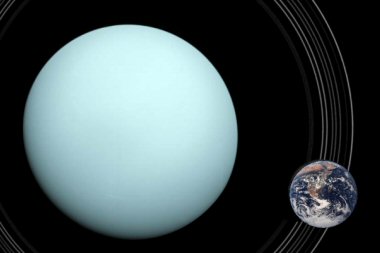
This image compares Uranus with Earth. Uranus is the fourth largest planet in the solar system, and is much larger than Earth, and mostly made of frozen gas.
Uranus' diameter is four times that of the Earth's
It has 15 times the mass of Earth's mass
If you weigh 180 pounds on Earth, you would weigh only 160 pounds at Uranus' cloud tops
Uranus is 19 times further from the Sun than the Earth
Planetary Orbits
Uranus Orbital Statistics
Rotational period (hours) -17.9
Orbital period (years) 84.01
Mean orbital velocity (km/sec) 6.81
Orbital eccentricity 0.0461
Tilt of axis (degrees) 97.86
Orbital inclination (degrees) 0.774
Uranus And it's Moons
Uranus: Moons
"Sweet Moon," William Shakespeare wrote in A Midsummer Night's Dream, "I thank thee for thy sunny beams; I thank thee, Moon, for shining now so bright." Centuries later, the moons of Uranus pay homage to famous playwright.
While most of the satellites orbiting other planets take their names from Greek mythology, Uranus' moons are unique in being named for Shakespearean characters, along with a couple from the works of Alexander Pope.
Oberon and Titania (king and queen of the fairies) are the largest Uranian moons, and were first to be discovered - by William Herschel in 1787. William Lassell, who had been first to see a moon orbiting Neptune, discovered the next two, Ariel and Umbriel. Nearly a century passed before Gerard Kuiper found Miranda in 1948. And that was it until a NASA's robot made it to distant Uranus.
All of Uranus's inner moons (those observed by Voyager 2) appear to be roughly half water ice and half rock. The composition of the moons outside the orbit of Oberon remains unknown, but they are likely captured asteroids.
Miranda, the innermost and smallest of the five major satellites, has a surface unlike any other moon that's been seen. It has giant fault canyons as much as 12 times as deep as the Grand Canyon, terraced layers, surfaces that appear very old, and others that look much younger.
Ariel has the brightest and possibly the youngest surface among all the moons of Uranus. It has few large craters and many small ones, indicating that fairly recent low-impact collisions wiped out the large craters that would have been left by much earlier, bigger strikes. Intersecting valleys pitted with craters scars its surface.
Umbriel is ancient, and the darkest of the five large moons. It has many old, large craters and sports a mysterious bright ring on one side.
Oberon, outermost of the five major moons, is old, heavily cratered, and shows little signs of internal activity. Unidentified dark material appears on the floors of many craters.
Cordelia and Ophelia are shepherd moons that keep Uranus' thin, outermost "epsilon" ring well defined.
Between them and Miranda is a swarm of eight small satellites unlike any other system of planetary moons. This region is so crowded that astronomers don't yet understand how the little moons have managed to avoid crashing into each other. They may be shepherds for the planet's 10 narrow rings, and scientists think there must be still more moons, interior to any known, to confine the edges of the inner rings.
Moons : Titania
Titania [Ty-TAY-ne-ah] is the largest moon of Uranus. It is marked by a few large impact basins, but is generally covered with small craters and very rough rocks. The above image shows a 1,600 kilometer (1,000 mile) long trench. A large double walled crater can be seen towards the top of the image. There are many faults on Titania indicating there has been internal forces molding its surface.Moon : Ariel
Ariel [AIR-ee-al] is a relatively small satellite and is the brightest moon of Uranus. The surface is pock-marked with craters, but the most outstanding features are long rift valleys stretching across the entire surface. Canyons much like the ones on Mars appear in the pictures. The canyon floors appear as though they have been smoothed by a fluid. The fluid could not have been water because water acts like steel at these temperatures. The flow marks might have been made by ammonia, methane or even carbon monoxide.
Moon : Oberon
Oberon [O-buh-ron] is a moon of Uranus that is characterized by an old, heavily cratered, and icy surface. The surface shows little evidence of internal activity other than some unknown dark material that apparently covers the floors of many craters. The above image shows several large impact craters towards the center of the image. On the limb, a high mountain rises 6 kilometers (4 miles) above its surroundings. There are bright rays similar to those seen on Jupiter's moon Callisto.
Copyright © Wingmakers.co.nz - All rights reserved.