← The Wingmakers Ways · not in the site's own index
Archived page · Asserted
Sedna
The_Planet_Sedna.html · captured from wingmakers.co.nz
Sedna
A team of astronomers (including Mike Brown, Chad Trujillo, and David Rabinowitz) announced the NASA-sponsored discovery of a very large planetary body sedna.On March 15, 2004
Navigation
Solar System
Sun
Mercury
Venus
Earth
Mobius
Mars
Jupiter
Saturn
Uranus
Neptune
Pluto
2004 DW
Quaoar
Sedna
2002 AW197
2003 UB313
Comets
Meteorites
Asteroids
Planetary Moons
The Moon
Europa
IO
Ganymede
Titan
Tethys
Extra Solar Planets
Lensing Galaxy - Einstein Cross
Introduction
On March 15, 2004, a team of astronomers (including Mike Brown, Chad Trujillo, and David Rabinowitz) announced the NASA-sponsored discovery of a very large planetary body (originally designated 2003 VB12) in one of the most distant planetary orbits yet discovered within the Solar System. Confirmed by the Spitzer (infrared) Space Telescope and tentatively named Sedna after the Inuit Goddess of the Sea (from which all creatures of the very cold Arctic sea were created), it is currently located around 90 AUs from our Sun, Sol -- an orbital distance that is roughly three times farther out than that of Pluto or Neptune -- but will eventually move as much as 10 times farther away (around 990 AUs) in a 12,260-year orbit around Sol; it's orbital semi-major axis is around 532 AUs with an extremely high eccentricity of 0.857. Based on its current distance, brightness, and presumed albedo or ability to reflect light, Sedna has been estimated to have more than half the diameter of Pluto and may be larger than any other planetary body found since Pluto -- at 730 to 1,470 miles or 1,180 to 2,360 kilometers (km) across, compared to Pluto's diameter of around 1,440 miles or 2,320 km.
An Image Of Sedna
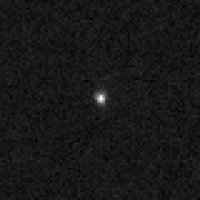
Sedna is the second most reddish planetary body in the Solar System, after Mars. Although inclined by only around 11.9 degrees from the ecliptic where the eight major planets orbit, Sedna's distant orbit is extremely elliptical indicating that its formation and orbit may have been influenced by by a passing nearby star during the early years of the Solar System, when Sol formed out of a molecular cloud with many other closeby stars around 4.6 billion years ago. There is indirect evidence (an unexpectedly slow 40-day rotation) that Sedna has its own moon, which astronomers hope to confirm with the Hubble Space Telescope (more information and images from NASA. The icy object will move closer to the Sun over the next 72 years -- to 76 AUs of Sol -- before receding back towards the inner Oort Cloud.
Planetary Orbit Of Sedna and the outer planets
Although Sedna has an extremely large orbit around the Sun, it appears to move
well within the hypothesized location of the inner Oort Cloud,A Comparison of the Outer Planets and our Moon and Earth
Sedna Mythology
Sedna is a very significant figure in Inuit mythology. There are a number of different versions of the myth of Sedna. I will share with you the one I prefer.
As the legend goes, Sedna was a beautiful Inuit girl who lived with her father. She was very vain and thought she was too beautiful to marry just anyone. Time and time again she turned down hunters who came to her camp wishing to marry her. Finally one day her father said to her "Sedna, we have no food and we will go hungry soon. You need a husband to take care of you, so the next hunter who comes to ask your hand in marriage, you must marry him." Sedna ignored her father and kept brushing her hair as she looked at her reflection in the water.
Soon her father saw another hunter approaching their camp. The man was dressed elegantly in furs and appeared to be well-to-do even though his face was hidden. Sedna's father spoke to the man. "If you wish to seek a wife I have a beautiful daughter . She can cook and sew and I know she will make a good wife." Under great protest, Sedna was placed aboard of the hunters kayak and journeyed to her new home. Soon they arrived at an island. Sedna looked around. She could see nothing. No sod hut, no tent, just bare rocks and a cliff. The hunter stood before Sedna and as he pulled down his hood, he let out and evil laugh. Sedna's husband was not a man as she had thought but a raven in disguise. She screamed and tried to run, but the bird dragged her to a clearing on the cliff. Sedna's new home was a few tufts of animal hair and feathers strewn about on the hard, cold rock. The only food she had to eat was fish. Her husband, the raven, brought raw fish to her after a day of flying off in search of food.Sedna was very unhappy and miserable. She cried and cried and called her father's name. Through the howling arctic winds Sedna's father could hear his daughter's cries. He felt guilty for what he had done as he knew she was sad. Sedna's father decided it was time to rescue his daughter. He loaded up his kayak and paddled for days through the frigid arctic waters to his Sedna's home. When he arrived Sedna was standing on the shore. Sedna hugged her father then quickly climbed into his kayak and paddled away. After many hours of travel Sedna turned and saw a black speck far off into the distance. She felt the fear well up inside of her for she knew the speck was her angry husband flying in search of her.
The big black raven swooped down upon the kayak bobbing on the ocean. Sedna's father took his paddle and struck at the raven but missed as the bird continued to harass them. Finally the raven swooped down near the kayak and flapped his wing upon the ocean. A vicious storm began to brew. The calm arctic ocean soon became a raging torrent tossing the tiny kayak to and fro. Sedna's father became very frightened. He grabbed Sedna and threw her over the side of the kayak into the ocean. "Here, he screamed, here is your precious wife, please do not hurt me, take her."
Sedna screamed and struggled as her body began go numb in the icy arctic waters. She swam to the kayak and reached up, her fingers grasping the side of the boat. Her father, terrified by the raging storm, thought only of himself as he grabbed the paddle and began to pound against Sedna's fingers. Sedna screamed for her father to stop but to no avail. Her frozen fingers cracked and fell into the ocean. Affected by her ghastly husbands powers, Sedna's fingers while sinking to the bottom, turned into seals. Sedna attempted again to swim and cling to her father's kayak. Again he grabbed the paddle and began beating at her hands. Again Sedna's hands, frozen by the arctic sea again cracked off. The stumps began to drift to the bottom of the sea, this time turned into the whales and other large mammals. Sedna could fight no more and began to sink herself.Sedna, tourmented and raging with anger for what had happened to her, did not perish. She became, and still is today, the goddess of the sea. Sedna's companions are the seals, and the whales that sit with her at the bottom on the ocean. Her anger and fury against man is what drums up the violent seas and storms . Hunters have a great respect for her. Legend has it that they must treat her with respect. Shaman's from the world above must swim down to her to comb her long black tangled hair. This calms Sedna down. Once this is done, she releases her mammals to allow the Inuit to eat from the bounty of the sea. It is for this reason in the north that after a hunter catches a seal he drops water into the mouth of the mammal, a gesture to thank Sedna for her kindness in allowing him to feed his family.
Copyright © Wingmakers.co.nz - All rights reserved.