← The Wingmakers Ways · not in the site's own index
Archived page · Asserted
Planet Earth
The_planet_Earth.html · captured from wingmakers.co.nz
Planet Earth
Earth, our home planet, is the only planet in our solar system known to harbor life - life that is incredibly diverse.
-
Navigation
Solar System
Sun
Mercury
Venus
Earth
Mobius
Mars
Jupiter
Saturn
Uranus
Neptune
Pluto
2004 DW
Quaoar
Sedna
2002 AW197
2003 UB313
Comets
Meteorites
Asteroids
Planetary Moons
The Moon
Europa
IO
Ganymede
Titan
Tethys
Extra Solar Planets
Lensing Galaxy - Einstein Cross
Oceanic Planet
Introduction
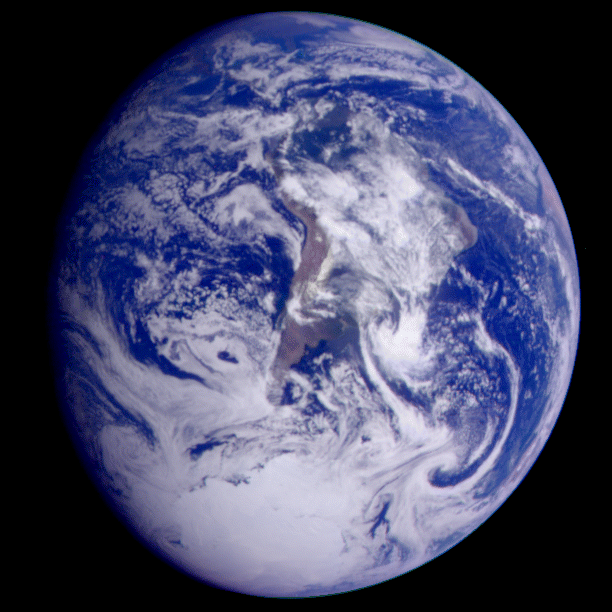
Earth, our home planet, is the only planet in our solar system known to harbor life - life that is incredibly diverse. All of the things we need to survive are provided under a thin layer of atmosphere that separates us from the uninhabitable void of space. Earth is made up of complex, interactive systems that are often unpredictable. Air, water, land, and life - including humans - combine forces to create a constantly changing world that we are striving to understand.
Viewing Earth from the unique perspective of space provides the opportunity to see Earth as a whole. Scientists around the world have discovered many things about our planet by working together and sharing their findings.
Some facts are well known. For instance, Earth is the third planet from the Sun and the fifth largest in the solar system. Earth's diameter is just a few hundred kilometers larger than that of Venus. The four seasons are a result of Earth's axis of rotation being tilted more than 23 degrees.
Interstellar Card
Planetary Statistics
Star System : Meridian Solar System
Discovery Status : Imaged
Mass : 1 Earths
Average Distance : 1 AUs
Period : 365.2 Days
Orbital Eccentricity : 0.0167
Argument of Perihelion (omega) : 102.94719°
Detection Method : Naked Eye
Year Discovered : Prehistory
Planetary Orbit 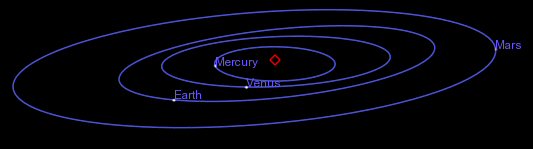
Vulcan, Mercury, Venus, Earth, Mobius, Mars, Jupiter
Saturn, Uranus, Neptune, Pluto, 2004 DW, Quaoar, Sedna, 2002 AW197.
Structure of the Interior of Earth 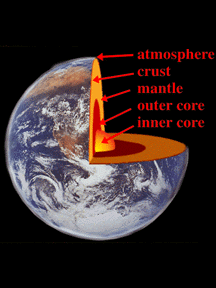 Earth has a diameter of 12,756 km (7,972 mi). The earth's interior consists of rock and metal. It is made up of four main layers:
1) the inner core: a solid metal made up of nickel and iron (1200 km diameter)
2) the outer core: a liquid molten core of nickel and iron
3) the mantle: dense and mostly solid silicate rock
4) the crust: thin silicate rock material
The temperature increases rapidly up to 9000 F in the core, which is hotter than the sun's surface. Therefore, the intense heat from the inner core causes material in the molten outer core and mantle to move around. As a result, the large plates on the e arth's crust slowly drift on the surface. It is also possible that these currents generate the earth's magnetic field, called the magnetosphere.
The Earth's Atmosphere
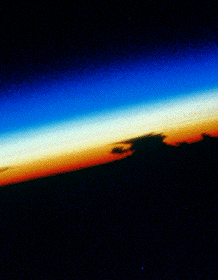
The atmosphere surrounds Earth and protects us by blocking out dangerous rays from the sun. The atmosphere is a mixture of gases that becomes thinner until it gradually reaches space. It is composed of Nitrogen (78%), Oxygen (21%), and other gases (1%).
Oxygen is essential to life because it allows us to breathe. In addition, some of the oxygen has changed over time forming ozone. The ozone layer filters out the sun's harmful ultraviolet radiation. Recently, there have been many studies on the ozone layer connected to the greenhouse effect . Scientists believe that the greenhouse effect is increasing the earth's temperature by trapping the sun's energy.
The atmosphere is divided into five layers depending on how temperature changes with height. Most of the weather occurs in the first layer.
Water 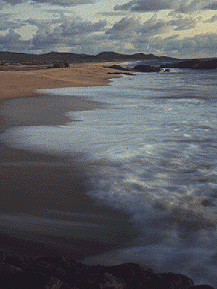
About 70% of the Earth is covered with water, and 97% of that is part of the salty oceans. Only a small portion of the Earth's water is freshwater. This includes such things as rivers, lakes, and groundwater. Freshwater is needed for drinking, farming, and washing. There is even water in the form of ice at the poles. Without water, life as we know it would not exist.
Few rivers flow into the Pacific Ocean since it is bordered by mountains. However, many large rivers flow into the Atlantic Ocean, carrying sediment from the land. This process is one step of the water cycle.
Weather 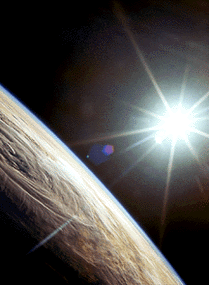
Weather is the state of the atmosphere at any given time and place. Most weather takes place in the lower layer of the atmosphere. Weather occurs because our atmosphere is in constant motion.
Some determining factors of weather are temperature, precipitation, fronts, cloud type, and wind. Other more severe weather conditions are hurricanes, tornadoes, and thunderstorms. When air is sinking, good clear weather occurs because the air is stable. However, cloudy and murky weather occurs when air rises because it is unstable.
Weather changes occur during the day. Weather also changes every season because of the Earth's tilt when it revolves around the sun.
Meteorology is the study of weather, and meteorologists are scientists who study and predict weather.
Clouds 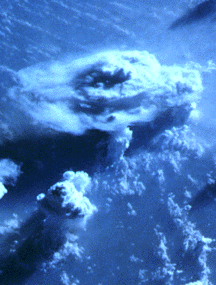
Clouds can come in all sizes and shapes, and can form near the ground or high in the atmosphere. Clouds are groups of tiny water droplets or ice crystals in the sky. They are associated with different kinds of precipitation depending on the atmosphere's temperature.
Cloud types are classified by height and appearance. The shape depends on the way the air moves around it. If air moves horizontally, clouds form in layers. However, clouds grow upward if air movement is vertical.
At any given time, clouds cover about 50% of the Earth. We would not have rain, thunderstorms, rainbows or snow without clouds. The atmosphere would be quite boring if the sky was always clear.
Views Of The Earth From Space
Northeast Africa and the Arabian Peninsula
This image of northeast Africa and the Arabian Peninsula was taken from an altitude of about 500,000 kilometers (300,000 miles) by the Galileo spacecraft on December 9, 1992, as it left Earth en route to Jupiter. Visible are most of Egypt (left of center), including the Nile Valley; the Red Sea (slightly above center); Israel; Jordan, and the Arabian Peninsula. In the center, below the coastal cloud, is Khartoum, at the confluence of the Blue Nile and the White Nile. Somalia (lower right) is partly covered by clouds. (Courtesy NASA/JPL)
Horn of Africa, Somalia
The orange and tan colors of this high-oblique photograph of the Horn of Africa indicate an arid-to-semiarid landscape in the northern half of the east African country of Somalia. Except in the darker areas where thicker vegetation can be found, most of the vegetation in this part of Somalia is shrub brush and grasslands. The general climate of this region features hot temperatures and scarce, irregular rainfall. Two distinct drainage basins are characterized by lighter colors-the Nugaaleed Valley along the western side of the photograph and the other watershed trending toward the Hafun Peninsula, the tombolo along the east coast of Somalia. The southern extent of the Saudi Arabian Peninsula is visible north across the Gulf of Aden. (Courtesy NASA)
Southern Tip of Greenland
The southern tip of Greenland is seen in this high-oblique, almost colorless, stark photograph of the world�s largest island. The blackness of space contrasts sharply with the whiteness of clouds, ice, and snow. The only true color is the blue of the Atlantic Ocean and the Labrador Sea. Cloud-free conditions existing along the southern coastal area emphasize the deeply indented fjords along the coast. A close look at the white areas reveals three different features-snow and ice on the land; cloud formations over the central region and the eastern and western sides of the island; and wispy-looking ice floes off the southeast and the southwest tip of the fjord-lined coast, which are moved by the East Greenland Current to the south-southwest, and larger ice packs developing north along the east coast. Greenland has the only surviving continental glacier in the Northern Hemisphere. This ice sheet covers seven-eighths of Greenland�s surface and contains an estimated 11 percent of the world�s fresh water. (Courtesy NASA)
Antarctica
This image of Antarctica was taken by Galileo several hours after it flew close to the Earth on December 8, 1990. This is the first picture of the whole Antarctic continent taken nearly at once from space. Galileo was about 200,000 kilometers (125,000 miles) from Earth when the pictures were taken.
The icy continent is surrounded by the dark blue of three oceans: the Pacific to the right, the Indian to the top, and a piece of the Atlantic to the lower left. Nearly the entire continent was sunlit at this time of year, just two weeks before southern summer solstice. The arc of dark spots extending from near the South Pole (close to the center) toward the upper right is the Transantarctic Mountain Range. To the right of the mountains is the vast Ross Ice Shelf and the shelf's sharp border with the dark waters of the Ross Sea. The thin blue line along the Earth's limb marks our planet's atmosphere.
Earth From Mars
Date: 03.08.2004
This is the first image ever taken of Earth from the surface of a planet beyond the Moon. It was taken by the Mars Exploration Rover Spirit one hour before sunrise on the 63rd Martian day, or sol, of its mission.
The image is a mosaic of images taken by the rover's navigation camera showing a broad view of the sky, and an image taken by the rover's panoramic camera of Earth. The contrast in the panoramic camera image was increased two times to make Earth easier to see.The inset shows a combination of four panoramic camera images zoomed in on Earth. The arrow points to Earth. Earth was too faint to be detected in images taken with the panoramic camera's color filters.
Moonrise
Date: 01.26.2003
A quarter moon is visible in this oblique view of Earth's horizon and airglow, recorded with a digital still camera on the final mission of the Space Shuttle Columbia.
The Earth and Moon From Space 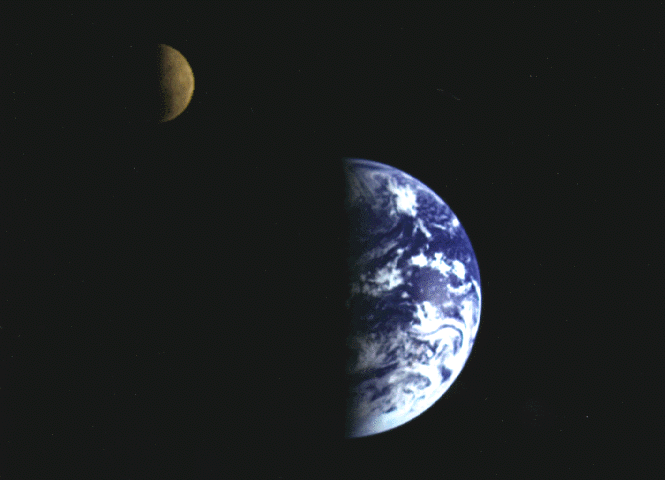
First Space Station Image
A mass of storm clouds was observed and recorded from the International Space Station (ISS) by Expedition 1 crew members. The picture, made with an Electrical Still Camera (ESC), was the first Earth observation still image downlinked by the three-man crew. Expedition 1 crew members were cosmonaut Sergei Krikalev, flight engineer; astronaut William Shepherd, mission commander; and cosmonaut Yuri Gidzenko, Soyuz commander.
Planetary Datafile
Copyright © Wingmakers.co.nz - All rights reserved.