← The Wingmakers Ways · Astronomy & Exoplanets
Archived page · Checkable
Orcus - 2004DW
Planetary_Body_2004DW.html · captured from wingmakers.co.nz
Planetary Body 2004DW
A new planet in the outer Solar System was discovered on 17 February 2004 by an automated sky survey telescope in California. At present the planet is call 2004DW
Navigation
Solar System
Sun
Mercury
Venus
Earth
Mobius
Mars
Jupiter
Saturn
Uranus
Neptune
Pluto
2004 DW
Quaoar
Sedna
2002 AW197
2003 UB313
Comets
Meteorites
Asteroids
Planetary Moons
The Moon
Europa
IO
Ganymede
Titan
Tethys
Extra Solar Planets
Lensing Galaxy - Einstein Cross
A large Kuiper Belt Object A new planet in the outer Solar System was discovered on 17 February 2004 by an automated sky survey telescope in California. At present the planet is designated 2004 DW and was found by California Institute of Technology astronomers Chad Trujillo and Mike Brown, and David Rabinowitz of Yale University. The same team discovered the planet Quaoar in 2002
Large orbit
2004 DW was found by California Institute of Technology astronomers Chad Trujillo and Mike Brown, and David Rabinowitz of Yale University, the same team that discovered Quaoar in 2002.
With an estimated size of somewhere between 840km (520 miles) and 1,800km it may be larger that Quaoar, which is 1,000km and 1,400km (870 miles) across.
If it is at the upper end of the uncertainty range then 2004 DW is larger than any other object found circling the Sun since Pluto was discovered in 1930 (Pluto is 2,300km across - 1,430 miles).
2004 DW Planetary Orbit
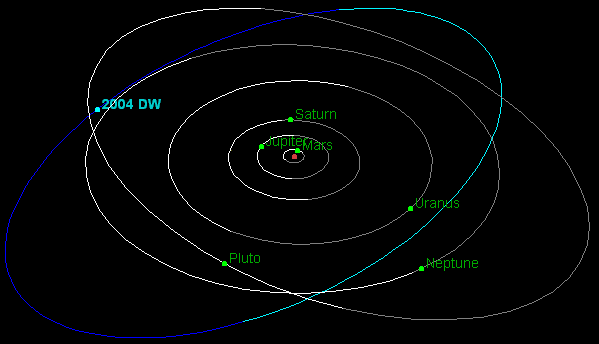
2004 DW could even be larger than Pluto's moon, Charon which is 1,300km (810 miles) across. It has an orbit that is much larger than Pluto's, being, on average, 2.4 billion km (1.5 billion miles) further out.
Astronomers believe that there are many more so-called "Kuiper Belt Objects" awaiting discovery in the cold, dark, outer reaches of the Solar System.
The Kuiper Belt (KB) is a region inhabited by small worlds of rock and ice. It is similar in some ways to the Asteroid Belt - a region of rocky debris between Mars and Jupiter. However, the KB contains a hundred times more material than all the asteroids put together.
Not a planetOne thing astronomers want to stress is that 2004 DW is not a major planet. Although it is probably slightly larger than half the size of Pluto, there are other objects of a similar size out there which do not, by the current definition, qualify as a planet.
But that is not to say that a new planet could not be found. Experts say there could be a Pluto-sized object lurking in the darkness awaiting discovery.
2004 DW could be a type of object called a "Plutino." Such objects have an orbit related to Pluto's path around the Sun.
Looking back in their archives astronomers have already picked up the new object in images taken in 2002. They will use this observation, and any others they may find further back, to determine its orbit more accurately.
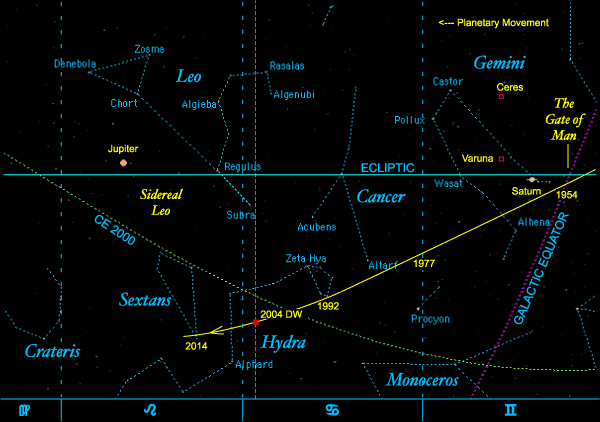
The sky chart below shows the location of asteroid 2004DW at the time of its discovery on Feb 19, 2004. It lies south of the ecliptic in Hydra, in later sidereal Cancer, and under the auspices of the Head of the Lion. The projected path of 2004DW shows it was just under the head of Hydra in 1992 and will align with Gamma Sextans in sidereal Leo by 2014 (retrograde loops not shown). (2004DW crossed the "Gate of Man" of the Holy Cross (5° sidereal Gemini) from July 1953 through March 1955.)
Star Field in Hydra with the predicted position of
2004 DW marked by green circle.
The object in circle is a +16.3 mag star
Copyright © Wingmakers.co.nz - All rights reserved.