← The Wingmakers Ways · Astronomy & Exoplanets
Archived page · Checkable
Ganymede
Ganymede.html · captured from wingmakers.co.nz
Ganymede
Ganymede is the seventh and largest satellites of Jupiter's. Ganymede is the third of the Galilean moons.
Navigation
Solar System
Sun
Mercury
Venus
Earth
Mobius
Mars
Jupiter
Saturn
Uranus
Neptune
Pluto
2004 DW
Quaoar
Sedna
2002 AW197
2003 UB313
Comets
Meteorites
Asteroids
Planetary Moons
Earth
The Moon
Saturn
Titan
Tethys
Enceladus
Dione
Extra Solar Planets
Lensing Galaxy - Einstein Cross
Satellite of Jupiter
Ganymede is the seventh and largest satellites of Jupiter's. Ganymede is the third of the Galilean moons. orbit: 1,070,000 km from Jupiter and It's diameter: 5262 km, and its mass is : 1.48e23 kg. Ganymede was a Trojan boy of great beauty whom Zeus carried away to be cup bearer to the gods. Discovered by Galileo and Marius in 1610.
Ganymede is the largest satellite in the solar system. It is larger in diameter than Mercury but only about half its mass. Ganymede is much larger than Pluto.
Interstellar Card
Ganymede And Jupiter
The solar system's largest moon, Ganymede, is captured here alongside the planet Jupiter in a color picture taken by NASA's Cassini spacecraft on Dec. 3, 2000.Ganymede is larger than the planets Mercury and Pluto and Saturn's largest moon, Titan. Both Ganymede and Titan have greater surface area than the entire Eurasian continent on our planet. Cassini was 26.5 million kilometers (16.5 million miles) from Ganymede when this image was taken. The smallest visible features are about 160 kilometers (about 100 miles) across.
The bright area near the south (bottom) of Ganymede is Osiris, a large, relatively new crater surrounded by bright icy material ejected by the impact, which created it. Elsewhere, Ganymede displays dark terrains that NASA's Voyager and Galileo spacecraft have shown to be old and heavily cratered. The brighter terrains are younger and laced by grooves. Various kinds of grooved terrains have been seen on many icy moons in the solar system. These are believed to be the surface expressions of warm, pristine, water-rich materials that moved to the surface and froze.
Ganymede has proven to be a fascinating world, the only moon known to have a magnetosphere, or magnetic environment, produced by a convecting metal core. The interaction of Ganymede's and Jupiter's magnetospheres may produce dazzling variations in the auroral glows in Ganymede's tenuous atmosphere of oxygen.
In this global view of Ganymede's trailing side, the colors are enhanced to emphasize color differences. The enhancement reveals frosty polar caps in addition to the two predominant terrains on Ganymede, bright, grooved terrain and older, dark furrowed areas. Many craters with diameters up to several dozen kilometers are visible. The violet hues at the poles may be the result of small particles of frost which would scatter more light at shorter wavelengths (the violet end of the spectrum). Ganymede's magnetic field, which was detected by the magnetometer on NASA's Galileo spacecraft in 1996, may be partly responsible for the appearance of the polar terrain. Compared to Earth's polar caps, Ganymede's polar terrain is relatively vast. The frost on Ganymede reaches latitudes as low as 40 degrees on average and 25 degrees at some locations. For comparison with Earth, Miami, Florida lies at 26 degrees north latitude, and Berlin, Germany is located at 52 degrees north.The Surface Of Ganymede
Ancient impact craters shown in this image of Jupiter's moon Ganymede taken by NASA's Galileo spacecraft testify to the great age of the terrain, dating back several billion years. At the margin at the left, half of a 19-kilometer-diameter (12-mile) crater is visible. The dark and bright lines running from lower right to upper left and from top to bottom are deep furrows in the ancient crust of dirty water ice. The origin of the dark material is unknown, but it may be accumulated dark fragments from many meteorites that hit Ganymede. In this view, north is to the top, and the sun illuminates the surface from the lower left about 58 degrees above the horizon. The area shown is part of Ganymede's Galileo Regio region at latitude 18 degrees north, longitude 147 degrees west; it is about 46 by 64 kilometers (29 by 38 miles) in extent. Resolution is about 80 meters (262 feet) per pixel. The image was taken June 27 at a range of 7.563 kilometers (4,700 miles).
It was thought that Ganymede and Callisto were composed of a rocky core surrounded by a large mantle of water or water ice with an ice surface (and that Titan and Triton were similar). Preliminary indications from the Galileo data now suggest that Callisto has a uniform composition while Ganymede is differentiated into a three layer structure: a small molten iron or iron/sulfur core surrounded by a rocky silicate mantle with a icy shell on top. In fact, Ganymede may be similar to Io with an additional outer layer of ice.
Ganymede's surface is a roughly equal mix of two types of terrain: very old, highly cratered dark regions (Above), and somewhat younger (but still ancient) lighter regions marked with an extensive array of grooves and ridges (Below). Their origin is clearly of a tectonic nature, but the details are unknown. In this respect, Ganymede may be more similar to the Earth than either Venus or Mars (though there is no evidence of recent tectonic activity).
Evidence for a tenuous oxygen atmosphere on Ganymede, very similar to the one found on Europa, has been found recently by HST (note that this is definitely NOT evidence of life).Similar ridge and groove terrain is seen on Enceladus, Miranda and Ariel. The dark regions are similar to the surface of Callisto.
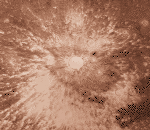
Extensive cratering is seen on both types of terrain. The density of cratering indicates an age of 3 to 3.5 billion years, similar to the Moon. Craters both overlay and are cross cut by the groove systems indicating the the grooves are quite ancient, too. Relatively young craters with rays of ejecta are also visible (left).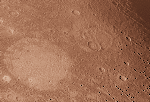
Unlike the Moon, however, the craters are quite flat, lacking the ring mountains and central depressions common to craters on the Moon and Mercury. This is probably due to the relatively weak nature of Ganymede's icy crust which can flow over geologic time and thereby soften the relief. Ancient craters whose relief has disappeared leaving only a "ghost" of a crater are known as palimpsests (right).Atmosphere Found On Ganymede
Though ozone may be diminishing on Earth, it is being manufactured one-half billion miles away, on Jupiter's largest satellite, Ganymede.
NASA's Hubbe Space Telescope found ozone's spectral "fingerprint" during observations of Ganymede made by Keith Noll and colleagues at the Space Telescope Science Institute in Baltimore, Maryland. These Hubble Faint Object Spectrograph results were presented at the American Astronomical Society's 27th Annual Meeting of the Division of Planetary Sciences in Kona, Hawaii.
The amount of ozone detected on Ganymede is small by earthly standards. The total is only a tiny fraction (between 1-10 percent) of the amount of ozone destroyed each winter in Antarctica's notorious "ozone hole" (a location on Earth where ozone levels seasonally drop to extremely low levels.)
Unlike ozone production in Earth's atmosphere, Ganymede's ozone is produced by charged particles trapped in Jupiter's powerful magnetic field (much like the Earth's Van Allen radiation belts). Jupiter's 9-hour, 59-minute rotation sweeps these particles along at tremendous speed, where they overtake the slower moving Ganymede and "rain" down onto the surface. The trailing hemisphere of Ganymede bears the brunt of this particle "sandblasting" (just as our Moon keeps the same face tilted toward Earth, Ganymede keeps the same face turned toward Jupiter, and so has a "leading" and "trailing" hemisphere as it orbits the giant planet).
The charged particles penetrate the ice surface where they disrupt water molecules. Simulations of this unusual environment in laboratory experiments, done by Hubble team member Robert Johnson (University of Virginia), suggest ozone is a possible product when energetic ions known to be present in Jupiter's magnetosphere impact water ice. However, the exact steps leading to ozone production are not yet fully understood, according to Noll.
Though no atmosphere has yet been detected on Ganymede, "the evidence for all this oxygen chemistry going on in the surface ice is a pretty strong hint that Ganymede will also turn out to have a tenuous oxygen atmosphere," said Noll. Earlier this year, Hubble detected a thin oxygen atmosphere on the Jovian moon, Europa.
This observation could only be done using a telescope located in space, because Earth's own atmospheric ozone absorbs the ultraviolet signature of ozone on Ganymede's surface. Ozone's presence was first hinted at during observations with the International Ultraviolet Explorer satellite (IUE), made by Arthur L. Lane of the Jet Propulsion Laboratory and a co-investigator on the HST team. Hubble's greater sensitivity was required to make a definite and unambiguous detection.
Ozone, a relatively unstable molecule made up of three atoms of oxygen, is found in Earth's atmosphere. Most ozone is concentrated in a layer some 16 miles (25 km) above the Earth's surface. This ozone layer is crucial to life on Earth, because it acts as a protective shield from the Sun's harmful ultraviolet radiation which can cause skin cancer, cataracts, and other health problems. Closer to Earth's surface, however, ozone produced from man-made pollutants is harmful, causing damage to lung tissue and plants.
Jupiter's largest moon (3,280 miles or 5,262 km in diameter; 1.5 times the size of the Earth's Moon), Ganymede's surface is composed of rock and ice beneath which lies a water/ice mantle and rocky core, according to models.
Copyright © Wingmakers.co.nz - All rights reserved.