← The Wingmakers Ways · Astronomy & Exoplanets
Archived page · Checkable
Titan
Titan.html · captured from wingmakers.co.nz
It was long thought that Titan was the largest satellite in the solar system but recent observations have shown that Titan's atmosphere
Navigation
Solar System
Sun
Mercury
Venus
Earth
Mobius
Mars
Jupiter
Saturn
Uranus
Neptune
Pluto
2004 DW
Quaoar
Sedna
2002 AW197
2003 UB313
Comets
Meteorites
Asteroids
Planetary Moons
Earth
The Moon
Saturn
Titan
Tethys
Enceladus
Dione
Extra Solar Planets
Lensing Galaxy - Einstein Cross

Basic Data
Distance from Saturn : 1 221 870 km
Distance from Sun : 1 427 000 000 km (9.54 AU)
Diameter (atmosphere) : 5550 km
Diameter (surface) : 5150 km
Mass : 1/45 that of Earth
Average density : 1.881 times liquid water
Surface temperature : 94K (-180 degrees C)
Atmospheric pressure at surface : 1500 mbar (1.5 times Earth's)
Atmospheric composition : Nitrogen, methane, traces of ammonia, argon, ethane
Orbital period : (Titanic day) 15.95 Earth daysGreek Mythology
In Greek mythology the Titans were a family of giants, the children of Uranus and Gaia, who sought to rule the heavens but were overthrown and supplanted by the family of Zeus.
Discovered by Huygens in 1655.It was long thought that Titan was the largest satellite in the solar system but recent observations have shown that Titan's atmosphere is so thick that its solid surface is slightly smaller than Ganymede's. Titan is nevertheless larger in diameter than Mercury and larger and more massive than Pluto.
One of the principal objectives of the Voyager 1 mission was the study of Titan. Voyager 1 came within 4000 km of the surface. We learned more in the few minutes of that encounter than in the previous 300 years.
And yet our knowledge is frustratingly incomplete. Titan is surrounded by a thick, opaque atmosphere; the surface cannot be seen at all in visible light (below left). (The Cassini mission will map Titan's surface with radar as Magellan did at Venus.) All that the Voyager images show is a slight variation in color between the northern and southern hemispheres. Some surface detail is visible in the infrared with HST.
Titan is similar in bulk properties to Ganymede, Callisto, Triton and (probably) Pluto. It is not known whether it has any internal structure like Ganymede or is uniform like Callisto.
Titan is about half water ice and half rocky material. It is probably differentiated into several layers with a 3400 km rocky center surrounded by several layers composed of different crystal forms of ice. Its interior may still be hot. Though similar in composition to Rhea and the rest of Saturn's moons, it is denser because it is so large that its gravity compresses its interior.
Alone of all the satellites in the solar system, Titan has a significant atmosphere. At the surface, its pressure is more than 1.5 bar (50% higher than Earth's). It is composed primarily of molecular nitrogen (as is Earth's) with no more than 6% argon and a few percent methane. Interestingly, there are also trace amounts of at least a dozen other organic compounds (i.e. ethane, hydrogen cyanide, carbon dioxide) and water. The organics are formed as methane, which dominates in Titan's upper atmosphere, is destroyed by sunlight. The result is similar to the smog found over large cities, but much thicker. In many ways, this is similar to the conditions on Earth early in its history when life was first getting started.
Titan has no magnetic field and sometimes orbits outside Saturn's magnetosphere. It is therefore directly exposed to the solar wind. This may ionize and carry away some molecules from the top of the atmosphere.
At the surface, Titan's temperature is about 94 K (-290 F). At this temperature water ice does not sublimate and thus there is little water vapor in the atmosphere. Nevertheless, there appears to be a lot of chemistry going on; the end result seems to be a lot like a very thick smog.
There are scattered variable clouds in Titan's atmosphere in addition to the overall deep haze. These clouds are probably composed of methane, ethane or other simple organics. Other more complex chemicals in small quantities must be responsible for the orange color as seen from space.
It seems likely that the ethane clouds would produce a rain of liquid ethane onto the surface perhaps producing an "ocean" of ethane (or an ethane/methane mixture) up to 1000 meters deep. Recent ground-based radar observations have cast this into doubt, however.
Recent observations with the Hubble Space Telescope show remarkable near infrared views of Titan's surface (right and top). Voyager's camera couldn't see through Titan's atmosphere but in the near infrared the haze becomes more transparent, and HST's pictures suggest that a huge bright "continent" exists on the hemisphere of Titan that faces forward in its orbit. These Hubble results don't prove that liquid "seas" exist, however, only that Titan has large bright and dark regions on its surface. The landing site for the Huygens probe has been chosen in part by examining these images. It will be just "offshore" of the largest "continent" at 18.1 degrees North, 208.7 degrees longitude.
The observations by HST also indicate that Titan's rotation is in fact synchronous like most of Saturn's other moons.
This image composite was created with images taken during the Cassini spacecraft's closest flyby of Titan on April 16, 2005. Cassini's cameras have numerous filters that reveal features above and beneath the shroud of Titan's atmosphere.
This monochrome view shows what Titan looks like at 938 nanometers, a near-infrared wavelength that allows Cassini to see through the hazy atmosphere and down to the surface. The view was created by combining three separate images taken with this filter, in order to improve the visibility of surface features. The variations in brightness on the surface are real differences in the reflectivity of the materials on Titan.North on Titan is up and tilted 30 degrees to the right.
These images were taken with the Cassini spacecraft wide angle camera on April 16, 2005, at distances ranging from approximately 173,000 to 168,200 kilometers (107,500 to 104,500 miles) from Titan and from a Sun-Titan-spacecraft, or phase, angle of 56 degrees. Resolution in the images is approximately 10 kilometers (6 miles) per pixel.
Titans Surface
This radar image of the surface of Saturn's moon Titan was acquired on October 26, 2004, when the Cassini spacecraft flew approximately 1,200 kilometers (745 miles) above the surface and acquired radar data for the first time. It reveals a complex geologic surface thought to be composed of icy materials and hydrocarbons.
A wide variety of geologic terrain types can be seen on the image; brighter areas may correspond to rougher terrains and darker areas are thought to be smoother. A large dark circular feature is seen at the western (left) end of the image, but very few features resembling fresh impact craters are seen. This suggests that the surface is relatively young. Enigmatic sinuous bright linear features are visible, mainly cutting across dark areas.
The image is about 150 kilometers (93 miles) wide and 250 kilometers (155 miles) long, and is centered at 50 N, 82 W in the northern hemisphere of Titan, over a region that has not yet been imaged optically.
Discovered in 1655 by the Dutch astronomer Christiaan Huygens, Titan is the biggest of the 31 known moons orbiting Saturn. It is a cold world enclosed by a thick, hazy atmosphere impenetrable by telescopes and cameras.
With an equatorial radius of 2,575 kilometers (1,600 miles), Titan is the second largest moon in our solar system. It's bigger than our own moon and even the planet Mercury. Only Jupiter's moon Ganymede is larger than Titan, with a diameter barely 112 kilometers (62 miles) greater.
The temperature at Titan's surface is about minus 178°C (minus 289°F).
Titan orbits Saturn at a distance of about 1.2 million kilometers (745,000 miles), taking almost 16 days to complete a full orbit - 15.94 days to be exact.
Titan is of great interest to scientists because it is the only moon in the solar system known to have clouds and a mysterious, thick, planet-like atmosphere. In 1980, NASA's Voyager 1 spacecraft tried to take close up images of the natural features of Titan's landscape but was unable to penetrate the thick clouds. Instead, the images showed only slight color and brightness variations in the atmosphere. Titan's atmospheric pressure is about 60 percent greater than Earth's - roughly the same pressure found at the bottom of a swimming pool.
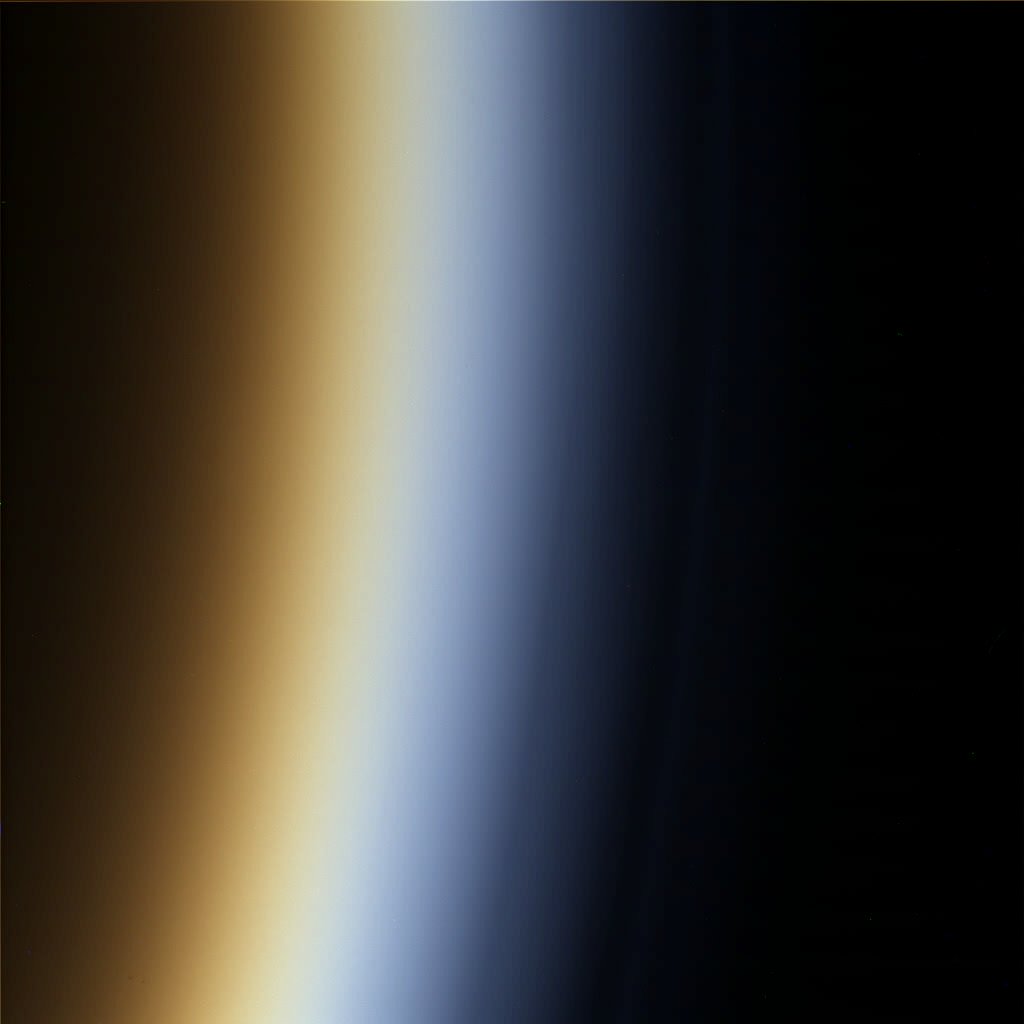
Titan's thick haze layer is shown in this enhanced Voyager 1 image taken Nov. 12, 1980 at a distance of 435,000 kilometers (270,000 miles). Voyager images of Saturn's largest moon show Titan completely enveloped by haze that merges with a darker "hood" or cloud layer over the north pole. Such a mantle is not present at the south pole. At Voyager's closest approach to Titan on Nov. 11, 1980, spacecraft instruments found that the moon has a substantial atmosphere, far denser than that of Mars and possibly denser than Earth's.roach toCassini has found Titan's upper atmosphere to consist of a surprising number of layers of haze, as shown in this ultraviolet image of Titan's night side limb, colorized to look like true color. The many fine haze layers extend several hundred kilometers above the surface. Although this is a night side view, with only a thin crescent receiving direct sunlight, the haze layers are bright from light scattered through the atmosphere.
The image was taken with the Cassini spacecraft narrow angle camera. About 12 distinct haze layers can be seen in this image, with a scale of 0.7 kilometers (.43 miles) per pixel. The limb shown here is at about 10 degrees south latitude, in the equatorial region.
Titan on Nov. 11, 1980, spacecraft instruments found that the moon has a substantial atmosphere, far denser t
Huygens at Titan 1
January 14, 2005
This raw image was returned by the Descent Imager/Spectral Radiometer camera onboard the European Space Agency's Huygens probe after the probe descended through the atmosphere of Titan. It shows the surface of Titan with ice blocks strewn around. The size and distance of the blocks will be determined when the image is properly processed.
The Descent Imager/Spectral Radiometer is one of two NASA instruments on the probe. The Cassini-Huygens mission is a cooperative project of NASA, the European Space Agency and the Italian Space Agency. The Jet Propulsion Laboratory, a division of the California Institute of Technology in Pasadena, manages the Cassini-Huygens mission for NASA's Science Mission Directorate, Washington, D.C. The Cassini orbiter and its two onboard cameras were designed, developed and assembled at JPL. The Descent Imager/Spectral team is based at the University of Arizona, Tucson, Ariz.Huygens at Titan 2
January 14, 2005
This is one of the first raw images returned by the European Space Agency's Huygens probe during its successful descent to Titan. It was taken at an altitude of 8 kilometers with a resolution of 20 meters per pixel. It shows what could be the landing site, with shorelines and boundaries between raised ground and flooded plains.
It was taken with the Descent Imager/Spectral Radiometer, one of two NASA instruments on the probe.The Cassini-Huygens mission is a cooperative project of NASA, the European Space Agency and the Italian Space Agency. The Jet Propulsion Laboratory, a division of the California Institute of Technology in Pasadena, manages the Cassini-Huygens mission for NASA's Science Mission Directorate, Washington, D.C. The Cassini orbiter and its two onboard cameras were designed, developed and assembled at JPL. The Descent Imager/Spectral team is based at the University of Arizona, Tucson, Ariz.
Huygens at Titan 3
January 14, 2005
This is one of the first raw images returned by the European Space Agency's Huygens probe during its successful descent to Titan. It was taken from an altitude of 16.2 kilometers with a resolution of approximately 40 meters per pixel. It apparently shows short, stubby drainage channels leading to a shoreline.
It was taken with the Descent Imager/Spectral Radiometer, one of two NASA instruments on the probe.The Cassini-Huygens mission is a cooperative project of NASA, the European Space Agency and the Italian Space Agency. The Jet Propulsion Laboratory, a division of the California Institute of Technology in Pasadena, manages the Cassini-Huygens mission for NASA's Science Mission Directorate, Washington, D.C. The Cassini orbiter and its two onboard cameras were designed, developed and assembled at JPL. The Descent Imager/Spectral team is based at the University of Arizona, Tucson, Ariz.
This composite was produced from images returned yesterday, 14 January 2005, by ESA's Huygens probe during its successful descent to land on Titan. It shows the boundary between the lighter-coloured uplifted terrain, marked with what appear to be drainage channels, and darker lower areas. These images were taken from an altitude of about 8 kilometres and a resolution of about 20 metres per pixel.
Credits: ESA/NASA/University of Arizona
This composite was produced from images returned yesterday, 14 January 2005, by ESA's Huygens probe during its successful descent to land on Titan. It shows a full 360-degree view around Huygens. The left-hand side, behind Huygens, shows a boundary between light and dark areas. The white streaks seen near this boundary could be ground 'fog', as they were not immediately visible from higher altitudes. As the probe descended, it drifted over a plateau (centre of image) and was heading towards its landing site in a dark area (right). From the drift of the probe, the wind speed has been estimated at around 6-7 kilometres per hour. These images were taken from an altitude of about 8 kilometres and a resolution of about 20 metres per pixel.
Credits: ESA/NASA/University of Arizona
Titans Orbit
Orbital period : (Titanic day) 15.95 Earth days
Copyright © Wingmakers.co.nz - All rights reserved.