← The Wingmakers Ways · Astronomy & Exoplanets
Archived page · Checkable
Tethys
Tethys.html · captured from wingmakers.co.nz
Tethys
Tethys is one of the 18 named moons, or natural satellites orbiting around Saturn
Navigation
Solar System
Sun
Mercury
Venus
Earth
Mobius
Mars
Jupiter
Saturn
Uranus
Neptune
Pluto
2004 DW
Quaoar
Sedna
2002 AW197
2003 UB313
Comets
Meteorites
Asteroids
Planetary Moons
Earth
The Moon
Saturn
Titan
Tethys
Enceladus
Dione
Extra Solar Planets
Lensing Galaxy - Einstein Cross
Tethys , in astronomy, one of the 18 named moons, or natural satellites, of Saturn. Also known as Saturn III (or S3), Tethys is 659 mi (1060 km) in diameter, orbits Saturn at a mean distance of 183,093 mi (294,660 km), and has equal orbital and rotational periods of 1.8878 earth days. Tethys was discovered by the Italian-French astronomer Gian Domenico Cassini in 1684. Tethys's low density (1.2) implies that is composed primarily of water ice. The heavily cratered satellite has two dominant surface features: one is an impact crater�called Odysseus�about 250 mi (400 km) in diameter that is quite flat and without the high wall and central peak common on the moon; the other a huge valley�called Ithaca Chasma�that is 63 mi (100 km) wide, 2.5 mi (4 km) deep, and 1,250 mi (2,000 km) long, stretching three quarters of the way around Tethys's circumference. Tethys is co-orbital with two other moons; that is, they orbit Saturn at the same distance as Tethys but precede (Telesto) and follow (Calypso) Tethys by about 60°.Planetary Moon of Saturn
Moon : TethysTethys [TEE-this] was discovered by Giovanni Cassini in 1684. It is an icy body similar in nature to Dione and Rhea. The density of Tethys is 1.21 gm/cm3, indicating that it is composed almost entirely of water-ice. Tethys's icy surface is heavily cratered and contains cracks caused by faults in the ice. There is one enormous trench on Tethys about 65 kilometers (40 miles) wide and extending from above the center to the extreme left. It covers three-fourths of Tethys' circumference. The fissure is about the size scientists would predict if Tethys were once fluid and its crust hardened before the interior. The canyon has been named Ithaca Chasma. A vast expanse of relative young plains also exists on Tethys. Tethys' surface temperature is -187° C (-305° F).
Greek Mythology
TETHYS was the TITANIS goddess of the nursing the young and of the underground flow of fresh water. She was the wife of Okeanos (the great fresh-water river that encircled the earth) and by him the mother of the three thousand Potamoi (Rivers) and Okeanides (Clouds). She was appropriately depicted attending the wedding of Thetis accompanied by Eileithyia, the goddess of childbirth.
Tethys was depicted as a woman usually accompanied (as the mother of so many offspring) by Eileithyia the goddess of childbirth.
Tethys And Dione
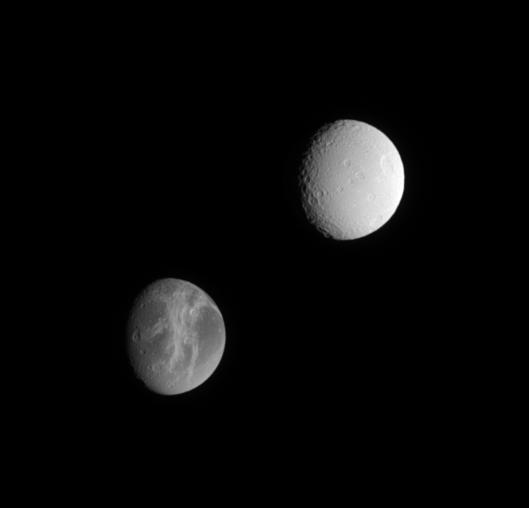
Cassini offers this lovely comparison between two of Saturn's satellites, Dione and Tethys, which are similar in size but have very different surfaces.Extensive systems of bright fractures carve the surface of Dione (1,118 kilometers, or 695 miles across). The double-pronged feature Carthage Linea points toward the crater Turnus at the nine o'clock position near the terminator, and Palatine Linea runs toward the moon's bottom limb near the five o'clock position.
In contrast, the surface of Tethys (1,071 kilometers, or 665 miles across) appears brighter and more heavily cratered. The large crater Penelope is near the eastern limb. The huge rift zone Ithaca Chasma, which is 3 to 5 kilometers (2 to 3 miles) deep and extends for about 2,000 kilometers (1,200 miles) from north to south across Tethys, is hidden in shadow just beyond the terminator. For comparison, the Grand Canyon in Arizona is about 1.5 kilometers (1 mile) deep, and about 450 kilometers (280 miles) long.
Tethy's And Saturn
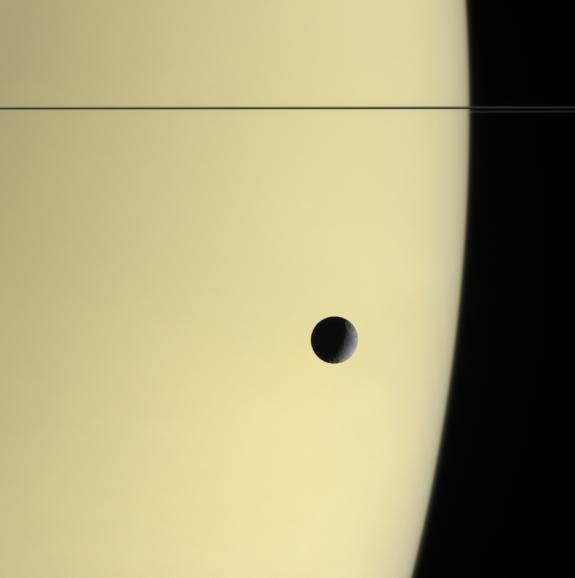
Tethys floats before the massive, golden-hued globe of Saturn in this natural color view. The thin, dark line of the rings curves around the horizon at top.Visible on Tethys (1,071 kilometers, or 665 miles across) are the craters Odysseus (top) and Melanthius (bottom). The view looks toward the anti-Saturn side of Tethys.
Images taken using red, green and blue spectral filters were combined to create this color view. Tethys is apparently darker than Saturn at these wavelengths. The edge of the planet appears fuzzy, which may indicate that we are seeing haze layers that are separated from the main cloud deck.
The images were acquired by the Cassini spacecraft narrow-angle camera on Dec. 3, 2005, at a distance of approximately 2.5 million kilometers (1.6 million miles) from Saturn. The image scale is 15 kilometers (9 miles) per pixel on Saturn and 13 kilometers (8 miles) per pixel on Tethys.
Surface Of Tethys
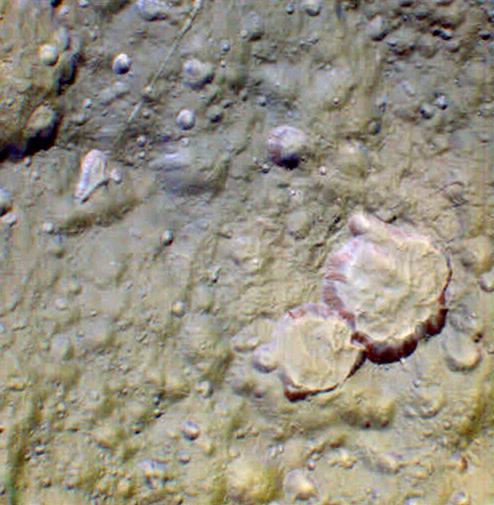
This view is among the closest Cassini images of Tethys' icy surface taken during the Sept. 24, 2005 flyby.This false-color image, created with infrared, green and ultraviolet frames, reveals a wide variety of surface colors across this terrain. The presence of this variety at such small scales may indicate a mixture of different surface materials. Tethys was previously known to have color differences on its surface, especially on its trailing side, but this kind of color diversity is new to imaging scientists. For a clear-filter view of this terrain, see PIA07736.
This view is centered on terrain at approximately 4.2 degrees south latitude and 357 degrees west longitude on Tethys. The view has been rotated so that north on Tethys is up.
The images for this view were obtained using the Cassini spacecraft narrow-angle camera at distances ranging from approximately 18,400 to 19,000 kilometers (11,400 to 11,800 miles) from Tethys and at a Sun-Tethys-spacecraft, or phase, angle of 17 degrees. Image scale is 213 meters (700 feet) per pixel.
Tethys And Saturns Rings
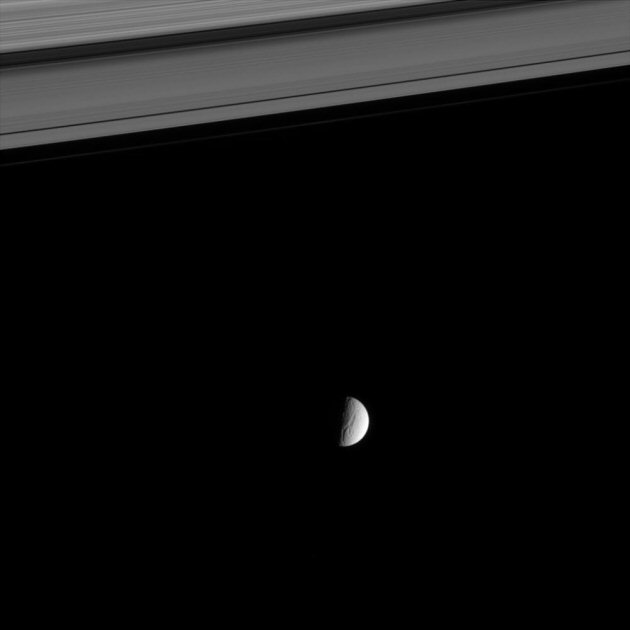
The dramatic Ithaca Chasma carves an enormous gash for more than 1,000 kilometers (620 miles) across Saturn's moon Tethys. Tethys is 1,071 kilometers (665 miles) across. Stretching across the top of this view are the B and A rings, separated by the Cassini Division.Ithaca Chasma is on the moon's Saturn-facing hemisphere. North on Tethys is up and rotated 15 degrees to the left in this view.
The image was taken in visible light with the Cassini spacecraft narrow-angle camera on Aug. 24, 2005, at a distance of approximately 2.2 million kilometers (1.3 million miles) from Tethys and at a Sun-Tethys-spacecraft, or phase, angle of 87 degrees. The image scale is 13 kilometers (8 miles) per pixel.
Tethys & Saturn On Oct. 18, 2004
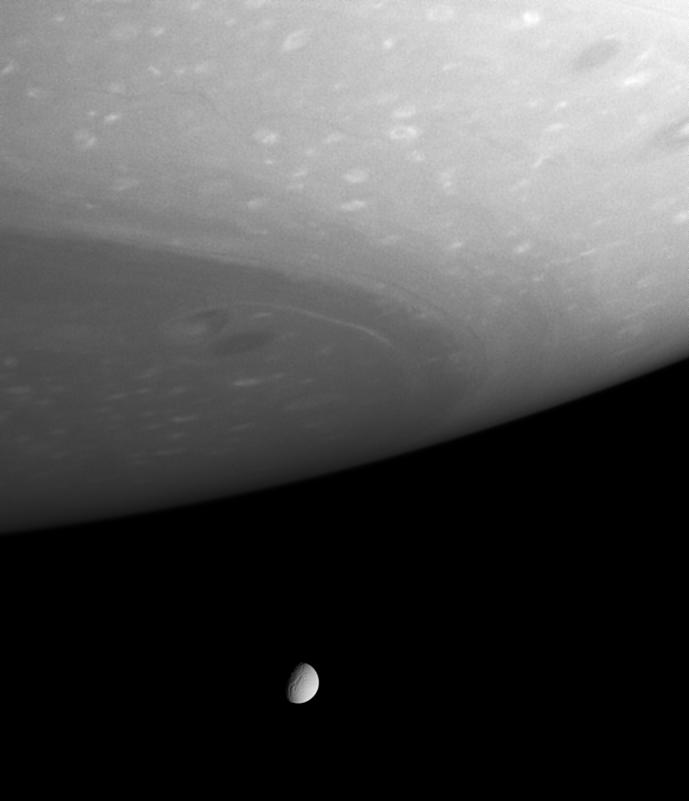
This dazzling view looks beyond gigantic storms near Saturn's south pole to the small but clear disc of Tethys (1,060 kilometers, or 659 miles, across). Clouds and ribbons of gas swirl about in the planet's atmosphere in the foreground, while a tremendous chasm is visible on the icy moon.The image was taken with the Cassini spacecraft narrow angle camera on Oct. 18, 2004, at a distance of 3.9 million kilometers (2.4 million miles) from Saturn and at a Sun-Saturn-spacecraft, or phase, angle of 61 degrees. The view is in wavelengths of visible red light centered at 619 nanometers. The image scale is 23 kilometers (14 miles) per pixel.
Copyright © Wingmakers.co.nz - All rights reserved.