← The Wingmakers Ways · Unsorted
Archived page · Asserted
Europa
Europa.html · captured from wingmakers.co.nz
Europa
Europa was first discovered by Galileo in 1610, making it one of the Galilean Satellites.
Navigation
Solar System
Sun
Mercury
Venus
Earth
Mobius
Mars
Jupiter
Saturn
Uranus
Neptune
Pluto
2004 DW
Quaoar
Sedna
2002 AW197
2003 UB313
Comets
Meteorites
Asteroids
Planetary Moons
Earth
The Moon
Saturn
Titan
Tethys
Enceladus
Dione
Extra Solar Planets
Lensing Galaxy - Einstein Cross
Europa was first discovered by Galileo in 1610, making it one of the Galilean Satellites. Of the 17 moons it is the 6th closest to Jupiter, with a standoff distance of 670,900 km. It is the 4th largest moon, with a diameter that is about half the distance across the United States, 3138 km (1950 miles), making Europa close to the same size as the Earth's moon.
Europa is named after one of Jupiter's many lovers from Greek mythology. Its main characteristic is the many cracks on its icy and smooth surface. Because of its modest activity, Europa may have more than just the most fragile of atmospheres. Europa is one of the few moons in the solar system with the possibility of a liquid water environment friendly to life.
Greek Mythology
Europa was the beautiful daughter of the king of Tyre, Agenor. Zeus (Jupiter), the King of the gods according to Greek mythology, saw Europa as she was gathering flowers by the sea a nd immediately fell in love with her.
Zeus transformed himself into the form of a magnificent white bull and appeared in the sea shore where Europa was playing. The great bull walked gently over to where Europa stood and knelt at her feet. The appearance and movements of the bull were so gentle that Europa spread flowers about his neck and dared to climb upon his back. But suddenly, the bull rushed over the sea abducting Europa. Only then the bull revealed its true identity and took Europa to the Mediterranean island of Crete.There, Zeus cast off the shape of the white bull, and back into his human form, made Europa his lover beneath a simple cypress tree. Europa became the first queen of Crete and had by Zeus three sons. At last, Zeus reproduced the shape of the white bull, used by Zeus to seduce Europa, in the stars. Even today we can recognize its shape in the constellation Taurus.
Europa
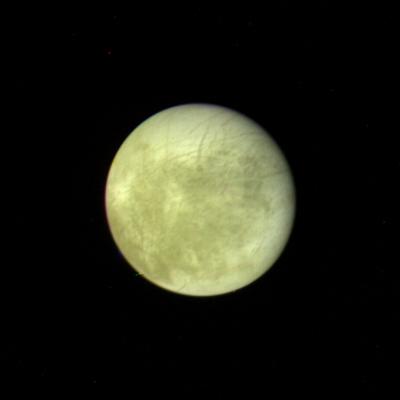
This picture of Europa, the smallest Galilean satellite, was taken in the afternoon of March 4, 1979, from a distance of about 2 million kilometers (1.2 million miles) by Voyager 1. This face of Europa is centered at about the 300` meridian. The resolution of this picture of Europa is about the best that will be obtained by Voyager 1, but the second spacecraft will take much clearer photographs of this satellite in July. The bright areas are probably ice deposits while the darkened areas may be the rocky surface or areas with a more patchy distribution of ice. The most unusual features are the systems of long linear structures which cross the surface in various directions. Some of these linear structures are over a thousand kilometers long and about 2 or 3 hundred kilometers wide. They may be fractures or faults which have disrupted the surface.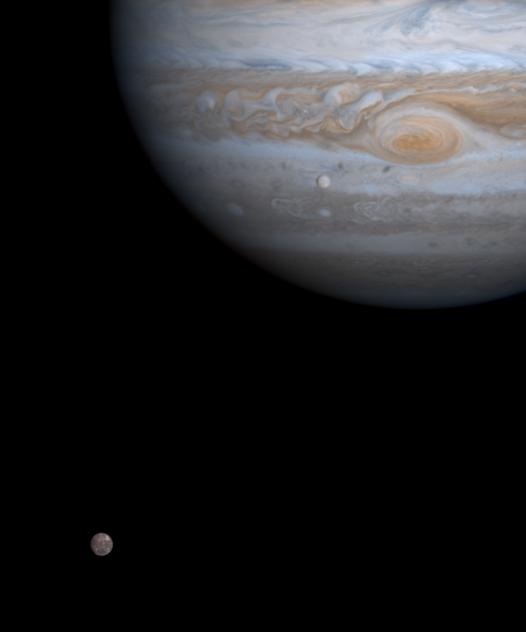
One moment in an ancient, orbital dance is caught in this color picture taken by NASA's Cassini spacecraft on Dec. 7, 2000, just as two of Jupiter's four major moons, Europa and Callisto, were nearly perfectly aligned with each other and the center of the planet.The distances are deceiving. Europa, seen against Jupiter, is 600,000 kilometers (370,000 miles) above the planet's cloud tops. Callisto, at lower left, is nearly three times that distance from the cloud tops. Europa is a bit smaller than Earth's Moon and has one of the brightest surfaces in the solar system. Callisto is 50 percent bigger -- roughly the size of Saturn's largest satellite, Titan -- and three times darker than Europa. Its brightness had to be enhanced in this picture, relative Europa's and Jupiter's, in order for Callisto to be seen in this image.
Europa and Callisto have had very different geologic histories but share some surprising similarities, such as surfaces rich in ice. Callisto has apparently not undergone major internal compositional stratification, but Europa's interior has differentiated into a rocky core and an outer layer of nearly pure ice. Callisto's ancient surface is completely covered by large impact craters: The brightest features seen on Callisto in this image were discovered by the Voyager spacecraft in 1979 to be bright craters, like those on our Moon. In contrast, Europa's young surface is covered by a wild tapestry of ridges, chaotic terrain and only a handful of large craters.
This color composite view combines violet, green, and infrared images of Jupiter's intriguing moon, Europa, for a view of the moon in natural color (left) and in enhanced color designed to bring out subtle color differences in the surface (right). The bright white and bluish part of Europa's surface is composed mostly of water ice, with very few non-ice materials. In contrast, the brownish mottled regions on the right side of the image may be covered by hydrated salts and an unknown red component. The yellowish mottled terrain on the left side of the image is caused by some other unknown component. Long, dark lines are fractures in the crust, some of which are more than 3,000 kilometers (1,850 miles) long.
North is to the top of the picture and the sun fully illuminates the surface. Europa is about 3,160 kilometers (1,950 miles) in diameter, or about the size of Earth's moon. The finest details that can be discerned are 25 kilometers across. The images in this global view were taken in June 1997 at a range of 1.25 million kilometers by the Solid State Imaging (SSI) system on NASA's Galileo spacecraft, during its ninth orbit of Jupiter.This feature on Europa was seen as a dark, diffuse circular patch on a previous Galileo global image of Europa's leading hemisphere on April 3, 1997. The "bulls-eye" pattern appears to be a 140- kilometer (86-mile) wide impact scar (about the size of the island of Hawaii) which formed as the surface fractured minutes after a mountain-sized asteroid or comet slammed into the satellite. This approximately 214-kilometer (132-mile) wide picture is the product of three images which have been processed in false color to enhance shapes and compositions.
North is toward the top of this picture, which is illuminated from sunlight coming from the west. This color composite reveals a sequence of events which have modified the surface of Europa. The earliest event was the impact which formed the Tyre structure at 34 degrees north latitude and 146.5 degrees west longitude. The impact was followed by the formation of the reddish lines superposed on Tyre. The red color designates areas that are probably a dirty water ice mixture. The fine blue-green lines crossing the region from west to east appear to be ridges which formed after the crater.Ancient Impact Basin on Europa
This feature on Europa was seen as a dark, diffuse circular patch on a previous Galileo global image of Europa's leading hemisphere on April 3, 1997. The "bulls-eye" pattern appears to be a 140- kilometer (86-mile) wide impact scar (about the size of the island of Hawaii) which formed as the surface fractured minutes after a mountain-sized asteroid or comet slammed into the satellite. This approximately 214-kilometer (132-mile) wide picture is the product of three images which have been processed in false color to enhance shapes and compositions.North is toward the top of this picture, which is illuminated from sunlight coming from the west. This color composite reveals a sequence of events which have modified the surface of Europa. The earliest event was the impact which formed the Tyre structure at 34 degrees north latitude and 146.5 degrees west longitude. The impact was followed by the formation of the reddish lines superposed on Tyre. The red color designates areas that are probably a dirty water ice mixture. The fine blue-green lines crossing the region from west to east appear to be ridges which formed after the crater.
Copyright © Wingmakers.co.nz - All rights reserved.