← The Wingmakers Ways · Astronomy & Exoplanets
Archived page · Checkable
Mercury
Mercury.html · captured from wingmakers.co.nz
Mercury
 Mercury, the planet nearest the Sun, is the second smallest planet in the solar system. Only slightly larger than the Earth's moon.
Universe
Solar System Sun
Mercury
Venus
Earth
Mobius
Mars
Jupiter
Saturn
Uranus
Neptune
Pluto
2004 DW
Quaoar
Sedna
2002 AW197
2003 UB313
Comets
Meteorites
Asteroids
Planetary Moons
Earth
The Moon
Saturn
Titan
Tethys
Enceladus
Dione
Extrasolar planets
Star Systems
Terrestrial Planet
Mercury, the planet nearest the Sun, is the second smallest planet in the solar system. Only slightly larger than the Earth's moon, Mercury's surface is covered with craters. This tiny planet does not have any rings or moons.
Mercury Statistics
Equatorial radius (km) : 2,439.7
Equatorial radius (Earth = 1) : 3.8252e-01
Mean density (gm/cm^3) : 5.42
Visual geometric albedo : 0.10
Magnitude (Vo) : -1.9
Mean surface temperature : 179°C
Maximum surface temperature : 427°C
Minimum surface temperature : -173°C
Star System : Meridian Solar System
Discovery Status : Imaged
Mass : 0.055 Earths
Average Distance :0.387 AUs
Period : 87.97 Days
Orbital Eccentricity : 0.2056
Argument of Perihelion (omega) : 77.45645°
Detection Method : Naked Eye
Year Discovered : Prehistory
Mercury's Atmospheric composition
Helium42%
Sodium42%
Oxygen 15%
Other 1%
Planetary Orbits 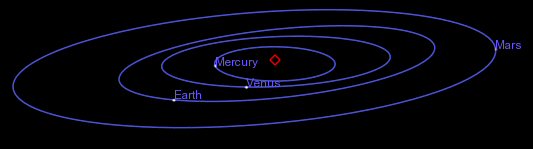
Mercury's Orbital Statistics
Mean distance from the Sun (Earth = 1) 0.3871
Rotational period (days) 58.6462
Orbital period (days) 87.969
Mean orbital velocity (km/sec) 47.88
Orbital eccentricity 0.2056
Tilt of axis (degrees) 0.00
Orbital inclination (degrees) 7.004
Equatorial surface gravity (m/sec^2) 2.78
Equatorial escape velocity (km/sec) 4.25
Mercury's Interior
Most of what is known about the internal structure of Mercury comes from data acquired by the Mariner 10 spacecraft that flew past the planet in 1973 and 1974. Mercury is about a third of the size of Earth, yet its density is comparable to that of Earth. This indicates that Mercury has a large core roughly the size of Earth's moon or about 75% of the planet's radius. The core is likely composed of 60 to 70% iron by mass. Mariner 10's measurements of the planet reveals a dipolar magnetic field possibly produced by a partially molten core. A solid rocky mantle surrounds the core with a thin crust of about 100 kilometers.
Surface of Mercury
The pictures returned from the Mariner 10 spacecraft showed a world that resembles the moon. It is pocked with craters, contains hugh multi-ring basins, and many lava flows. The craters range in size from 100 meters (the smallest resolvable feature on Mariner 10 images) to 1,300 kilometers. They are in various stages of preservation. Some are young with sharp rims and bright rays extending from them. Others are highly degraded, with rims that have been smoothed from the bombardment of meteorites. The largest crater on Mercury is the Caloris basin. A basin was defined by Hartmann and Kuiper (1962) as a "large circular depression with distinctive concentric rings and radial lineaments." Others consider any crater larger than 200 kilometers a basin. The Caloris basin is 1,300 kilometers in diameter, and was probably caused by a projectile larger than 100 kilometers in size. The impact produced concentric mountain rings three kilometers high and sent ejecta 600 to 800 kilometers across the planet. (Another good example of a basin showing concentric rings is the Valhalla region on Jupiter's moon Callisto.) The seismic waves produced from the Caloris impact focused onto the other side of the planet and produced a region of chaotic terrain. After the impact the crater was partially filled with lava flows.
Mercury is marked with great curved cliffs or lobate scarps that were apparently formed as Mercury cooled and shrank a few kilometers in size. This shrinking produced a wrinkled crust with scarps kilometers high and hundreds of kilometers long.
The majority of Mercury's surface is covered by plains. Much of it is old and heavily cratered, but some of the plains are less heavily cratered. Scientists have classified these plains as intercrater plains and smooth plains. Intercrater plains are less saturated with craters and the craters are less than 15 kilometers in diameter. These plains were probably formed as lava flows buried the older terrain. The smooth plains are younger still with fewer craters. Smooth plains can be found around the Caloris basin. In some areas patches of smooth lava can be seen filling craters.
Mercury's history of formation is similar to that of Earth's. About 4.5 billion years ago the planets formed. This was a time of intense bombardment for the planets as they scooped up matter and debris left around from the nebula that formed them. Early during this formation, Mercury probably differentiated into a dense metallic core, and a silicate crust. After the intense bombardment period, lava flowed across the surface and covered the older crust. By this time much of the debris had been swept up and Mercury entered a lighter bombardment period. During this period the intercrater plains formed. Then Mercury cooled. Its core contracted which in turn broke the crust and produced the prominent lobate scarps. During the third stage, lava flooded the lowlands and produced the smooth plains. During the fourth stage micrometeorite bombardment created a dusty surface also known as regolith. A few larger meteorites impacted the surface and left bright rayed craters. Other than the occasional collisions of a meteorites, Mercury's surface is no longer active and remains the same as it has for millions of years.
Could water exist on Mercury?
It would appear that Mercury could not support water in any form. It has very little atmosphere and is blazing hot during the day, but in 1991 scientists at Caltech bounced radio waves off Mercury and found an unusual bright return from the north pole. The apparent brightening at the north pole could be explained by ice on or just under the surface. But is it possible for Mercury to have ice? Because Mercury's rotation is almost perpendicular to its orbital plain, the north pole always sees the sun just above the horizon. The insides of craters would never be exposed to the Sun and scientists suspect that they would remain colder than -161 C. These freezing temperatures could trap water outgassed from the planet, or ices brought to the planet from cometary impacts. These ice deposits might be covered with a layer of dust and would still show bright radar returns.
Double Ring Basin
This image shows a double-ring basin which is 200 kilometers (120 miles) in diameter. The floor contains smooth plains material. The inner ring basin is at a lower elevation than the outer ring.
Large Faults on Mercury
This Mariner 10 image shows Santa Maria Rupes, the sinuous dark feature running through the crater at the center of this image. Many such features were discovered in the Mariner images of Mercury and are interpreted to be enormous thrust faults where part of the mercurian crust was pushed slightly over an adjacent part by compressional forces. The abundance and length of the thrust faults indicate that the radius of Mercury decreased by 1-2 kilometers (.6 - 1.2 miles) after the solidification and impact cratering of the surface. This volume change probably was due to the cooling of the planet, following the formation of a metallic core three-fourths the size of the planet. North is towards the top and is 200 kilometers (120 miles) across.
Antoniadi Ridge
This is an image of a 450 kilometer (280 mile) ridge called Antoniadi. It travels along the right edge of the image, and transects a large 80 kilometer (50 mile) crater about half way in between. It crosses smooth plains to the north and intercrater plains to the south [Strom et al., 1975]
Mercury: Geology and Magnetosphere
Reflections Of The Heart - By Darryn John Murphy

Published by First Edition Publishers
Book Title - Reflections of the Heart
Author - Darryn John Murphy
ISBN 978-1-877479-28-1
192 pages
20cm x 14cm soft cover
Published March 2008
Reflections of the Heart - Click Here
In Reflections Of The Heart, Darryn shares a personal collection of candid and open hearted poems. His honest and sincere approach is a celebration of the most important thing in life - Love