← The Wingmakers Ways · Astronomy & Exoplanets
Archived page · Checkable
Venus
Venus.html · captured from wingmakers.co.nz
Venus
 Venus is a slightly smaller than the Earth, with a radius 95% that of Earth (12,103 km) and a mass 81% that of Earth.
Universe
Solar System Sun
Mercury
Venus
Earth
Mobius
Mars
Jupiter
Saturn
Uranus
Neptune
Pluto
2004 DW
Quaoar
Sedna
2002 AW197
2003 UB313
Comets
Meteorites
Asteroids
Planetary Moons
Earth
The Moon
Saturn
Titan
Tethys
Enceladus
Dione
Extrasolar planets
Star Systems
Terrestrial Planet
Venus is second planet from the Sun, attaining the greatest brilliancy in the night sky, outshining all the stars, hence its poetic names 'morning / evening star'. It has no natural satellite. It has the following characteristics: mass 4.87 × 1024 kg; radius 6051 km / 3760 mi; mean density 5.2 g / cm3; equatorial gravity 860 cm / s2; rotational period 243 days (retrograde); orbital period 224.7 days; obliquity 0°; orbital eccentricity 0.007; mean distance from the Sun 108.2 × 10⁶ km / 67.2 × 10⁶ mi.
Venus and Earth are almost the same size. Venus is the closest planet to Earth, but it does not have oceans or human life like Earth. It approaches nearer to the Earth than any other planet, and is a near twin to Earth in size and density, but with a radically different atmosphere of mainly carbon dioxide, 90 times denser than our own, and with surface temperatures near 460°C. This planet is unusual because it rotates in a direction opposite that of all of the other planets. Venus spins very slowly as it orbits the Sun. There is no observable magnetic field.
Interstellar Card
Venus Statistics
Mass (kg) : 4.869e+24
Mass (Earth = 1) : .81476
Equatorial radius (km) : 6,051.8
Equatorial radius (Earth = 1) : .94886
Mean density (gm/cm^3) : 5.25
Mean distance from the Sun (km) : 108,200,000
Mean distance from the Sun (Earth = 1) : 0.7233
Equatorial surface gravity (m/sec^2) 8.87
Equatorial escape velocity (km/sec) 10.36
Visual geometric albedo 0.65
Magnitude (Vo) -4.4
Mean surface temperature 482°C
Atmospheric pressure (bars) 92
Star System: Meridian Solar System
Discovery Status: Imaged
Mass: 0.814 Earths
Average Distance: 0.723 AUs
Period: 224.7 Days
Orbital Eccentricity: 0.0068
Argument of Perihelion (omega): 131.53298°
Detection Method: Naked Eye
Year Discovered: Prehistory
Planetary Orbit 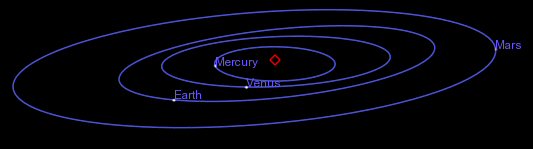
Venus Orbital Statistics
Rotational period (days) -243.0187
Orbital period (days) 224.701
Mean orbital velocity (km/sec) 35.02
Orbital eccentricity 0.0068
Tilt of axis (degrees) 177.36
Orbital inclination (degrees) 3.394
Venus interior
Venus is a slightly smaller than the Earth, with a radius 95% that of Earth (12,103 km) and a mass 81% that of Earth. If we could walk around on the surface of the planet (without being killed by the toxic blast furnace of an atmosphere), gravity would be close to that on the surface of Earth.
The interior of Venus is probably similar to Earth's interior. Venus, like Earth, is one of the terrestrial planets and is made of rock and metal. It probably has a partly molten metallic core, a rocky mantle, and a crust. The planet rotates very slowly, taking more than 243 Earth days to spin once on it's axis (even longer than the time it takes for Venus to orbit the Sun, about 225 Earth days). This may be the reason the planet doesn't have a magnetic field like many of the other planets, including Earth.
The varied terrain of Venus, including volcanoes, mountains, craters, and lava flows, suggests that the planet was once, and perhaps still is, geologically active. But basic questions about the interior of Venus remain, such as the thickness of the lithosphere.
Venus Atmospheric composition
Carbon dioxide : 96%
Nitrogen : 3+%
Trace amounts of: Sulfur dioxide, water vapor,
carbon monoxide, argon, helium, neon,
hydrogen chloride, and hydrogen fluoride.
Atmosphere
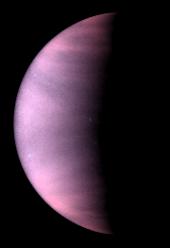
Venus has very thick, rapidly spinning clouds of sulfur dioxide and sulphuric acid droplets which cover the planet completely, obscuring any surface details. There are constant thunderstorms in these clouds. The thick atmosphere and cloud cover create a greenhouse effect that maintains high temperatures, even though clouds reflect a large fraction of incident sunlight, so Venus appears very bright to us here on Earth.
Pressure from the dense atmosphere is about 90 times greater than Earth's and would crush a human. This is a very unpleasant place, with winds that blow constantly at hundreds of miles per hour and extremely high temperatures. This planet is an example of a runaway greenhouse effect. Venus gets so hot during the day that it could melt a lead cannonball. The temperature rises to 484 degrees Celsius on the side facing the Sun.
Surface Of Venus The surface of Venus has many craters which were made by meteorites and asteroids crashing into the planet. Venus also has volcanoes.
The surface was mapped at sub-kilometre resolution by the Magellan spacecraft in 1990-2. About 85% consists of volcanic plains (mostly at low elevations) marked by thousands of individual volcanic constructs and (unlike most other solid planetary surfaces) relatively few (c.900) impact craters. The most extensive plains are flood lavas, within which are found shield volcanoes, cones, and domes of up to c.90 km / 60 mi diameter.
Some features appear unique to Venus, and have been given descriptive names: coronae are complex volcano-tectonic features whose morphology suggests they result from mantle plumes; arachnoids have inner concentric and outer radial ridges and fractures; pancake domes are almost perfectly circular, with steep sides and heights of a few hundred metres. The surface is evidently very young (200-700 million years).
Surface features are disrupted by tectonic activity, and deformation occurs over a wide variety of styles and scales (up to 1000 km / 600 mi). There is no evidence for Earth-like plate tectonics, though some features do resemble terrestrial subduction trenches. Reconstruction of the planetary history by interpretation of the Magellan geological observations and the earlier Pioneer and Venera atmospheric composition measurements is a process expected to continue for many years.
Addams Crater 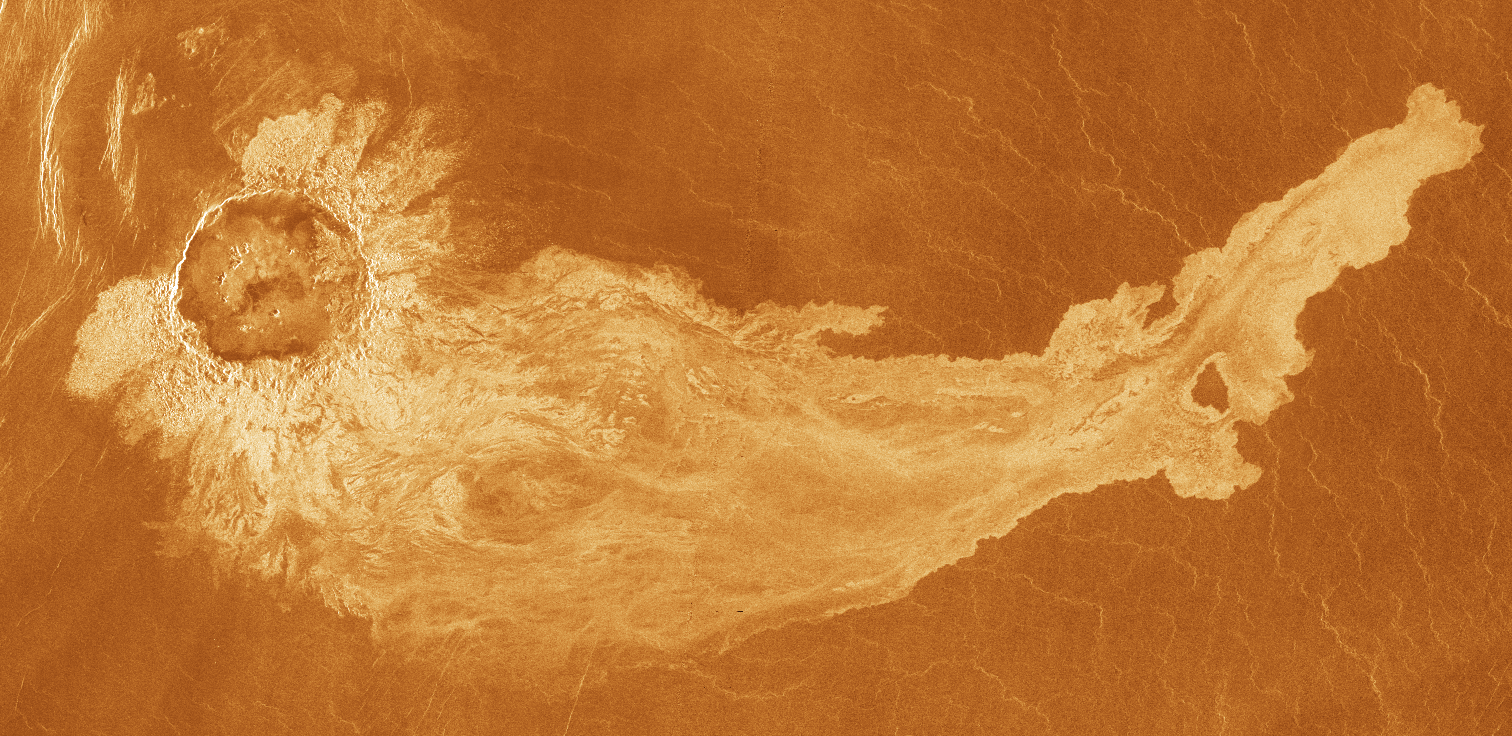 Addams crater is remarkable for the extensive outflow that extends 600 kilometers (373 miles) from the crater rim. Because of the high temperature and pressure on the Venusian surface, impacts produce more melt than on other planets. Outflow deposits are very thin. Their direction is controlled by the local topography.
Crater Riley
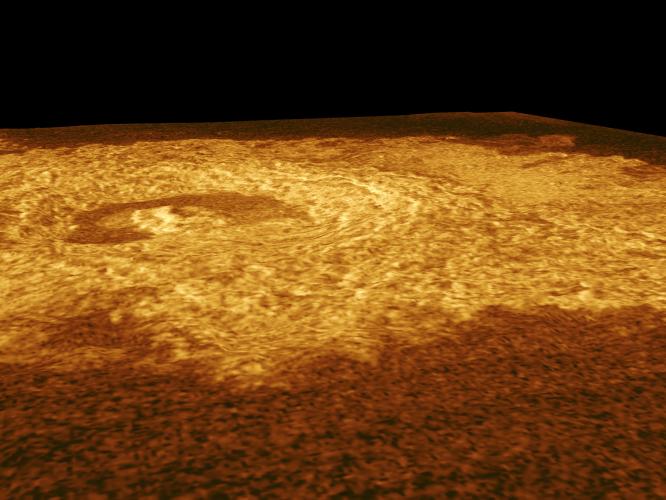
This image shows an oblique view of the impact crater Riley, named for Margaretta Riley, a 19th Century botanist. This view was prepared from two left-looking Magellan radar images acquired with different incidence angles. Because the relief displacements of the two images are different, depths from the crater rim to the crater floor and heights of the crater rim and flanks above the surrounding plains can be measured. The crater is 25 kilometers (15.5 miles) in diameter. The floor of the crater is 580 meters (1,914 feet) below the plains surrounding the crater. The crater's rim rises 620 meters (2,046 feet) above the plains and 1,200 meters (3,960 feet) above the crater floor. The crater's central peak is 536 meters (1,769 feet) high. The crater's diameter is 40 times the depth resulting in a relatively shallow appearance. The topography is exaggerated by 22 times to emphasize the crater's features.
The Moon & Venus 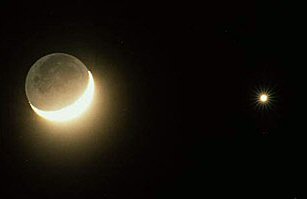 While you're out looking for Perseid Meteors, be sure to checkout the beautiful conjunction between the tiny Crescent Moon, and the Planet Venus. If you're really good, you'll even spot the Planet Saturn due east of the Moon. The trio will be due east before sunrise. Check out our Conjunctions Page to view past such events.
Reflections Of The Heart - By Darryn John Murphy

Published by First Edition Publishers
Book Title - Reflections of the Heart
Author - Darryn John Murphy
ISBN 978-1-877479-28-1
192 pages
20cm x 14cm soft cover
Published March 2008
Reflections of the Heart - Click Here
In Reflections Of The Heart, Darryn shares a personal collection of candid and open hearted poems. His honest and sincere approach is a celebration of the most important thing in life - Love