← The Wingmakers Ways · Astronomy & Exoplanets
Archived page · Checkable
Pluto
Pluto.html · captured from wingmakers.co.nz
Pluto
 Pluto is usually the outermost planet in the solar system, and is the only planet that has not been visited by a spacecraft from Earth.
Universe
Solar System Sun
Mercury
Venus
Earth
Mobius
Mars
Jupiter
Saturn
Uranus
Neptune
Pluto
2004 DW
Quaoar
Sedna
2002 AW197
2003 UB313
Comets
Meteorites
Asteroids
Planetary Moons
Earth
The Moon
Saturn
Titan
Tethys
Enceladus
Dione
Extrasolar planets
Star Systems
Kuiper Object
Pluto is usually the outermost planet in the solar system, and is the only planet that has not been visited by a spacecraft from Earth. This mysterious planet is really a double planet system, since its moon, Charon, is very close to Pluto and about the same size.
Pluto's unique orbit causes it to periodically come within the orbit of Neptune. Pluto was the eighth planet from the Sun from February 7th, 1979 through February 11, 1999. Now Pluto will remain the ninth planet through the 23rd century.
Planetary Orbits
It may seem hard to believe that Pluto could have an atmosphere because it is so cold at 39 AU, where Pluto is found, but it does. Because there are times when Pluto is closer to the sun than is Neptune (making it the 8th planet for roughly 20 years at a time), ices on Pluto's surface evaporate and form an atmosphere. It is continually produced and lost again as long as Pluto is inside Neptune's orbit.
Interstellar Card
It is also possible that the presence of nearby Charon draws molecules escaping from Pluto's atmosphere to the surface of Charon, as suggested in this image. So this double planet may exchange molecules from their atmospheres.
Pluto's Interior
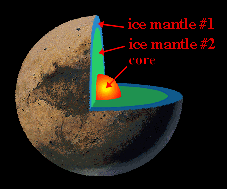
Pluto's Interior
The structure of Pluto is not very well understood at present. Nevertheless, spectroscopic observation from Earth in the 1970s has revealed that the planet surface is covered with methane ice. Surface temperature is -230?C, and the frozen methane exhibits a bright coloration. However, with the exception of the polar caps, the frozen methane surface is seen to change to a dark red on the basis of observation of eclipse by its moon Charon.
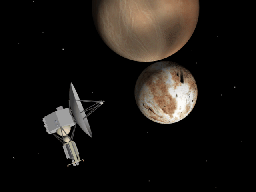
Of all the planets and moons in the solar system, Pluto and Charon are the two which resemble each other the most closely. They are almost the same size, and they are very close together. They are so close together that they orbit the center of mass between them, and the center of mass goes around the sun. Pluto and Charon are so close that they may even share an atmosphere. Molecules may be drawn off Pluto and turn to solids on the surface of Charon.
The only other planet and moon in the solar system which could be a double planet are the Earth and the Moon. As in the case of the Earth and the Moon, the origin of such a system is hard to explain. The explanation which seems best is that some large object struck Pluto (and the Earth) and tore out a blob which became Charon (and the Moon) from the crust of the planet. In the case of the Moon, the Moon seems to be made of material very much like the Earth's crust and not like the Earth's more metallic interior. Likewise Charon may be made of more icy material which resembles Pluto's surface, rather than the more rocky interior of Pluto.
Pluto News
Thin atmosphere
Pluto was discovered in 1930 as the result of some celestial detective work. It has always been mysterious. Even the mighty Hubble Space Telescope can only make out the haziest details on its icy surface.
Its atmosphere was first detected in 1985 when it made a star passing behind the planet, as viewed from Earth, appear to waver slightly. The atmosphere is very thin by Earth standards - about a millionth of the thickness of our atmosphere.
Observations and calculations suggested Pluto's atmosphere was made of nitrogen, which is in a delicate balance with surface ice.
Orbiting the Sun every 248 years, tiny Pluto - smaller than our own Moon - is usually the most distant planet in our Solar System, except for a few years either side of its closest approach to the Sun (and then Neptune is slightly more distant).
Lucky break
That last happened in 1989, and since then Pluto has been moving away from the Sun, presumably getting colder.
The last occultation of a star by Pluto was in 1988, so astronomers looked forward to two occultations in July and August 2002, setting up camp in North and South America, and Hawaii.
A probe will get there in about 13 years time
A star designated P126A passed behind Pluto on 20 July 2002, and immediately astronomers realised that Pluto's atmosphere had changed in some way, but the quality of the observations were not good enough to say exactly how.
The occultation of 21 August, of star P131.1, yielded better results, suggesting that Pluto's atmosphere had swelled since 1988, even though it seemed that its temperature had stayed roughly constant.
The astronomers report their observations in the Journal Nature.
Planet race
The researchers think that thermal lag is the explanation. Pluto will inevitably get colder as it moves away from the Sun, but there might be a delay to heat accumulated when closest to the Sun.
Because of the delicate balance between Pluto's atmosphere and its icy surface, researchers expect the atmosphere to completely contract sometime around 2015, with an uncertainty of a few years.
It was the need to reach planet and make measurements before the atmosphere collapsed that has made Pluto-Kuiper Express an urgent mission. It may, or may not, reach the planet in time.
"The observations are timely," says William Hubbard writing in Nature, "Pluto's orbit over the next few years offers an opportunity to learn more about this planet, at a time when technological developments make consideration of a mission to the planet feasible."
Pluto, Charon and Triple Star"P126 A, B, C"
Pluto Among the Stars
When Pluto passed in front of two stars twice last month, astronomers had a rare chance to study the atmosphere of the frigid, distant world. This image of Pluto, Charon and distant stars was captured on July 20, 2002.
Pluto: Moons: Charon
Charon is Pluto's only known moon. It really may be more accurate to call Pluto and Charon a double-planet system. At about 1,186 km (737 miles), Charon's diameter is a little more than half of Pluto's. No other planetary moon in our solar system is so close in size to its planet.
The duo are also our solar system's only planet and moon whose gravity has locked them into a mutually synchronous orbit, which keeps each one facing the other with the same side. Many moons - including our own - keep the same hemisphere facing their planet. But this is the only case in which the planet always presents the same hemisphere to its moon. If you stood on one and watched the other, it would appear to hover in place, never moving across the sky.
In Greek mythology, Charon was the boatman who carried the souls of the dead to the underworld - a kingdom that in Roman mythology was ruled by the god, Pluto. The U.S. Naval Observatory's James Christy suggested the name after he found the moon in 1978.
Seven years later, Charon and Pluto began a five-year period of eclipsing each other from Earth's point of view. That was lucky for us, because it enabled scientists to measure the diameters and masses of both objects as each passed in front of the other.
Charon appears to be covered by water ice, which differs from Pluto's surface of frozen nitrogen, methane, and carbon dioxide. One theory is that the materials that formed Charon were blasted out of Pluto in a collision. That's very similar to the way in which our own moon is thought to have been created.
Pluto: Moons: Charon: Facts & Figures
Discovered By : J. Christy
Date of Discovery : 1978
Average Distance from Pluto
Metric: 19,600 km
Equatorial Radius
Metric: 593 km
Mass
Metric: 1,620,000,000,000,000,000,000 kg
Scientific Notation: 1.62 x 10²¹ kg
Rotation Period (Length of Day)
6.4 Earth days
153.3 hours
By Comparison: Synchronous with Pluto
Orbit Period (Length of Year)
6.38725 Earth days
Orbital Inclination to Ecliptic
96.16 degrees
Charon, Nix, And Hydra Orbits Around Pluto 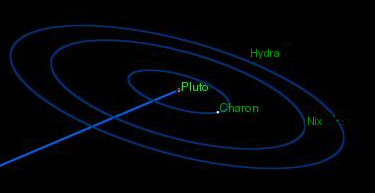
Pluto & Charon
NASA's Hubble Reveals Possible New Moons Around Pluto
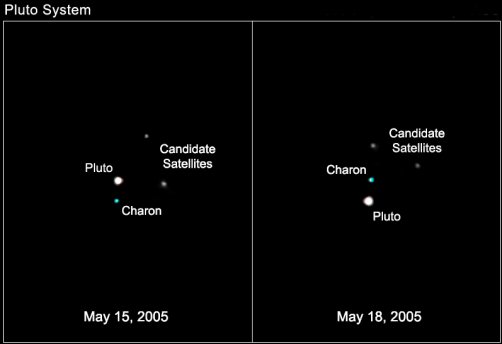
NASA's Hubble Space Telescope has spotted two possible new moons orbiting Pluto, the ninth planet in our solar system. If confirmed, the candidate moons could provide new insight into the nature and evolution of the Pluto system and the early Kuiper Belt. The Kuiper Belt is a vast region of icy, rocky bodies beyond Neptune's orbit.
These Hubble Space Telescope images reveal Pluto, its large moon Charon, and the planet's two new candidate satellites. Between May 15 and May 18, 2005, Charon, and the putative moons all appear to rotate counterclockwise around Pluto.
Lastest Image Of Pluto, Charon, Nix, Hydra
Discovered in mid-2005, Pluto's small moons were provisionally designated S/2005 P1 and S/2005 P2. They have now been officially christened Nix and Hydra. Compared to Pluto and its large moon Charon, at 2,360 and 1,210 kilometers in diameter respectively, Nix (inner moon) and Hydra (outer moon) are tiny, estimated to be only 40 to 160 kilometers across. Pluto and Charon are bright enough to create diffraction spikes in this Hubble Space Telescope image, but Nix and Hydra are some 5,000 times fainter than Pluto and appear only as small points of light. Still, their new names are appropriate for the distant Pluto system. In mythology, Nix was the goddess of darkness and night and the mother of Charon, while Hydra was a nine headed monster and is now orbiting the solar system's ninth planet. Of course Nix and Hydra also share initials with the pluto-bound spacecraft New Horizons. taken on 24/06/2006.
Reflections Of The Heart - By Darryn John Murphy

Published by First Edition Publishers
Book Title - Reflections of the Heart
Author - Darryn John Murphy
ISBN 978-1-877479-28-1
192 pages
20cm x 14cm soft cover
Published March 2008
Reflections of the Heart - Click Here
In Reflections Of The Heart, Darryn shares a personal collection of candid and open hearted poems. His honest and sincere approach is a celebration of the most important thing in life - Love