← The Wingmakers Ways · Unsorted
Archived page · Asserted
Dione
Dione.html · captured from wingmakers.co.nz
Dione
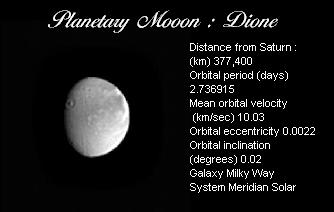
Dione was discovered in 1684 by Giovanni Cassini. It is an icy body similar to Tethys and Rhea.
Navigation
Solar System
Sun
Mercury
Venus
Earth
Mobius
Mars
Jupiter
Saturn
Uranus
Neptune
Pluto
2004 DW
Quaoar
Sedna
2002 AW197
2003 UB313
Comets
Meteorites
Asteroids
Planetary Moons
Earth
The Moon
Saturn
Titan
Tethys
Enceladus
Dione
Extra Solar Planets
Lensing Galaxy - Einstein Cross
Dione was discovered in 1684 by Giovanni Cassini. It is an icy body similar to Tethys and Rhea. Its density is 1.43 gm/cm3, which makes it the densest moon of Saturn other than Titan. Dione is probably composed of a rocky core making up one-third of the moon's mass, with the rest water-ice. Its ice coverage is less than that of Tethys and Rhea.Planetary Moon of Saturn
Dione's icy surface includes heavily cratered terrain, moderately cratered plains, lightly cratered plains, and wispy material. The heavily cratered terrain has numerous craters greater than 100 kilometers in diameter. The plains area tends to have craters less than 30 kilometers in diameter. Some of the plains are heavily cratered while others are not. Much of the heavily cratered terrain is located on the trailing hemisphere, with the less cratered plains area existing on the leading hemisphere. This is opposite from what some scientists expected. Shoemaker and Wolfe proposed a cratering model for a tidally locked satellite with the highest cratering rates on the leading hemisphere and the lowest on the trailing hemisphere. This suggests that during the period of heavy bombardment, Dione was tidally locked to Saturn in the opposite orientation. Because Dione is relatively small, an impact causing a 35 kilometer (21 mile) crater could have spun the satellite. Since there are many craters larger than 35 kilometers (21 miles), Dione could have been repeatedly spun.
Dione has probably been tidally locked in its current position for the past several billion years. This is reflected in the average surface albedo of the leading and trailing hemispheres. The surface albedo decreases from the leading to the trailing hemispheres due to a higher micrometeor dusting on the leading hemisphere.
DIONE: Alternative mother of APHRODITE.
Interstellar Card
Greek MythologyDIONE was one of the early birds in the Goddess stakes. She was one of the Ocean NYMPHS, or possibly a daughter of CRONUS and GAIA or OCEANUS and TETHYS - or maybe even both (or neither). In fact she was on the scene so early that no-one else seems to have been around to make notes for posterity. The fact that her name is a feminine form of ZEUS just adds to the confusion.
But ZEUS was also early on the scene and, if one is to believe the very early rumors, between them they produced APHRODITE, claiming URANUS was never fit to be any sort of parent. Also that having sex with a sea foam bath is not any way to produce a daughter.
DIONE went on to marry TANTALUS, making her the mother of NIOBE and PELOPS.
Dione And Saturn
Speeding toward pale, icy Dione, Cassini's view is enriched by the tranquil gold and blue hues of Saturn in the distance. The horizontal stripes near the bottom of the image are Saturn's rings. The spacecraft was nearly in the plane of the rings when the images were taken, thinning them by perspective and masking their awesome scale. The thin, curving shadows of the C ring and part of the B ring adorn the northern latitudes visible here, a reminder of the rings' grandeur.
It is notable that Dione, like most of the other icy Saturnian satellites, looks no different in natural color than in monochrome images.
Images taken on Oct. 11, 2005, with blue, green and infrared (centered at 752 nanometers) spectral filters were used to create this color view, which approximates the scene as it would appear to the human eye. The images were obtained with the Cassini spacecraft wide-angle camera at a distance of approximately 39,000 kilometers (24,200 miles) from Dione and at a Sun-Dione-spacecraft, or phase, angle of 22 degrees. The image scale is about 2 kilometers (1 mile) per pixel.
Dione And Tethys
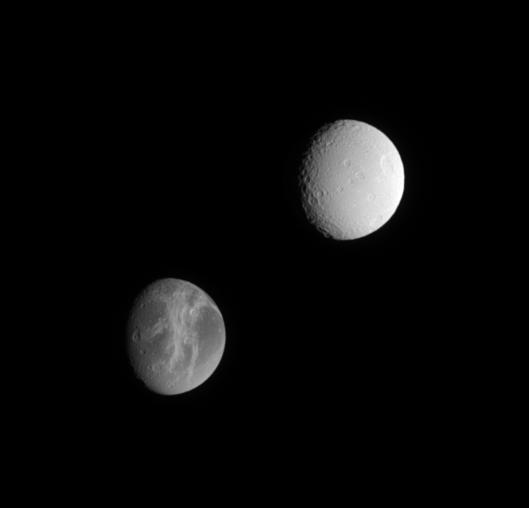
Cassini offers this lovely comparison between two of Saturn's satellites, Dione and Tethys, which are similar in size but have very different surfaces.Extensive systems of bright fractures carve the surface of Dione (1,118 kilometers, or 695 miles across). The double-pronged feature Carthage Linea points toward the crater Turnus at the nine o'clock position near the terminator, and Palatine Linea runs toward the moon's bottom limb near the five o'clock position.
In contrast, the surface of Tethys (1,071 kilometers, or 665 miles across) appears brighter and more heavily cratered. The large crater Penelope is near the eastern limb. The huge rift zone Ithaca Chasma, which is 3 to 5 kilometers (2 to 3 miles) deep and extends for about 2,000 kilometers (1,200 miles) from north to south across Tethys, is hidden in shadow just beyond the terminator. For comparison, the Grand Canyon in Arizona is about 1.5 kilometers (1 mile) deep, and about 450 kilometers (280 miles) long.
Surface Of Dione
Dione's icy surface is scarred by craters and sliced up by multiple generations of geologically-young bright fractures. Numerous fine, roughly-parallel linear grooves run across the terrain in the upper left corner.Most of the craters seen here have bright walls and dark deposits of material on their floors. As on other Saturnian moons, rockslides on Dione (1,126 kilometers, or 700 miles across) may reveal cleaner ice, while the darker materials accumulate in areas of lower topography and lower slope (e.g. crater floors and the bases of scarps).
The terrain seen here is centered at 15.4 degrees north latitude, 330.3 degrees west longitude, in a region called Carthage Linea. North on Dione is up and rotated 50 degrees to the left.
Saturnian Moon, Dione
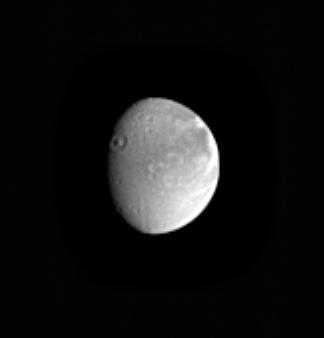
This Cassini image of Saturn's moon Dione shows a nice view of the crater Aeneas on the terminator. The crater's diameter is approximately 175 kilometers (109 miles). The crater's central peak is about 3.5 kilometers (2 miles) high, which is comparable to the depth of the crater. This is principally the side of Dione that faces Saturn. Dione is 1,118 kilometers (695 miles) across.The bright features on the moon's eastern limb are part of the fracture system seen at higher resolution in Cassini's first close approach to Dione on Dec. 14, 2004.
Copyright © Wingmakers.co.nz - All rights reserved.