← The Wingmakers Ways · Unsorted
Archived page · Asserted
The Sun
Sun.html · captured from wingmakers.co.nz
The Sun
 Our Sun has inspired mythology in almost all cultures, including ancient Egyptians, Aztecs, Native Americans, and Chinese.
Universe
Solar System Sun
Mercury
Venus
Earth
Mobius
Mars
Jupiter
Saturn
Uranus
Neptune
Pluto
2004 DW
Quaoar
Sedna
2002 AW197
2003 UB313
Comets
Meteorites
Asteroids
Planetary Moons
Earth
The Moon
Saturn
Titan
Tethys
Enceladus
Dione
Extrasolar planets
Star Systems
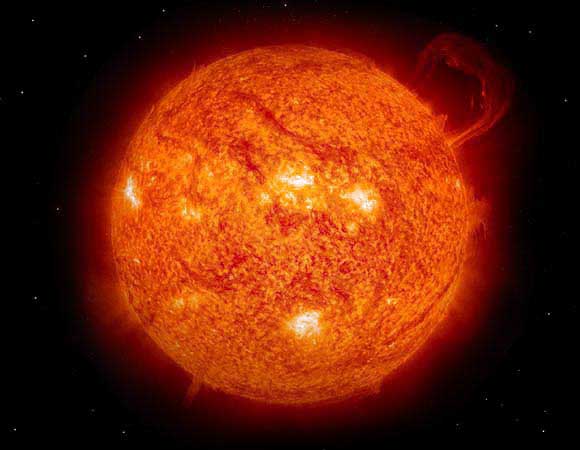
Sun: Facts & Figures
Discovered By : Known by the Ancients
Date of Discovery : Unknown
Equatorial Radius
Metric: 695,500 km
English: 432,200 miles
Scientific Notation: 6.955 x 10⁵ km
By Comparison: 109 x that of Earth
Equatorial Circumference
Metric: 4,379,000 km
English: 2,715,000 miles
Scientific Notation: 4.36 x 10⁶ km
By Comparison: 109 x that of Earth
Volume
Metric: 1,142,200,000,000,000,000 km3
English: 2.7403 x 10¹⁷ mi3
Scientific Notation: 1.1422 x 10¹⁸ km3
By Comparison: 1,300,000 Earths
Mass
Metric: 1,989,000,000,000,000,000,000,000,000,000 kg
English: 4,385,000,000,000,000,000,000,000,000,000 lbs
Scientific Notation: 1.989 x 1030 kg
By Comparison: 332,900 x Earth's
Density
Metric: 1.409 g/cm3
By Comparison: 0.255 that of Earth
Surface Area
Metric: 6,087,799,000,000 km2
English: 2,347,000,000,000 square miles
Scientific Notation: 6.0787 x 10¹² km2
By Comparison: 11,990 Earths
Equatorial Surface Gravity
Metric: 274.0 m/s2
English: 899.0 ft/s2
Scientific Notation: 2.740 x 10² m/s2
By Comparison: 28 x Earth's surface gravity
Escape Velocity
Metric: 2,223,720 km/h
English: 1,381.760 mph
Scientific Notation: 6.177 x 10⁵ m/s
By Comparison: 55 x Earth
Sidereal Rotation Period (Length of Day)
25.38 Earth days
609.12 hours
Effective Temperature
Metric: 5504 °C
English: 9939 °F
Scientific Notation: 5777 K
Additional Information:
Spectral Type: G2 V
Synodic Period: 27.2753 days
Velocity Relative to Near Stars: 19.7 km/s
Solar Constant (Total Solar Irradiance): 1.365 - 1.369 kW/m2
(at the mean distance of the earth from the Sun, about one AU)
Introduction
Our Sun has inspired mythology in almost all cultures, including ancient Egyptians, Aztecs, Native Americans, and Chinese. We now know that the Sun is a huge, bright sphere of mostly ionized gas, about 4.5 billion years old, and is the closest star to Earth at a distance of about 150 million km. The next closest star - Proxima Centauri - is nearly 268,000 times farther away. There are millions of similar stars in the Milky Way Galaxy (and billions of galaxies in the universe). Our Sun supports life on Earth. It powers photosynthesis in green plants and is ultimately the source of all food and fossil fuel. The connection and interaction between the Sun and the Earth drive the seasons, currents in the ocean, weather, and climate.
The Sun is some 333,400 times more massive than Earth and contains 99.86 percent of the mass of the entire solar system. It is held together by gravitational attraction, producing immense pressure and temperature at its core (more than a billion times that of the atmosphere on Earth, with a density about 160 times that of water).
At the core, the temperature is 16 million degrees kelvin (K), which is sufficient to sustain thermonuclear fusion reactions. The released energy prevents the collapse of the Sun and keeps it in gaseous form. The total energy radiated is 383 billion trillion kilowatts, which is equivalent to the energy generated by 100 billion tons of TNT exploding each second.
In addition to the energy-producing solar core, the interior has two distinct regions: a radiative zone and a convective zone. From the edge of the core outward, first through the radiative zone and then through the convective zone, the temperature decreases from 8 million to 7,000 K. It takes a few hundred thousand years for photons to escape from the dense core and reach the surface.
The Sun's "surface," known as the photosphere, is just the visible 500-km-thick layer from which most of the Sun's radiation and light finally escape, and it is the place where sunspots are found. Above the photosphere lies the chromosphere ("sphere of color") that may be seen briefly during total solar eclipses as a reddish rim, caused by hot hydrogen atoms, around the Sun. Temperature steadily increases with altitude up to 50,000 K, while density drops to 100,000 times less than in the photosphere. Above the chromosphere lies the corona ("crown"), extending outward from the Sun in the form of the "solar wind" to the edge of the solar system. The corona is extremely hot - millions of degrees kelvin. Since it is physically impossible to transfer thermal energy from the cooler surface of the Sun to the much hotter corona, the source of coronal heating has been a scientific mystery for more than 60 years. Scientists believe that energy transfer has to be in the form of waves or magnetic energy. Likely solutions have emerged from recent SOHO and TRACE satellite observations, which found evidence for the upward transfer of magnetic energy from the Sun's surface toward the corona above. Researchers in NASA's Sun-Earth Connection Space Science theme study these myserious phenomena.
First Cosmic Ray : linking Through : Leo
"These subjects are motivated by their will and have lots of energy and drive. But this very active force needs creative outlets otherwise it may degenerate into lust or violence. Basically egocentric and often showy, such subjects are very original, but their natural instinct to rush things sometimes leads to a lack of care. They are stern and sometimes severe, but also fair-minded, paternal, gentle, loving, kind and capable of compassion. Such subjects need to be the dominant partner and, although independent, occasionally need someone to react upon. They tend to have sudden and stunning effects on others, and their will-power is strong enough to force those around them to do what they demand without question.
The Solar Wind and CMEs 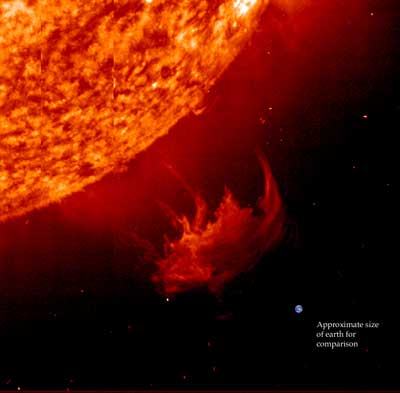
Eruptions on the Sun's surface occur often. During normal solar activity the intense heat of the corona of about 1,000,000°C (1,800,000°F) to 2,000,000°C (3,600,000°F) accelerates the plasma to escape velocity. A million tons of matter are hurled into space every second at an average speed of 400 km/s (900,000 miles/hr). Extreme speeds vary from 300 km/s (700,000 miles/hr) to 900 km/s (2 million miles/hr). In the process the plasma drags the magnetic field lines of the Sun out into space. A million tons of matter per second is huge. However, since this solar wind is spread throughout space in all directions, there are only about 6 protons per cubic centimeter when the solar wind reaches Earth. The Ulysses spacecraft and the Advanced Composition Explorer (ACE) have gathered considerable information about the solar wind. Would you like to know the solar wind conditions for the past seven days?
Solar winds are comparable to daily breezes on Earth -mild and steady. Solar flares, however, are like intense storms. The solar flares are much more powerful than solar winds, but they are localized and tend to blast material in just one direction. Flares release a quick burst of energy equivalent to 10 million volcanic eruptions or more than a billion hydrogen bombs. A coronal mass ejection (CME) is the like a hurricane- an energetic storm spread over a large area. A CME is the eruption of a huge bubble of plasma from the corona. A CME travels between 400 km/s (1 million miles per hour) and 1000 km/s (5 million miles per hour). A typical eruption can carry a billion tons of plasma, a mass equal to that of 10,000 aircraft carriers. A CME is very directional, blasting material out in a fairly narrow jet that can expand to about 30 million miles.
Solar Wind Variations
The solar wind is not uniform. Although it is always directed away from the Sun, it changes speed and carries with it magnetic clouds, interacting regions where high speed wind catches up with slow speed wind, and composition variations. The solar wind speed is high (800 km/s) over coronal holes and low (300 km/s) over streamers. These high and low speed streams interact with each other and alternately pass by the Earth as the Sun rotates. These wind speed variations buffet the Earth's magnetic field and can produce storms in the Earth's magnetosphere.
The Ulysses spacecraft has now completed one orbit through the solar system during which it passed over the Sun's south and north poles. Its measurements of the solar wind speed, magnetic field strength and direction, and composition have provided us with a new view of the solar wind.
The Advanced Composition Explorer (ACE) satellite was launched in August of 1997 and placed into an orbit about the L1 point between the Earth and the Sun. The L1 point is one of several points in space where the gravitational attraction of the Sun and Earth are equal and opposite. This particular point is located about 1.5 million km (1 million miles) from the Earth in the direction of the Sun. ACE has a number of instruments that monitor the solar wind and the spacecraft team provides real-time information on solar wind conditions at the spacecraft
Interstellar Trajectories
The heliosphere is a bubble in space produced by the solar wind. Although electrically neutral atoms from interstellar space can penetrate this bubble, virtually all the material in the heliosphere emanates from the Sun itself. The solar wind streams off of the Sun in all directions at speeds of several hundred kilometers per second (about 1,000,000 mph in the Earth's vicinity). At some distance from the Sun, well beyond the orbit of Pluto, this supersonic wind must slow down to meet the gases in the interstellar medium. It must first pass through a shock, the termination shock, to become subsonic. It then slows down and gets turned in the direction of the ambient flow of the interstellar medium to form a comet-like tail behind the Sun. This subsonic flow region is called the heliosheath. The outer surface of the heliosheath, where the heliosphere meets the interstellar medium, is called the heliopause.
The solar wind consists of particles, ionized atoms from the solar corona, and fields (magnetic fields in particular). As the Sun rotates once in about 27 days, the magnetic field transported by the solar wind gets wrapped into a spiral. Variations in the Sun's magnetic field are carried outward by the solar wind and can produce magnetic storms in the Earth's own magnetosphere.
Earth and the Sun
This illustration shows the approximate size of Earth compared to the Sun. The giant coronal mass ejection in the image blasted off the Sun in October 2003. The image was taken by the international SOHO spacecraft.
Coronal Loops
Extending above the photosphere or visible surface of the Sun , the faint, tenuous solar corona can't be easily seen from Earth, but it is measured to be hundreds of times hotter than the photosphere itself. What makes the solar corona so hot? Astronomers have long sought the source of the corona's heat in magnetic fields which loft monstrous loops of solar plasma above the photosphere. Still, new and dramatically detailed observations of coronal loops from the orbiting TRACE satellite are now pointing more closely to the unidentified energy source. Recorded in extreme ultraviolet light, this and other TRACE images indicate that most of the heating occurs low in the corona, near the bases of the loops as they emerge from and return to the solar surface. The new results confound the conventional theory which relies on heating the loops uniformly. This tantalizing TRACE image shows clusters of the majestic, hot coronal loops which span 30 or more times the diameter of planet Earth.
Sunspot Loops
Even a relatively quiet day on the Sun is busy. This ultraviolet image shows bright, glowing arcs of gas flowing around the sunspots.
The Solar Atmosphere
The visible solar atmosphere consists of three regions: the photosphere, the chromosphere, and the solar corona. Most of the visible (white) light comes from the photosphere, this is the part of the Sun we actually see. The chromosphere and corona also emit white light, and can be seen when the light from the photosphere is blocked out, as occurs in a solar eclipse. The sun emits electromagnetic radiation at many other wavelengths as well. Different types of radiation (such as radio, ultraviolet, X-rays, and gamma rays) originate from different parts of the sun. Scientists use special instruments to detect this radiation and study different parts of the solar atmosphere.
The solar atmosphere is so hot that the gas is primarily in a plasma state: electrons are no longer bound to atomic nuclei, and the gas is made up of charged particles (mostly protons and electrons). In this charged state, the solar atmosphere is greatly influenced by the strong solar magnetic fields that thread through it. These magnetic fields, and the outer solar atmosphere (the corona) extend out into interplanetary space as part of the solar wind.
Aurora Australis 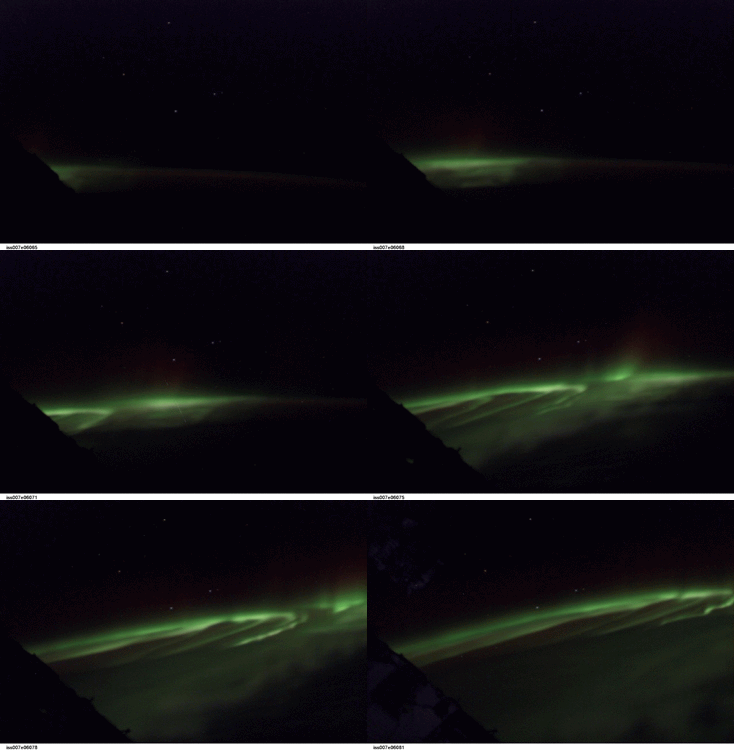
On June 2nd, Earth entered a high-speed solar wind stream. Its source: a coronal hole on the sun. Solar wind gusts shook Earth's magnetic field and sparked bright auroras for days.
Reflections Of The Heart - By Darryn John Murphy

Published by First Edition Publishers
Book Title - Reflections of the Heart
Author - Darryn John Murphy
ISBN 978-1-877479-28-1
192 pages
20cm x 14cm soft cover
Published March 2008
Reflections of the Heart - Click Here
In Reflections Of The Heart, Darryn shares a personal collection of candid and open hearted poems. His honest and sincere approach is a celebration of the most important thing in life - Love