← The Wingmakers Ways · Astronomy & Exoplanets
Archived page · Checkable
Enceladus
Enceladus.html · captured from wingmakers.co.nz
Enceladus
Enceladus is one of the innermost moons of Saturn. It is quite similar in size to Mimas but has a smoother, brighter surface.
Navigation
Solar System
Sun
Mercury
Venus
Earth
Mobius
Mars
Jupiter
Saturn
Uranus
Neptune
Pluto
2004 DW
Quaoar
Sedna
2002 AW197
2003 UB313
Comets
Meteorites
Asteroids
Planetary Moons
Earth
The Moon
Saturn
Titan
Tethys
Enceladus
Dione
Extra Solar Planets
Lensing Galaxy - Einstein Cross
Enceladus is one of the innermost moons of Saturn. It is quite similar in size to Mimas but has a smoother, brighter surface. Enceladus reflects almost 100 percent of the sunlight that strikes it. Unlike Mimas, Enceladus displays at least five different types of terrain. Parts of Enceladus shows craters no larger than 35 km in diameter. Other areas show regions with no craters indicating major resurfacing events in the geologically recent past. There are fissures, plains, corrugated terrain and other crustal deformations. All of this indicates that the interior of the moon may be liquid today, even though it should have frozen aeons ago. It is postulated that Enceladus is heated by a tidal mechanism similar to Jupiter's moon Io. It is perturbed in its orbit by Saturn's gravitational field and by the large neighboring satellites Tethys and Dione. Because Enceladus reflects so much sunlight, the surface temperature is only -201° C (-330° F).Planetary Moon of Saturn
Moon : TethysTethys [TEE-this] was discovered by Giovanni Cassini in 1684. It is an icy body similar in nature to Dione and Rhea. The density of Tethys is 1.21 gm/cm3, indicating that it is composed almost entirely of water-ice. Tethys's icy surface is heavily cratered and contains cracks caused by faults in the ice. There is one enormous trench on Tethys about 65 kilometers (40 miles) wide and extending from above the center to the extreme left. It covers three-fourths of Tethys' circumference. The fissure is about the size scientists would predict if Tethys were once fluid and its crust hardened before the interior. The canyon has been named Ithaca Chasma. A vast expanse of relative young plains also exists on Tethys. Tethys' surface temperature is -187° C (-305° F).
Greek Mythology
TETHYS was the TITANIS goddess of the nursing the young and of the underground flow of fresh water. She was the wife of Okeanos (the great fresh-water river that encircled the earth) and by him the mother of the three thousand Potamoi (Rivers) and Okeanides (Clouds). She was appropriately depicted attending the wedding of Thetis accompanied by Eileithyia, the goddess of childbirth.
Tethys was depicted as a woman usually accompanied (as the mother of so many offspring) by Eileithyia the goddess of childbirth.
Enceladus And Saturns Rings
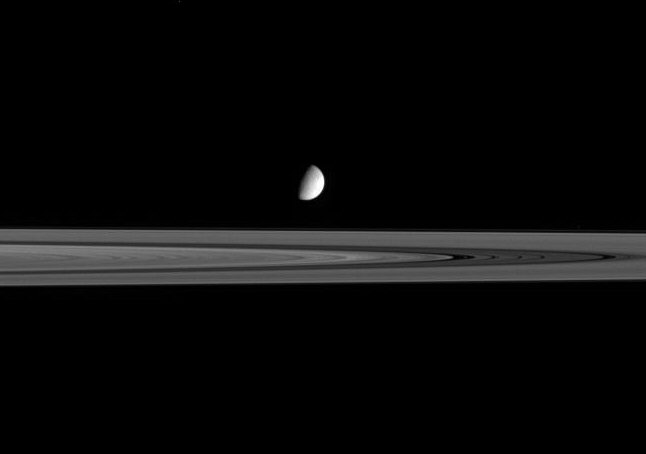
The moon Enceladus seems to hover above the outer reaches of Saturn's B ring. Below and to the right of Enceladus, four faint bands lie in the center of the dark Cassini Division.Recently, scientists have speculated that the particles that make up the dense B and A rings might be more like fluffy snowballs than hard ice cubes. The conclusion is based on temperature data obtained by the Cassini spacecraft.
Enceladus' diameter is 505 kilometers (314 miles). The icy moon is on the near side of the rings in this view.
This image was taken in visible light with the Cassini spacecraft narrow-angle camera on Sept. 15, 2005, at a distance of approximately 2.3 million kilometers (1.4 million miles) from Enceladus. The image scale is 14 kilometers (9 miles) per pixel on Enceladus.
Rhea And Enceladus
Though much farther away from Cassini when the spacecraft acquired this image, Saturn's second-largest moon Rhea still dwarfs the brightest icy moon Enceladus in this scene. Rhea is 1,528 kilometers (949 miles) across. Enceladus is 505 kilometers (314 miles) across.The image was taken in visible light with the Cassini spacecraft narrow-angle camera on Feb. 21, 2005, at a distance of approximately 2 million kilometers (1.3 million miles) from Enceladus and 2.5 million kilometers (1.6 million miles) from Rhea. The image scale is 12 kilometers (7 miles) per pixel on Enceladus, and 15 kilometers (9 miles) per pixel on Rhea.
Surface Of Enceladus
During its very close flyby of Enceladus on March 9, 2005, Cassini took high resolution images of the icy moon that are helping scientists interpret the complex topography of this intriguing little world.This scene is an icy landscape that has been scored by tectonic forces. Many of the craters in this terrain have been heavily modified, such as the 10-kilometer-wide (6-mile-wide) crater near the upper right that has prominent north-south fracturing along its northeastern slope.
The image has been rotated so that north on Enceladus is up.
The image was taken in visible light with the narrow angle camera from a distance of about 11,900 kilometers (7,400 miles) from Enceladus and at a Sun-Enceladus-spacecraft, or phase, angle of 44 degrees. Pixel scale in the image is 70 meters (230 feet) per pixel.
Cassini Finds an Atmosphere on Saturn's Moon Enceladus
The Cassini spacecraft's two flybys of the icy moon Enceladus have revealed that the moon has a significant atmosphere. Scientists using Cassini's magnetometer instrument for their studies, say the source may be due to volcanism, geysers, or gases escaping from the surface or its interior.
When the Cassini had its first encounter with Enceladus on 17 February 2005 at an altitude of 1,167 kilometres (725 miles), the magnetometer instrument saw a striking signature in the magnetic field. On 9 March 2005 Cassini approached to within 500 km (310 miles) of Enceladus' surface and obtained additional evidence.
The observations showed a bending of the magnetic field with the magnetospheric plasma being slowed and deflected by the moon. In addition magnetic field oscillations were observed. These are caused when electrically charged (or ionised) molecules interact with the magnetic field by spiralling around the field line. This interaction creates characteristic oscillations in the magnetic field at frequencies that can be used to identify the molecule. The observations from the Enceladus flybys are believed to be due to ionised water vapour.
"It was a complete surprise to find these signals at Enceladus. These new results from Cassini may be the first evidence of gases originating either from the surface or possibly from the interior of Enceladus," said Professor Michele Dougherty, of Imperial College, London and Principal Investigator for the Cassini magnetometer. In 1981 the Voyager spacecraft flew by Enceladus at a distance of 90,000 kilometres (56,000 miles) without detecting an atmosphere. It is possible that detection was beyond Voyager's capabilities or something may have changed since that flyby.
This is the first time since Cassini arrived in orbit around Saturn last summer that an atmosphere has been detected around a moon of Saturn, other than its largest moon, Titan. Enceladus is a relatively small moon. The amount of gravity it exerts is not enough to hold an atmosphere very long. Therefore at Enceladus, a strong continuous source is required to maintain the atmosphere.
The need for such a strong source leads scientists to consider eruptions from the surface, such as volcanoes and geysers. If such eruptions are present, Enceladus would join two other such active moons, Io at Jupiter and Triton at Neptune. "Enceladus could be Saturn's more benign counterpart to Jupiter's dramatic Io", said Professor Fritz Neubauer, co-investigator for the Cassini magnetometer from the University of Cologne, Germany.
Since the Voyager flyby scientists have suspected that this moon is geologically active and is the source of Saturn's icy E ring. Enceladus is the most reflective object in the solar system, reflecting about 90 percent of the sunlight that hits it. If Enceladus does have ice volcanoes, the high reflectivity of the moon's surface might result from continuous deposition of icy particles originating from the volcanoes.
Enceladus' diameter is about 500 kilometres or 310 miles (the equivalent distance between London and Penzance). Yet despite its small size Enceladus exhibits one of the most interesting surfaces of all the icy satellites.
This artist concept shows the detection of an atmosphere on Saturn's icy moon Enceladus. The Cassini magnetometer instrument is designed to measure the magnitude and direction of the magnetic fields of Saturn and its moons. During Cassini's two close flybys of Enceladus - Feb. 17 and March 9 - the instrument detected a bending of the magnetic field around Enceladus.The graphic shows the magnetic field observed by Cassini along its trajectory plotted in a vector form. Even though the spacecraft altitude was almost 500 kilometres (310 miles) at closest approach and the flyby was upstream of the moon (where the interaction is expected to be weaker) Cassini's magnetometer observed bending of the magnetic field consistent with its draping around a conducting object, which indicates that the Saturnian plasma is being diverted away from an extended atmosphere.
Credit: NASA/JPLSaturnian Moons, Dione And Enceladus
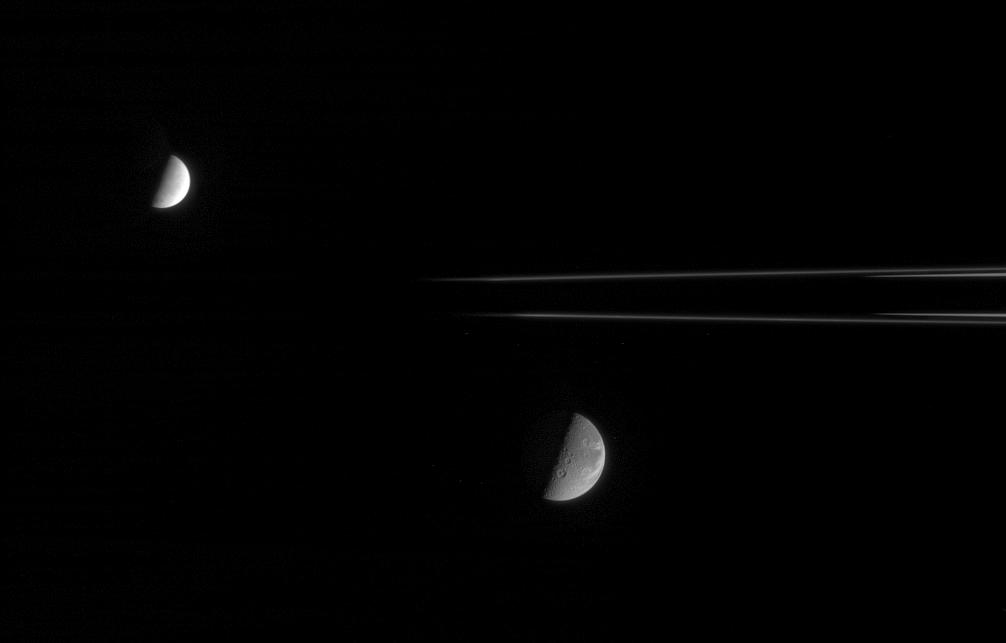
This fanciful view spies the Saturnian moons, Dione and Enceladus, from just beneath the ringplane. Enceladus (505 kilometers, or 314 miles across) is on the near side of the rings with respect to Cassini, and Dione (1,126 kilometers, or 700 miles across) is on the far side.Saturn's shadow stretches beyond the outermost reaches of the main rings, causing them to disappear at left.
The image was taken with the Cassini narrow-angle camera using spectral filters sensitive to polarized green light on Oct. 15, 2005 at a distance of approximately 2.1 million kilometers (1.3 million miles) from Dione and 1.5 million kilometers (900,000 miles) from Enceladus. The image scale is 12 kilometers (7 miles) per pixel on Dione and 9 kilometers (6 miles) per pixel on Enceladus.
Copyright © Wingmakers.co.nz - All rights reserved.