← The Wingmakers Ways · Astronomy & Exoplanets
Archived page · Checkable
Columba
Columba.html · captured from wingmakers.co.nz
Columba
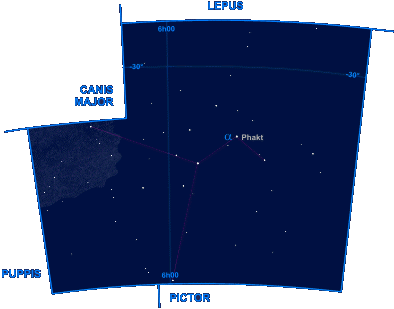
Columba, the Dove, is a minor constellation just south of Lepus (the Hare). This picture shows slightly slant because taken when the constellation was going down to the west sky,
Navigation
The Universe
Mapping Technique
Sky Maps
The Constellations
Andromeda ....
Antila .....
Apus .....
Aquarius ....
Aquila .....
Ara .....
Aries .....
Auriga
Caelum .....
Camelopardalis ....
Cancer .....
Canes Venatici .....
Canis Major .....
Canis Minor
Capricornus ....
Carina .....
Cassiopeia .....
Centaurus .....
Cepheus ....
Cetus .....
Chamaeleon .....
Circinus
Columba .....
Coma Berenices .....
Corona Austrina
Corona Borealis
Corvus
Crater .....
Crux .....
Cygnus
Delphinus .....
Dorado .....
Draco
Hercules .....
Horogium .....
Hydra .....
Hydrus
Lacerta .....
Leo .....
Leo Minor .....
Lepus .....
Libra .....
Lupus .....
Lynx .....
Lyra
Mensa .....
Microscopium .....
Monoceros .....
Musca
Octans .....
Ophiuchus .....
Orion
Pavo .....
Pegasus .....
Perseus .....
Phoenix .....
Pictor .....
Pisces .....
Piscis Austrinus
Puppis .....
Pyxis
Saggita .....
Sagittarius .....
Scorpio .....
Sculptor .....
Scutum .....
Serpens Cauda
Serpens Caput .....
Sextans
Taurus .....
Telescopium .....
Triangulum .....
Triangulum Australe .....
Tucana
Ursa Major .....
Ursa Minor
Vela .....
Virgo .....
Volans .....
Vulpecula
Constellation Chart
Columba, the Dove, is a minor constellation just south of Lepus (the Hare). This picture shows slightly slant because taken when the constellation was going down to the west sky, the whole figure of Columba looks like "T" shape in culmination. Columba shows the bird with flapping wings and holding a sprig of olive in its mouth. The constellation first appeared in 17th century, and may refer to the dove in the story of Noah and the Ark. According to the investigation for the motion of stars close to the solar system, almost all of them seem to move forward to around the northern region in Columba. It's considered that the region agrees with the opposite point of the solar apex in Hercules. The sun and its all family are moving to the apex with the velocity about 19 km/s (12 miles/s) in the Galaxy.
The Dove
NGC1851 is a globular in winter south of M79, in a constellation of Columba. Actually NGC1851 has brighter magnitude and larger diameter than those of M79. But the globular has a height of meridian transit at most 15 degrees at around Tokyo, has much fewer chances to observe that than M79. The cluster has a highly concentration class of II, and coming on top of the bad scintillation in lower skies, it's fairly difficult to resolve the individual member stars around center of cluster.
This is a close-up view of the galaxy's center, the hotbed of vigorous star formation. The yellow color pinpoints older stars; the blue color reveals areas of star birth. NGC 1808 is called a barred spiral galaxy because of the straight lines of star formation on both sides of the bright nucleus. The bar may be the catalyst for this intense star formation. The rotation of the bar may have triggered the star birth, or matter streaming along the bar towards the central region may be feeding the stellar breeding ground.
Double stars:Columba has no binaries of interest. Phaet (alpha Col) is only an optical (with an 11- magnitude companion), although Tirion's Sky Atlas marks it as a true binary.
Variable stars:
The constellation has a number of Mira-type variables; of these T Col is the brightest.R Col varies from 8.0 to about 14 every 327 days. It's three degrees NE of mu Col.
T Col varies from 6.7 to 12.6 every 225 days. It's located one degree NNE of omicron Col.
Copyright © Wingmakers.co.nz - All rights reserved.