← The Wingmakers Ways · Astronomy & Exoplanets
Archived page · Checkable
Mensa
Mensa.html · captured from wingmakers.co.nz
Mensa
--------------------------------------------- Navigation
The Universe
Mapping Technique
Sky Maps
The Constellations
Andromeda ....
Antila .....
Apus .....
Aquarius ....
Aquila .....
Ara .....
Aries .....
Auriga
Caelum .....
Camelopardalis ....
Cancer .....
Canes Venatici .....
Canis Major .....
Canis Minor
Capricornus ....
Carina .....
Cassiopeia .....
Centaurus
Cepheus
Cetus
Chamaeleon
Circinus
Columba
Coma Berenices
Corona Austrina
Corona Borealis
Corvus
Crater
Crux
Cygnus
Delphinus .....
Dorado .....
Draco
Hercules .....
Horogium .....
Hydra .....
Hydrus
Lacerta .....
Leo .....
Leo Minor .....
Lepus .....
Libra .....
Lupus .....
Lynx .....
Lyra
Mensa .....
Microscopium .....
Monoceros .....
Musca
Octans .....
Ophiuchus .....
Orion
Pavo .....
Pegasus .....
Perseus .....
Phoenix .....
Pictor .....
Pisces .....
Piscis Austrinus
Puppis .....
Pyxis
Saggita .....
Sagittarius .....
Scorpio .....
Sculptor .....
Scutum .....
Serpens Cauda
Serpens Caput .....
Sextans
Taurus .....
Telescopium .....
Triangulum .....
Triangulum Australe .....
Tucana
Ursa Major .....
Ursa Minor
Vela .....
Virgo .....
Volans .....
Vulpecula
Constellation Chart
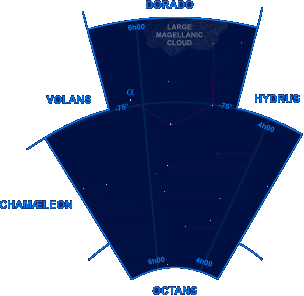
The Table MountainNear the Southern Celestial Pole lies this small faint group of stars, which also contains a part of the Large Magellanic Cloud. Its original full name was Mons Mensae, named after the Table Mountain where de La Caille had his observatory.
Large Magellanic Cloud : LMC, Nubecula Major
The Large Magellanic Cloud is an 'attendant' galaxy to our own. It lies in the southern skies, astride the border between Dorado and Mensa, and contains the gigantic Tarantula Nebula.NGC1520 Is a open cluster in the constellation of Mensa
While NGC1841 is a compact globular cluster in Mensa.
NGC1956 is a spiral galaxy in the constellation of mensaPlanetary Destinations In Mensa
Parent Star: pi Mensae / HD39091(G1 IV) in the constellation of Mensa is located at a distance of 67.02 Light Years from our Solar system Co-ordinates of Right Ascension: 05 37 09.8917 & Declination: -80 28 08.839. The apparent Magnitude of the star is 6.25. The Inner Edge of Habitability Zone is 0.67 AU & the Outer Edge of Habitability Zone: 2.09 AU and the estimated stellar lifespan of the star is 7513 million years. Orbiting around pi Mensae / HD39091 is planet pi Mensae b / HD39091 b the planet is believed to be a water cloud jovian, eccentric and its exitence has been confirmed. The Planets Appearance is white water ice clouds. The Planet orbits the star at Mean Orbital Distance of 3.29 AU . The Planet passes through the habitability zone. The planet Orbits around the star every 2063.818 Days and was discovered by Vogt S., Butler P., Marcy G., Fischer D., Pourbaix D., Apps K., & Laughlin G. in 2001.Double stars:
h3607 is a binary with colour contrast, yellow and blue: 8, 8.5; PA 127º, separation 37.2".
Variable stars:The binary is 2º WSW of delta Mensae.
U Mensae is a semi-regular, 7-10, with a period of approximately every 410 days.
It's found a half degree southwest of nu Mensae.
Copyright © Wingmakers.co.nz - All rights reserved.