← The Wingmakers Ways · Astronomy & Exoplanets
Archived page · Checkable
Telescopium
Telescopium.html · captured from wingmakers.co.nz
Telescopium
Navigation
The Universe
Mapping Technique
Sky Maps
The Constellations
Andromeda ....
Antila .....
Apus .....
Aquarius ....
Aquila .....
Ara .....
Aries .....
Auriga
Caelum .....
Camelopardalis ....
Cancer .....
Canes Venatici .....
Canis Major .....
Canis Minor
Capricornus ....
. Carina .....
Cassiopeia .....
Centaurus .....
Cepheus ....
. Cetus .....
Chamaeleon .....
Circinus
Columba .....
Coma Berenices .....
Corona Austrina .....
Corona Borealis .....
Corvus
Crater .....
Crux .....
Cygnus
Delphinus .....
Dorado .....
Draco
Hercules .....
Horogium .....
Hydra .....
Hydrus
Lacerta .....
Leo .....
Leo Minor .....
Lepus .....
Libra .....
Lupus .....
Lynx .....
Lyra
Mensa .....
Microscopium .....
Monoceros .....
Musca
Octans .....
Ophiuchus .....
Orion
Pavo .....
Pegasus .....
Perseus .....
Phoenix .....
Pictor .....
Pisces .....
Piscis Austrinus
Puppis .....
Pyxis
Saggita .....
Sagittarius .....
Scorpio .....
Sculptor .....
Scutum .....
Serpens Cauda
Serpens Caput .....
Sextans
Taurus .....
Telescopium .....
Triangulum .....
Triangulum Australe .....
Tucana
Ursa Major .....
Ursa Minor
Vela .....
Virgo .....
Volans .....
Vulpecula
Constellation Chart
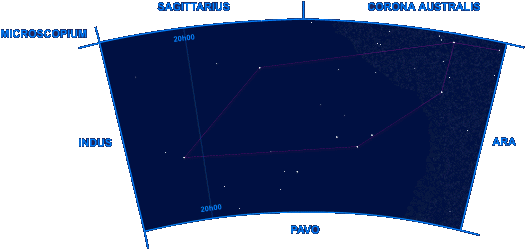
The TelescopeIt is natural that there should be a group of stars dedicated to the telescope, but this region is a sparse area of the sky with no significant bright stars. It lies in the southern sky, close to Peacock, the brightest star of Pavo.
Galaxy NGC 6584 In the constellation of Telescopium. The galaxies Co-ordinates are Right Ascension: 18 18 36.0 & Declination: -52 13 00. The magnitude of the galaxy is 7.9'.
Galaxy NGC 6725 In the constellation of Telescopium. The galaxies Co-ordinates are Right Ascension: 19 01 48.0 & Declination: -53 56 00. The magnitude of the galaxy is 2.2'X0.5'.Galaxy NGC 6761 In the constellation of Telescopium. The galaxies Co-ordinates are Right Ascension: 19 15 18.0 & Declination: -50 40 00. The magnitude of the galaxy is 1.7:'.
Galaxy NGC 6754 In the constellation of Telescopium. The galaxies Co-ordinates are Right Ascension: 19 11 24.0 & Declination: -50 39 00. The photo magnitude of the galaxy is 2.1'X1.1'.
Galaxy NGC 6851 In the constellation of Telescopium. The galaxies Co-ordinates are Right Ascension: 20 03 36.0 & Declination: -48 17 00. The photo magnitude of the galaxy is 12.6e.
Planetary Destinations In Telescopium
Parent Star: HD 164427 (G4 IV) in the constellation of Telescopium is located at a distance of 127.52 Light Years from our Solar system Co-ordinates of Right Ascension: 18 04 42.60 & Declination: -59 12 34.5. The apparent mass of the star is 1.05 Solar Masses. The Inner Edge of Habitability Zone is 0.82 AU & the Outer Edge of Habitability Zone: 2.58 AU. Orbiting around HD 164427 is planet HD 164427 b the planet is believed to be a brown dwarf planet and its exitence has been confirmed. The Planets Appearance is a brown haze. The planet is positioned outside of habitability zone at mean orbital distance of 0.46 AU. The planet Orbits around the star every 108.55 Days and was discovered by TINNEY C., BUTLER P., MARCY G., JONES H., PENNY A., VOGT S., APPS K. & HENRY C. in 2000.
Double Stars In Telescopium
This constellation has no outstanding binaries, and indeed all the visual binaries have rather faint primaries (sixth, seventh, or even eighth magnitude). For this reason none are listed.Variable Stars In Telescopium
The brightest Mira-type variable is R Telescopii, which has a period of 462 days, and a range in magnitude of 7.8 to 14. The next maximum is expected in mid-March 1997; in 2000 the maximum should occur late in the year.
Copyright © Wingmakers.co.nz - All rights reserved.