← The Wingmakers Ways · Astronomy & Exoplanets
Archived page · Checkable
Orion
Orion.html · captured from wingmakers.co.nz
Orion
One of the best known and most recognisable star-patterns in the sky, Orion represents an heroic hunter of Greek myth
Navigation
The Universe
Mapping Technique
Sky Maps
The Constellations
Andromeda ....
Antila .....
Apus .....
Aquarius ....
Aquila .....
Ara .....
Aries .....
Auriga
Caelum .....
Camelopardalis ....
Cancer .....
Canes Venatici .....
Canis Major .....
Canis Minor
Capricornus ....
Carina .....
Cassiopeia .....
Centaurus
Cepheus
Cetus
Chamaeleon
Circinus
Columba
Coma Berenices
Corona Austrina
Corona Borealis
Corvus
Crater
Crux
Cygnus
Delphinus .....
Dorado .....
Draco
Hercules .....
Horogium .....
Hydra .....
Hydrus
Lacerta .....
Leo .....
Leo Minor .....
Lepus .....
Libra .....
Lupus .....
Lynx .....
Lyra
Mensa .....
Microscopium .....
Monoceros .....
Musca
Octans .....
Ophiuchus .....
Orion
Pavo .....
Pegasus .....
Perseus .....
Phoenix .....
Pictor .....
Pisces .....
Piscis Austrinus
Puppis .....
Pyxis
Saggita .....
Sagittarius .....
Scorpio .....
Sculptor .....
Scutum .....
Serpens Cauda
Serpens Caput .....
Sextans
Taurus .....
Telescopium .....
Triangulum .....
Triangulum Australe .....
Tucana
Ursa Major .....
Ursa Minor
Vela .....
Virgo .....
Volans .....
Vulpecula
Constellation Chart
The Hunter
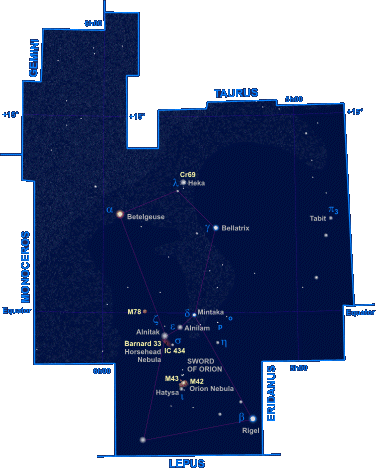
One of the best known and most recognisable star-patterns in the sky, Orion represents an heroic hunter of Greek myth. Lying on the edge of the Milky Way, this constellation is rich in bright stars and nebulae.
Derivation
In Greek myth, Orion was a giant who hunted the wild animals of the earth. He was the enemy of Artemis the huntress, who according to some tales was responsible for his death. Other stories, though, tell how he pursued the daughters of Pleione - the Pleiades - and with them was turned into a constellation to chase them forever across the sky.The origins of Orion as a celestial figure predate even the ancient Greeks. It is thought, for example, that the Egyptians revered this constellation as the heavenly embodiment of their god Osiris.
Stars
Orion contains some of the best known stars in the sky, with perhaps the most famous being the variable red giant Betelgeuse, which marks Orion's left shoulder. At his right shoulder is another variable star, this time blue in colour, known as Bellatrix. At Orion's right foot is yet another famous star, blue like Bellatrix: the supergiant Rigel.A key feature of Orion's constellation is his Belt of three bright stars that form a nearly straight line across its central parts. These stars are Alnitak, Alnilam and Mintaka, three very distant but very luminous bodies. Beneath Alnilam (the central star of the Belt) is the Sword of Orion - a vertical line of fainter stars and nebulosity.
In addition to its better known stellar features, Orion also contains a bow-shaped array of less prominent stars to the west of the constellation's main body, which are said to represent the hunter's cape or shield. To the north, where the Milky Way passes through the constellation, a less clearly defined star-group supposedly describe's Orion's club.
Nebulae
The Sun and Solar System are situated on the inner edge of a small spiral arm of the Milky Way Galaxy known as the Orion Arm. In the direction of the constellation of Orion is the dense heart of this galactic arm, and so this part of the sky is filled with nebulous regions. In particular, a vast dark cloud known as the Orion Molecular Cloud fills a significant portion of the constellation. The Cloud, which lies about 1,300 light years away, is generally invisible from Earth. Where conditions are right, though, areas of this matter are illuminated by nearby stars to become visible as nebulae.The most prominent of these is the diffuse nebula at the centre of the Sword of Orion, sometimes simply called the Great Nebula, but more commonly known as the Orion Nebula. This is a region of star formation just within the inner edge of the Cloud, where the newly formed stars that make up the Trapezium formation light up the gas and dust that surrounds them.
Another very well known object in Orion is the so-called Horsehead Nebula. This is a plume of interstellar matter that cuts out some of the light cast by the bright nebula IC 434, just south of Alnitak. The fact that this plume has a shape irresistably reminiscent of a horse's head makes it one of the most recognisable such phenomena in the sky.
The region around the Belt and Sword of Orion, on the edge of the Molecular Cloud, is so active that it exerts immense pressure on the surrounding interstellar material. The result is an apparent spherical 'wave' some three hundred light years across. This phenomenon is visible as a faint and broken ring known as Barnard's Loop, extending outwards as much as 14° from the central regions of Orion.
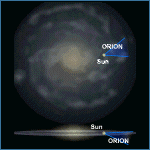
The Solar System lies at the inner edge of the Orion Arm of our Galaxy. When we look at Orion, then, we are looking outward through the stars of our own galactic arm, towards the Galaxy's edge.
This image has been captured the whole figure of Barnard's Loop surrounding the southern region of Orion. The Loop has a real size of 440 by 280 light years in ellipse. And I've enhanced red channel of this image intentionally. The Barnard's Loop is bright in northern region and can be taken clearer than southern part. And this image shows you the extraordinary dimmed gaseous matter is distributed between the Great Orion Nebula (M42) and the outer shell of the Loop in southern region. It's considered that the Barnard's Loop is a spreading hydrogen gas by a supernova explosion occurred around between the Great Orion Nebula and the Horse head Nebula about a million years ago. And maybe the dimmed nebulosities may be left matter in a process of the diffusion of "Blast". The Barnard's Loop has a catalogue number of Sh2-276, but it's a number of only northern regions, the southern remaining part has no identifying numbers.
This image presents you the most splendid sky field in winter. The Great Orion Nebula (M42) can be seen at the lower right-hand side. And the vast and very dimmed hydrogen gaseous region is spread around the field of central Orion from the Great Orion Nebula to the Horse Head Nebula. The field is central region of so-called "The Orion Association", and contains many inter-stellar matter and young stars. I've emphasized the red color in this picture.
M43 is part of the much larger Orion Nebula complex. This section features a an extremely bright OB star that is creating a matter bound Stromgren sphere. This means that the star is ionizing the gas that is near it- making a sphere of glowing (pink) hydrogen gas. The size of this sphere is determined by the density of gas/dust that surrounds the star. Another good example of this process can be found in IC 1274. M43 and the Orion Nebula are around 1,500 light years away. Many new stars will be formed from these clouds of gas.
M78 (NGC2068) is a faint reflection nebula about 2.5 degree NE of Altanik (zeta Ori) with a size of 8 arc minutes. The nebula is fairly striking because vast dark nebula conceals stars around M78.
The Barnard's loop is a faint and gigantic ring nebula with a diameter of over 18 degrees, which covers whole of eastern Orion. Its shape can be detected only by photo films, it's considered that the Barnard's loop is a remnant of supernova exploded about one million years ago. This picture shows you a north end of the loop; it's the deepest region in this inter-stellar gas. Detailed structure of M78
What lights up the Flame Nebula? Fifteen hundred light years away towards the constellation of Orion lies a nebula which, from its glow and dark dust lanes, appears like a billowing fire. But fire, the rapid acquisition of oxygen, is not what makes this Flame glow. Rather the bright star Alnitak, the easternmost star in the Belt of Orion visible to the nebula's right, shines energetic light into the Flame that knocks electrons away from the great clouds of hydrogen gas that reside there. Much of the glow results when the electrons and ionized hydrogen recombine. The above false-color picture of the Flame Nebula (NGC 2024) was taken in infrared light, where a young star cluster becomes visible. The Flame Nebula is part of the Orion Molecular Cloud Complex, a star-forming region that includes the famous Horsehead Nebula.
This shot has captured a star field just 1 degree east of Mintaka, the western star of Orion's belt. You can see some of dimmed reflection nebulae here. A round one on left hand side is IC426,
The Horsehead Nebula", a reddish nebula as a background of the horsehead-shaped dark cloud is registered in a catalogue as IC434, that is spread to about 3.5 degree SW, around The Great Orion Nebula. It's extremely difficult to detect with our eyes.
IC2162 is a compact diffused nebula lying around the tip of Orion's cudgel. The nebula is positioned at only 2.5 degrees south of "Monkey nebula" belongs to same Orion. Though IC2162 has a smaller size of 15 arc minutes than that of Monkey nebula, fairly photogenic object. But the nebula has fewer characteristics in its shape and has no familiar nicknames like "Monkey nebula", not well known in amateur observers. This picture tells us that IC2162 consists of three round nebulae paralleling in east-west direction.
A small reflection nebula only 1degree SSE of the Great Orion Nebula(M42) is named NGC1999. The nebula has an apparent diameter of only 1 arc minute. This object looks like a compact ring because a lump of dark nebulosity is obstructing a white gas in background. A newborn star of V380 with a magnitude of 10.5 is shining in eastern region of the nebula and NGC1999 is glittering by the star. In January 2000, the Hubble Space Telescope (HST) took a splendid shot of NGC1999, the shot made this faint object popular overnight. The nebula is lying about 1500 light years away, just in the Orion Association.
NGC2112 is a medium sized open cluster about 4 degrees northeast of Altanik, the east star of Orion's belt. The cluster is being on top of the Barnard's loop covering the eastern region of Orion, you can detect very dimmed reddish gaseous matter in this picture. The cluster has several tens of fine stars in about 11 arc minutes in diameter, and visual brightness of 9th magnitude. Although NGC2112 is one of minor celestial objects in dazzling constellation of Orion, you can appreciate the cluster like a nebula only with binoculars.
Named for the crescent-shaped wave made by a ship as it moves through water, a bow shock can be created in space when two streams of gas collide. LL Ori emits a vigorous solar wind, a stream of charged particles moving rapidly outward from the star. Our own Sun has a less energetic version of this wind that is responsible for auroral displays on the Earth.
The material in the fast wind from LL Ori collides with slow-moving gas evaporating away from the center of the Orion Nebula, which is located to the lower right in this Heritage image. The surface where the two winds collide is the crescent-shaped bow shock seen in the image.
Unlike a water wave made by a ship, this interstellar bow shock is a three-dimensional structure. The filamentary emission has a very distinct boundary on the side facing away from LL Ori, but is diffuse on the side closest to the star, a characteristic common to many bow shocks.
A second, fainter bow shock can be seen around a star near the upper right-hand corner of the Heritage image. Astronomers have identified numerous shock fronts in this complex star-forming region and are using this data to understand the many complex phenomena associated with the birth of stars.
This image was taken in February 1995 as part of the Hubble Orion Nebula mosaic. A close visitor in our Milky Way galaxy, the nebula is only 1,500 light-years from Earth. The filters used in this color composite represent oxygen, nitrogen, and hydrogen emissions.
Betelgeuse is another huge red supergiant. One of the brightest stars in the sky. Betelgeuse is 429 light years distant. Has a temperature of 3,488K a size of 1,516 solar radii, and a luminosity of 305,089 suns.BETELGEUSE . The great star Betelgeuse is one of the two that dominate mighty Orion of winter, the other Rigel, the pair respectively called Alpha and Beta Orionis. The name Betelgeuse is a corruption of the Arabic "yad al jauza," which means the "hand of al-jauza," al-jauza the ancient Arabs' "Central One," a mysterious woman. For us, it marks the upper left hand corner of the figure of the Greek's ancient hunter (and since he is facing you, his right shoulder). One of the sky's two first magnitude supergiants (the other Antares of summer), Betelgeuse is one of the larger stars that can be seen, indeed one of the larger stars to be found anywhere. At its most likely distance of 425 light years, its measured angular diameter yields a radius 630 times that of the Sun, 2.9 astronomical units. If placed at the Sun, the star would go 55% of the way to the orbit of the planet Jupiter. The star is so large that it is the first ever actually directly imaged as a disk from Earth (by the Hubble Space Telescope). From its size and temperature, allowing for its infrared radiation, Betelgeuse shines an amazing 60,000 times brighter than our Sun. The distance, however, is so great to be subject to some uncertainty, the possible radius ranging from 45% to 70% of Jupiter's orbit, the luminosity from 40,000 solar to 100,000 solar. Whatever the actual numbers, Betelgeuse is clearly a highly evolved star, one whose central hydrogen fuel supply has run out. As a result, the core contracted into a hot dense state, and the outer portions swelled outward. We do not really know the star's condition at the moment, but the odds are that it is now in the process of fusing helium into carbon and oxygen in its core. Betelgeuse is variable over long time periods, is ejecting part of itself through a strong wind, and is surrounded by a huge shell of dust of its own making. The wind and variability are perhaps related to huge hot spots on the star's surface, one of which was seen by Hubble. Betelgeuse is also surrounded by some controversy. From theory, its initial mass should have fallen somewhere between 12 and about 17 times that of the Sun. If at the high end, the core will fuse elements through neon, magnesium, sodium, and silicon all the way to iron. It will then collapse, and Betelgeuse will blow up as a "supernova", most likely leaving a compact neutron star about the size of a small town behind. If it were to explode today, it would become as bright as a crescent Moon, would cast strong shadows on the ground, and would be seen easily in full daylight. If the star is near or under the lower end of the range, then Betelgeuse may eventually become a shrunken and dense white dwarf about the size of Earth. Even then, however, it will be different. Most white dwarfs are made of carbon and oxygen, whereas Betelgeuse has enough mass to become one of the exceedingly rare neon-oxygen white dwarfs. The only way we will really know is to wait a few million years.
Orion (the Hunter) climbs the sky. Orion's belt, Mintaka at right, Alnilam in the center, and Alnitak at left, runs through the middle of the picture. Orion's head is marked by the trio of stars at the top of the picture just left of center, the brightest of which is Meissa. The red glow in the middle of Orion's sword is the Orion Nebula. Betelgeuse is at the northwest apex of the Winter Triangle. Orion also has a star with an orbiting planet.
Planetary Destinations In Orion
Parent Star: HD 33636 (G0 V) in the constellation of Orion is located at a distance of 93.6 Light Years from our Solar system. Co-ordinates of Right Ascension: 05 11 46.4490 & Declination: +04 24 12.742. The apparent Magnitude of the star is 7.06. The Inner Edge of Habitability Zone is 0.53 AU & the Outer Edge of Habitability Zone: 1.66 AU and the estimated stellar lifespan of the star is 10306 million years . Orbiting around HD 33636 is planet HD 33636 b the planet is believed to be a Ammonia Cloud Jovian, Eccentric and its existence has been confirmed. The planets appearance is White ammonia and water ice clouds, brown hydrocarbon stains. The planet is positioned is outside edge of the habitability zone at mean orbital distance of 3.56 AU and the estimated mass of the planet is 9.28 Jupiters. The planet Orbits around the star every 2447.292 Days and was discovered by Vogt S., Butler P., Marcy G., Fischer D., Pourbaix D., Apps K., & Laughlin G. in 2001
.
HR 1988 Orionis
THE PLANET
The circle shows the location of the class G star HR 1988, found in the constellation Orion, is orbited by not one, but two planets. The inner of the pair has mass at least 0.78 times the mass of Jupiter. Like so many other planets of nearby stars, it is tucked up close to its parent at a distance of only 0.13 Astronomical Units (19 million kilometers, or 33% the distance between the Sun and Mercury), causing it to orbit in a mere 14.3 days (16% of Mercury's orbital period). Even though close to its star, its orbital eccentricity is fairly high, the planet going as far from the star as 0.17 AU and as close as 0.09 AU. The outer of the two planets has a much larger mass of 12.7 Jupiters, which makes it close to being a deuterium (heavy hydrogen) fusing brown dwarf and perhaps not a planet at all. The big one orbits in 5.95 years at a mean distance from the star of 3.68 AU (going from 2.4 to 5.0 AU over its "year").
Parent Star: HD 38529 (G4 IV) in the constellation of Orion is located at a distance of 138.39 Light Years from our Solar system. Co-ordinates of Right Ascension: 05 46 34.9120 & Declination: +01 10 05.496. The apparent Magnitude of the star is 5.94. The Inner Edge of Habitability Zone is 1.31 AU & the Outer Edge of Habitability Zone: 4.09 AU and the estimated stellar lifespan of the star is 3723 million years. Orbiting around HD 38529 is planet HD38529 b the planet is believed to be a Cloudy Hot Jupiter, Eccentric and its existence has been confirmed. The planets appearance is Silicate clouds over dark sodium haze. The planet is positioned is at outside edge of the habitability zone at mean orbital distance of 0.129 AU and the estimated mass of the planet is 0.78 Jupiters . The planet Orbits around the star every 14.309 ± 0.05 Days and was discovered by FISCHER D., MARCY G., BUTLER P., VOGT S., FRINK S. & APPS K. in 2000.
Parent Star: HD 38529 (G4 IV) in the constellation of Orion is located at a distance of 138.39 Light Years from our Solar system. Co-ordinates of Right Ascension: 05 46 34.9120 & Declination: +01 10 05.496. The apparent Magnitude of the star is 5.94. The Inner Edge of Habitability Zone is 1.31 AU & the Outer Edge of Habitability Zone: 4.09 AU and the estimated stellar lifespan of the star is 3723 million years. Orbiting around HD 38529 is planet HD 38529 c the planet is believed to be a Water Cloud Jovian, Eccentric and its existence has been confirmed. The planets appearance is White water ice clouds. The planet is believed to be a large ringed planet with three satellites. The moon close up has icy sheets and ridges similar to those found on Europa and a thin atmosphere. The planet is positioned is at within the out edge of the habitability zone at mean orbital distance of 3.68 AU and the estimated mass of the planet is 12.7 Jupiters. The planet Orbits around the star every 2174.3 ± 30 Days and was discovered by Fischer et al. on 13 Jun 2002 .
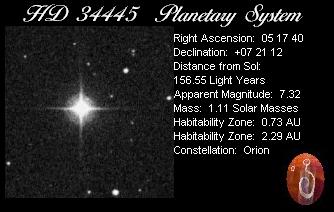
Parent Star: HD 34445 ( G0 V ) in the constellation of Orion is located at a distance of 156.55 Light Years from our Solar system. Co-ordinates of Right Ascension: 05 17 40 & Declination: +07 21 12 . The apparent Magnitude of the star is 7.32 . The Inner Edge of Habitability Zone is 0.73 AU & the Outer Edge of Habitability Zone: 2.29 AU and the estimated stellar lifespan of the star is 7311 million years . Orbiting around HD 34445 is planet HD 34445 b the planet is believed to be a Clarified Jovian, Eccentric and its existence has been confirmed. The planets appearance is Blue and cloudless. The planet is positioned is outside edge of the habitability zone at mean orbital distance of 0.51 AU and the estimated Radius of the planet is 0.954 Jupiters 1. The planet Orbits around the star every 14.309 ± 0.05 Days and was discovered by Marcy et al. in 2005.
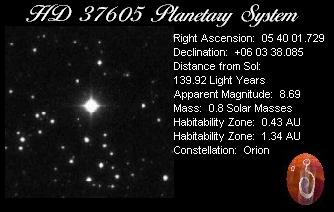
Parent Star: HD 37605 (K0 V) in the constellation of Orion is located at a distance of 139.92 Light Years from our Solar system. Co-ordinates of Right Ascension: 05 40 01.7296 & Declination: +06 03 38.085. The apparent Magnitude of the star is 8.69. The Inner Edge of Habitability Zone is 0.43 AU & the Outer Edge of Habitability Zone: 1.34 AU and the estimated stellar lifespan of the star is 19531 million years. Orbiting around HD 37605 is planet HD 37605 b the planet is believed to be a Clarified Jovian, Eccentric and its existence has been confirmed. The planets appearance is Blue and cloudless. The planet is positioned is outside edge of the habitability zone at mean orbital distance of 0.25 AU and the estimated mass of the planet is 2.3 Jupiters . The planet Orbits around the star every 55 ± 0.1 Days and was discovered by COCHRAN W. et al. in 2004.
The Stars
Orion is the master of the winter skies. He lords over the heavens from late fall to early spring, with his hunting dog Sirius trailing at his feet. The mythic tales of Orion go as far back as the Hittites, who flourished from the Second Millenium BC to around 1200 BC. One story from this culture gives an interesting account of Orion's death. Here he is called Aqhat, and was a handsome and famous hunter. The Battle-Goddess Anat fell in love with Aqhat, but when he refused to lend her his bow, she sent another man to steal it. This chap bungled the job, and wound up killing Aqhat and dropping the bow into the sea. This is said to explain the astronomical fact that Orion and the Bow (an older version of the constellation) drops below the horizon for two months every spring.Like all myths borrowed from several sources over a great length of time, the Greek stories offer many variations. Generally speaking, Orion was known as the "dweller of the mountain", and was famous for his prowess both as a hunter and as a lover. But when he boasted that he would eventually rid the earth of all the wild animals, his doom may have been sealed.
It might have been the Earth Goddess herself who sent the deadly scorpion to Orion. Or possibly Apollo, concerned that Orion had designs on his sister, Artemis. Thus Apollo may have told the Earth Goddess of Orion's boast. In any case, it seems clear that it was the Earth Goddess who sent the scorpion on its mission.Some stories have the scorpion killing Orion with its sting. However the general consensus is that he engaged the scorpion in battle but quickly realised its armour was impervious to any mortal's attack. Orion then jumped into the sea and swam toward Delos. But Apollo had witnessed Orion's struggle with the scorpion and would not let him escape so easily. He challenged his sister Artemis, who was an excellent shot, if she could hit that small black object far away in the sea, the head -- he told her -- of an infamous and treacherous villan. Artemis struck the object with her first shot. She then swam out to retrieve her victim's corpse, and discovered she had killed Orion. Artemis implored the gods to restore his life, but Zeus objected. So she put Orion's image in the heavens.
In his eternal hunting, Orion is careful to keep well ahead of the scorpion. In fact Orion has disappeared over the horizon by the time Scorpio rises in the east, as it becomes his turn to rule the evening sky.
Finding Orion
Finding Orion should be no problem. Its stars are some of the most familiar in all the heavens. Question: can you name the three stars that make up Orion's Belt. (Answer below.)
Above the belt, slightly to the left, is Betelgeuse, alpha Orionis.Betelgeuse, the right arm of Orion (or "armpit" as the name suggests), glows with a dull red. Although labelled alpha Orionis, it is less bright than beta Orionis (Rigel), in the opposite corner of the constellation, to the southwest. Yet if slightly less bright, it is much larger, estimated at around 250 Suns. If one were to replace our Sun with Betelgeuse, its size would completely engulf the Earth and extend as far as Mars.
As the brightest star in Orion, Rigel ranks as the seventh brightest star in all the heavens, just behind Capella. It is a visual binary; its companion is much fainter, but quite visible if you are persistent enough (PA 202º, 9.4").
The other corners of the constellation are formed by Bellatrix (gamma Orionis) and Saiph (kappa Orionis). It was once thought that all women born under the sign of Bellatrix would be fortunate and have the gift of speech. The star's name is often translated as Female Warrior or Amazon, and another name sometimes seen is "Amazon Star".
The constellation's main feature is of course the three stars which form the "belt" across the middle of Orion: from west to east Mintaka, Alnilam, and Alnitak. Even the Bible makes reference to this famous group. God, while pointing out how all-powerful he was, is purported to have asked Job if he (Job) was able to "loose the bands of Orion" (Job 38.31).
The last of these stars is also known as zeta Orionis, and is a well known triple star system. The primary is a blue-white star, and its companion (165º, 2.3") is a dull red. Close by, just to the south, is the renowned Horsehead Nebula, a so-called dark nebula that is not visible in scopes but quite spectacular in long-exposure photographs.
Binary stars in Orion:
There are many double stars in this constellation visible in small telescopes. Below are several selected from a wide list.Beta Orionis (Rigel) has a 10.4 visual magnitude companion at 202º and a wide 9.5" separation. This is a fixed system.
Lambda Orionis (between Betelgeuse and Bellatrix) is another fixed binary, with a 5.5 companion at PA 43º and 4.4" away.Theta1 is a complex system of fixed stars. The four brightest form The Trapezium, an outstanding multiple system for small telescopes. AB is at a position angle of 32º and separation 8.8", AC: PA 132º, 12.7", and AD: PA 96º, 21.5".
Theta2 is also a fine binary, a triple system to the southeast of The Trapezium. Component B is a binocular object: 6.4 magnitude at a position angle of 92º and separation 52.5". Component C (8.5) is even wider: PA 98º and separation 128.72".
Sigma Orionis is one of the few orbiting binaries found in Orion. Component B has an orbit of 158 years and is one of the few components that traces a not-quite-perfect circle. That's to say, we see it nearly face on, as a wheel spinning around its hub.
The separation never changes much from its current distance of only 0.2". Its 2000.0 position angle is 132º.
Much easier to resolve is component E, with a visual magnitude of 6.7, this is a binocular object at a position angle of 61º and separtion of 42".Zeta Orionis (1.9, 4.0) has a very slow orbit of 1509 years, and is currently at 165º and 2.3" separation.
Variable stars in Orion:
A dozen stars in this constellation are visible in small scopes, but most of them are of the EA type of eclipsing binaries, which change very little. These include two stars of the Trapezium (theta 1A and 1B).
EA variables are old stars, nearing the end of their evolutionary process. The companion has grown to the size of a subgiant, perhaps equal in size to its primary. But their luminosities are quite different; thus, as the dimmer companion revolves around its primary, variations in the total brightness occur.
The maximum brightness occurs of course when the two are not eclipsed, with each one adding its luminosity to the total output. Two minima also occur: the principal minimum is when the companion blocks out the primary; while a secondary minimum occurs when the companion is eclipsed by the primary.The only interesting Mira-type regular variable is U Orionis, which usually has a brightness of 4.8 but every 368.3 days it drops down to 13. In 2000 the minimum is scheduled to occur on 5 December.
Orion Constellation
Copyright © Wingmakers.co.nz - All rights reserved.